
Care-E-Well Insights
Baby Wrap vs Structured Carrier vs Ring Sling
Compare baby wraps, structured carriers and ring slings by fit, learning curve, adjustability and newborn suitability without brand hype.
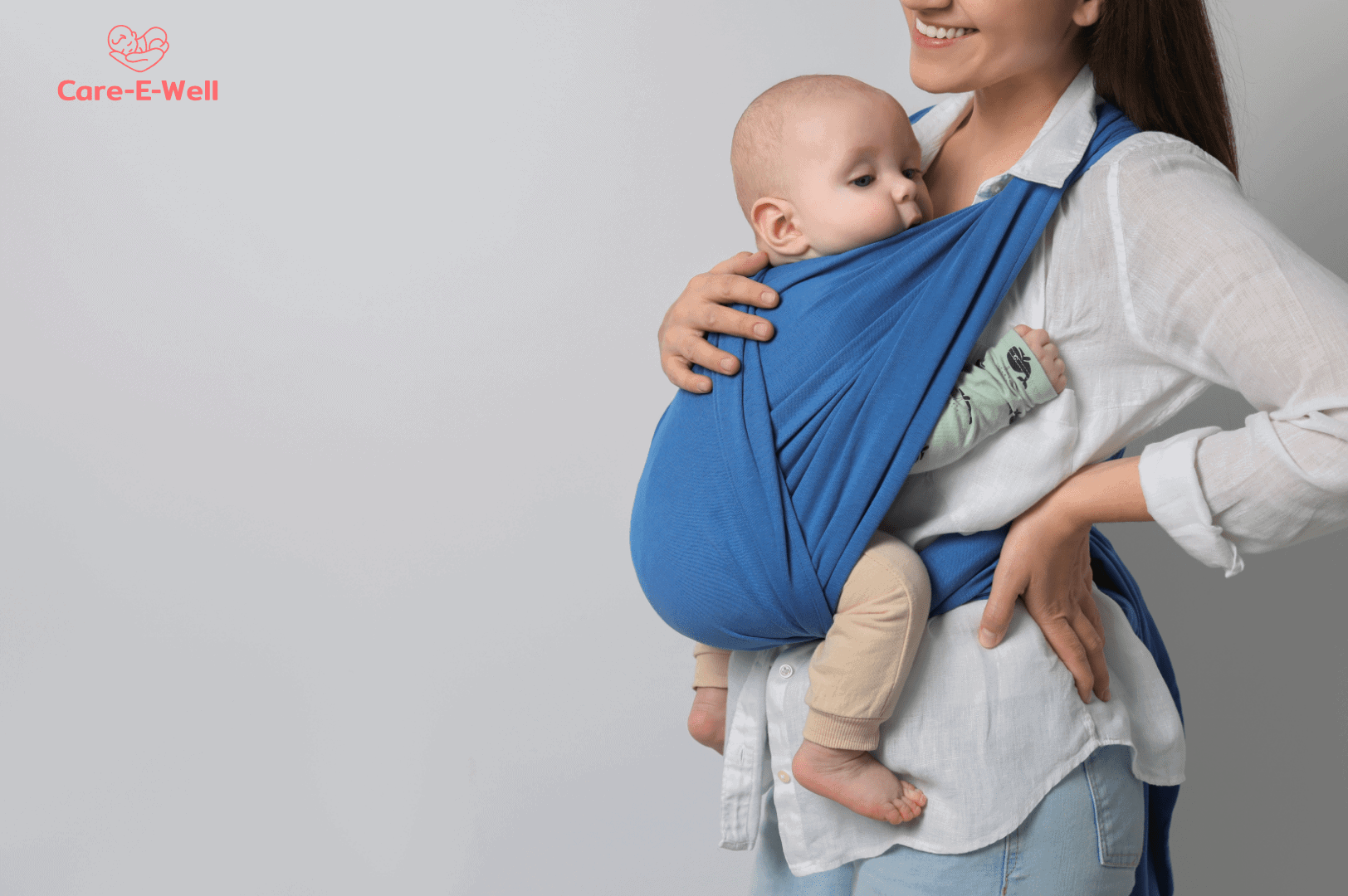
Baby wrap vs structured carrier vs ring sling is not a choice between one “safe” option and two inferior ones. All three can carry a baby well when they fit the baby, are adjusted correctly and keep the airway visible and unobstructed. The better choice is the one you can use consistently and comfortably for your baby’s current size and your own body.
Wraps offer the most fabric-based adjustability, structured carriers make repeatable buckled setups easier for many families, and ring slings are compact and quick for short carries once the technique is learned. Newborn suitability depends on the individual product and the position you can achieve—not only on the carrier category.
Choose a carrier by the fit you can achieve in real life, not by which style looks most “ergonomic” in marketing photographs.
What matters more than the carrier type?
Before comparing convenience, start with the non-negotiables. The baby’s face should remain visible, the nose and mouth clear, the chin away from the chest and the trunk supported enough to prevent slumping. For young babies, head and neck support must match their developmental ability.
The pelvis and thighs should also be comfortably supported, with the hips and knees allowed to flex without forcing the legs straight or excessively wide. The carrier should remain snug enough that the baby moves with the wearer rather than bouncing independently.
Medical reviews of adult-worn slings and carriers identify poor positioning and airway obstruction as the main serious safety concern. A beautifully tied wrap or expensive buckle carrier is not safe if the baby’s face is buried or the neck is folded forward.
Whatever carrier you choose, stop and reposition if the baby’s face becomes covered, the chin falls onto the chest, breathing changes or the baby becomes unusually floppy or discoloured.
What is a baby wrap?
A baby wrap is a long piece of fabric that is tied around the wearer and baby. Stretchy wraps are common in the newborn months, while woven wraps can be used in a wider range of carries depending on the fabric and tying method.
The main advantage is adjustability. The same fabric can often be tightened around a very small baby without relying on a fixed-width panel, which can make it easier to support a newborn’s trunk and thighs when the technique is correct.
The trade-off is that fit depends heavily on how the wrap is tied and tightened each time. Uneven tension can create slack, twisting or a deep pocket where a newborn sinks. A wrap therefore rewards practice more than simply owning the right fabric.
Baby wrap strengths
- Highly adjustable around different baby and adult body shapes
- Can distribute load over broad areas of the wearer’s shoulders and torso when tied well
- Often adaptable as the baby grows, especially with woven wraps
- No fixed carrier panel that must match a newborn’s torso width
- Fabric can be spread to support the pelvis and thighs
Baby wrap limitations
- Requires learning a reliable tying method
- Fit changes each time the wrap is retied
- Long fabric can be inconvenient outdoors or in small spaces
- Uneven tightening can allow slumping or asymmetry
- Stretchy wraps may have product-specific weight or carry limitations
Wrap technique should remain simple enough that you can reproduce a safe fit while tired, outside the home or after the baby falls asleep.

What is a structured baby carrier?
A structured carrier uses a sewn body panel with shoulder straps and usually a waist or torso belt secured with buckles. Some models have adjustable seat width, panel height and strap routing; others are relatively fixed.
Its main practical advantage is repeatability. Once adjusted for a particular wearer and baby, the same carrier can often be buckled on with fewer steps than a wrap.
The main fit challenge is that a sewn panel has defined dimensions. A carrier marketed for a broad age range may still be too tall, wide or loose for a particular newborn until the baby grows or the newborn setting is configured correctly.
Structured carrier strengths
- Quick to put on once adjusted
- Easier to reproduce the same setup from one carry to the next
- Often convenient for longer walks as the baby becomes heavier
- Adjustable models can change seat width and panel height as the baby grows
- Buckles make it easier for some caregivers to confirm that fastening points are secure
Structured carrier limitations
- The smallest setting may still be too large for some newborns
- Different adults may need to readjust straps substantially
- Bulky padding can feel warm or restrictive in hot weather
- Fixed panel geometry offers less fine-tuning than fabric-based carriers
- Some models require specific newborn inserts or configurations
Do not add homemade padding to make an oversized structured carrier fit. If the baby disappears behind the panel or cannot remain stable, use an approved newborn setup or wait until the carrier fits.
What is a ring sling?
A ring sling is a shorter length of fabric threaded through two rings and worn over one shoulder. The baby sits in a fabric seat across the wearer’s front or hip area, depending on age and skill.
Ring slings can be compact and fast because they remain partly threaded between uses. Fine adjustment happens by tightening sections of fabric through the rings.
The design places the carrier over one shoulder, so the adult load is asymmetrical. This is not automatically harmful, but it can become uncomfortable for longer carries or heavier babies, especially if the fabric bunches at the neck rather than spreading across the shoulder and back.
Ring sling strengths
- Compact and easy to carry in a bag
- Quick to put on once threading and tightening are familiar
- Highly adjustable fabric around small babies
- Useful for short frequent up-and-down carries
- Does not require a waist belt
Ring sling limitations
- One-shoulder loading may tire some wearers sooner
- Uneven fabric tension can let the baby lean or slump
- A deep fabric pouch can hide a newborn’s face if positioning is poor
- The seat must be deliberately created rather than supplied by a fixed panel
- The rings and fabric need correct placement to avoid uncomfortable pressure
A ring sling should hold the baby upright and close. It should not function like a deep hammock in which a newborn curls with the chin on the chest.
Which option is easiest for a newborn?
There is no universal winner. A properly used wrap or ring sling can adapt closely around a newborn, while a structured carrier designed for small newborns can offer an equally practical setup with less tying.
The deciding question is whether the carrier genuinely fits this newborn. Can you keep the face fully visible? Does the head remain supported without being pushed forward? Can you remove slack without compressing the baby? Are the pelvis and thighs supported without forcing the legs apart?
If the answer is no, that carrier is not the right newborn option yet, regardless of its product category.
Which carrier has the easiest learning curve?
Structured carriers often have the shortest initial learning curve because buckles and sewn panels make the sequence more obvious. However, incorrect strap height, excessive looseness or a too-wide seat can still produce poor fit.
Wraps require more initial practice because the wearer controls the fabric tension and body position directly. Once learned, that adjustability can become an advantage rather than a complication.
Ring slings sit between the two for many users: there are fewer steps than a long wrap, but effective tightening requires learning how different fabric sections control the baby’s upper back, middle and seat.
The easiest carrier is the one you can adjust correctly without guesswork every time.
Which carrier offers the most adjustability?
Wraps generally provide the greatest continuous adjustability because fabric can be tensioned around the baby’s exact shape. Ring slings also offer fine fabric adjustment but on an asymmetrical base.
Structured carriers vary widely. Some have several seat widths, panel heights and strap positions; others have limited adjustment. Two buckle carriers in the same broad category may therefore fit the same baby very differently.
Adjustability matters most during periods of rapid growth. Recheck fit whenever the baby’s legs lengthen, clothing becomes bulkier or the carrier panel begins to sit differently.
Which is most comfortable for the adult?
Adult comfort depends on baby weight, carrying position, duration, body shape, previous pain and load distribution. Systematic-review evidence shows that babywearing alters posture, gait and muscular demand, but the clinical importance varies.
Broad, evenly tensioned wrap fabric can spread load well. Structured carriers often transfer some load through a waist belt and two shoulder straps. Ring slings concentrate the load more on one side.
None of these characteristics guarantees comfort. Persistent neck, shoulder, back, pelvic or scar pain is a reason to change fit, shorten the carry or try a different method rather than assuming discomfort is an unavoidable part of babywearing.
How do the three compare for baby hip positioning?
Any of the three can support flexed hips and thighs when fitted well. The carrier label does not create the position by itself.
Biomechanical and ultrasound studies have focused mostly on particular structured carriers and show that some inward-facing designs produce favourable flexion-abduction positions in healthy infants. Those findings cannot be automatically transferred to every structured carrier, wrap or sling.
For all types, avoid forcing the legs into extension or an excessively wide spread. Support should match the baby’s size and allow comfortable movement.

How do you choose between the three?
- Check which options are genuinely approved for your baby’s current size and stage.
- Try to achieve a visible, unobstructed airway before considering convenience.
- Confirm that the baby stays stable without constant manual support.
- Check thigh and pelvis support rather than relying on “ergonomic” labels.
- Put the carrier on and remove it several times to test the learning curve.
- Walk for a realistic period and notice pressure on your shoulders, back and waist.
- Consider whether another caregiver also needs to use it.
- Think about where you will use it: home, public transport, hiking, short errands or frequent transfers.
- Choose the carrier you can adjust correctly and comfortably most consistently.
Some families eventually use more than one type because different carriers solve different practical problems. That does not mean everyone needs a carrier collection; one well-fitting option can be enough.
When should you get hands-on fitting help?
Get help if the baby repeatedly slumps, the face disappears, one leg or shoulder is consistently uneven, the carrier seems too large despite adjustment, or the wearer develops persistent pain.
For prematurity, low muscle tone, breathing problems or diagnosed hip dysplasia, seek clinical guidance as well as carrier fitting support. Equipment advice cannot replace medical assessment.
If the baby has breathing difficulty, blue or grey colour, marked limpness or cannot maintain a clear airway, remove the baby from the carrier and seek urgent medical help.
Frequently asked questions
Is a wrap safer than a structured carrier for newborns?
Not automatically. A wrap can fit a newborn very precisely, but poor tying can create dangerous slack. A correctly sized structured carrier can also be safe.
Are ring slings only for older babies?
No. Some ring slings can be used from the newborn stage when the baby is upright, visible and securely supported, but technique is especially important.
Do I need a different carrier when my baby gets heavier?
Not necessarily. Stay within the product limits and reassess comfort and fit. Some carriers remain useful for years; others become less practical as the child grows.
Which carrier is most ergonomic?
“Ergonomic” is not a sufficient comparison. Look at the actual baby position, adult load distribution, fit range and your ability to adjust it correctly.
The key takeaway
Baby wrap vs structured carrier vs ring sling is a trade-off between adjustability, setup style, portability and load distribution—not a simple safety ranking. A wrap offers maximum fabric adjustment, a structured carrier offers repeatability, and a ring sling offers compact quick carrying.
The best choice is the carrier that fits the baby now, protects the airway, supports the body comfortably and can be used correctly by the actual caregiver. Recheck that fit as both baby and wearer change.
Sources and references
- World Health Organization. Kangaroo mother care: a clinical practice guide. https://www.who.int/publications/i/item/9789240115910
- Lovell-Kennedy SR, Strong RLJ, Grieve LM, et al. Safety and benefits of adult-worn slings and baby carriers: a narrative systematic review to inform guidance for parents. https://doi.org/10.1136/bmjpo-2026-004693
- Strong RLJ, Lovell-Kennedy S, Grieve LM, et al. Adult-worn sling and baby carrier safety: exploring parental practices, knowledge and information needs. https://doi.org/10.1136/bmjpo-2026-004696
- Sidharthan S, Kehoe C, Dodwell ER, et al. Post-Natal Positioning through Babywearing: What the Orthopaedic Surgeon Needs to Know. https://doi.org/10.55275/jposna-2020-131
- Siddicky SF, Wang J, Rabenhorst BM, et al. Exploring infant hip position and muscle activity in common baby gear and orthopedic devices. https://doi.org/10.1002/jor.24818
- Siddicky SF, Eckels J, Rabenhorst BM, et al. Ultrasonographic evaluation of infant hips in the Pavlik harness compared to body-worn commercial baby carriers. https://doi.org/10.1002/jor.25571
- Taboada-Iglesias Y, Domínguez-Estévez A, Rodríguez-Gude C, et al. Physical and Physiological Consequences of Babywearing on the Babywearer: A Systematic Review. https://doi.org/10.3390/healthcare13172193
- Pehlivan S, Tanrıverdi M, Argunşah Bayram H, et al. Infant-carrying methods and their biomechanical influence on maternal gait patterns and joint mechanics. https://doi.org/10.1177/10538127251321771
- Bigelow AE, Williams LR. To have and to hold: Effects of physical contact on infants and their caregivers. https://doi.org/10.1016/j.infbeh.2020.101494
Did this Insight help?
A little love for something worth reading.


