
Care-E-Well Insights
Babywearing After a C-Section: Comfort and Timing
Babywearing after a C-section: how to judge readiness, protect your incision, choose a comfortable fit and know when to wait.
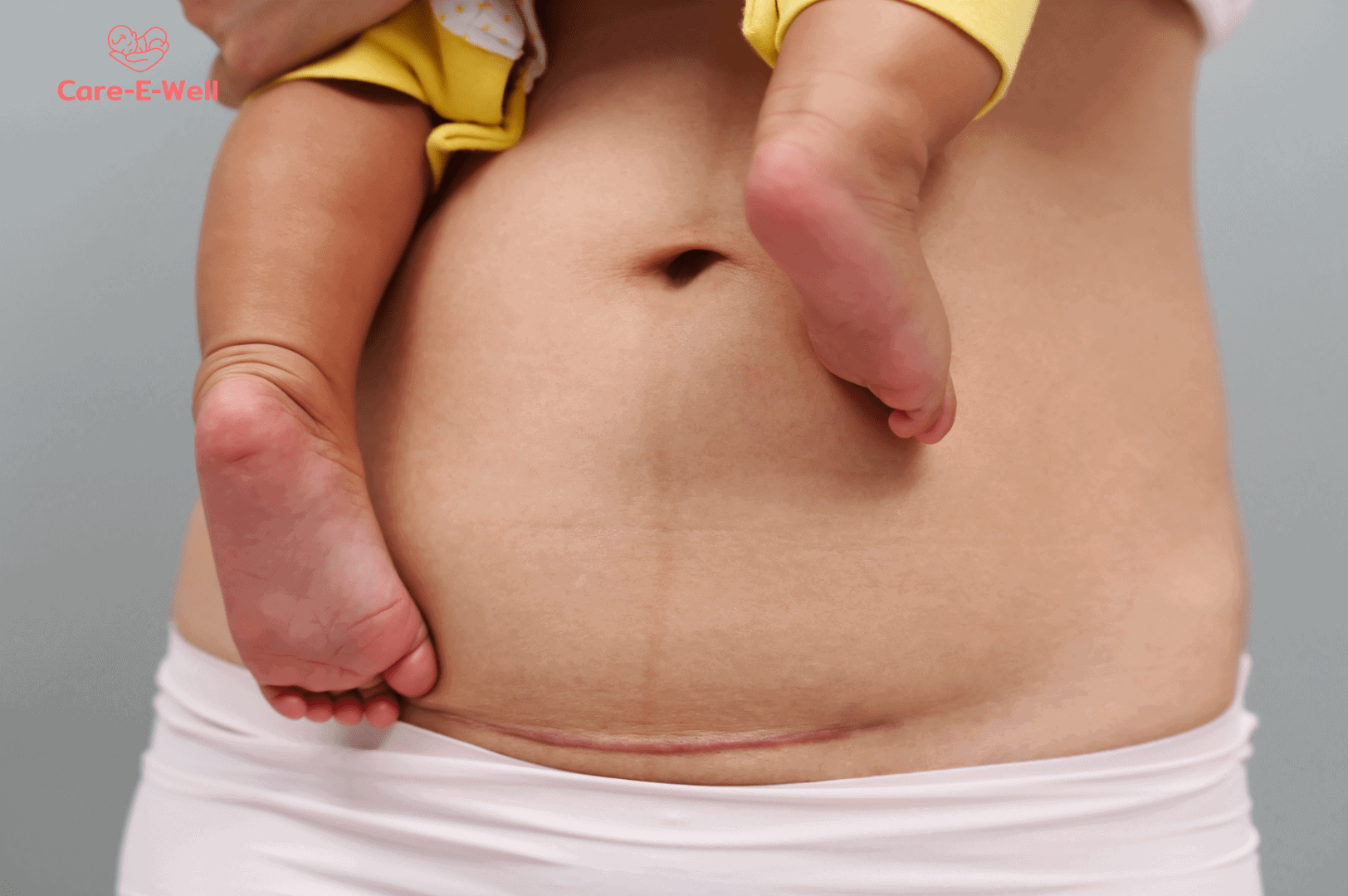
Babywearing after a C-section can be possible, but there is no single evidence-based day when every parent should start. A caesarean is abdominal surgery, and early recovery commonly includes wound pain, reduced mobility and difficulty with lifting, standing and other everyday movements.
The safest timing depends on how your incision is healing, how you feel when standing and walking, whether you have dizziness or significant pain, and what restrictions your maternity team has given you. The practical goal is to carry your baby without pressure on the wound, without straining to compensate and without ignoring signs that your body needs more recovery time.
After a C-section, “can I lift my baby?” and “can I comfortably wear my baby?” are not exactly the same question. A carrier adds duration, posture and pressure that you need to tolerate safely.
Is babywearing allowed after a C-section?
Often, yes—but not necessarily immediately or for long periods. Many post-caesarean recovery instructions allow routine care of the newborn while advising parents to avoid heavier lifting and vigorous activity during early healing. Individual advice can differ according to the surgery, complications and local maternity practice.
Babywearing should therefore be treated as a gradual activity. If holding the baby against your chest for several minutes is painful, putting the same weight into a carrier for a longer walk is unlikely to be comfortable yet.
When can I start babywearing after a C-section?
There is no high-quality evidence establishing a universal postpartum day or week for starting a carrier. Some parents feel able to try a short, carefully fitted front carry relatively early; others need substantially longer because of pain, wound sensitivity, fatigue or complications.
A reasonable readiness check is whether you can stand upright, walk steadily, lift and hold your baby without sharp incisional pain, and tolerate light pressure from clothing around the abdomen. If your clinician has given a specific lifting or activity restriction, that advice takes priority.
Delay babywearing and seek medical advice if your incision is opening, increasingly red, swollen, draining pus or blood, or if pain is worsening rather than improving. Fever, severe abdominal pain, heavy bleeding, chest pain, shortness of breath or feeling acutely unwell also need prompt assessment.
Why can a carrier feel different after abdominal surgery?
Even a well-fitted carrier changes how load is distributed through the trunk and pelvis. After a C-section, the abdominal wall has been surgically opened and repaired, and pain can cause protective postures such as leaning backward, rounding the shoulders or moving stiffly.
Research on postpartum function shows that caesarean birth is associated with greater early pain and functional limitation than uncomplicated vaginal birth. Infant care tasks such as lifting and carrying are among the activities parents use to judge their recovery.
Which carrier position is usually easiest after a C-section?
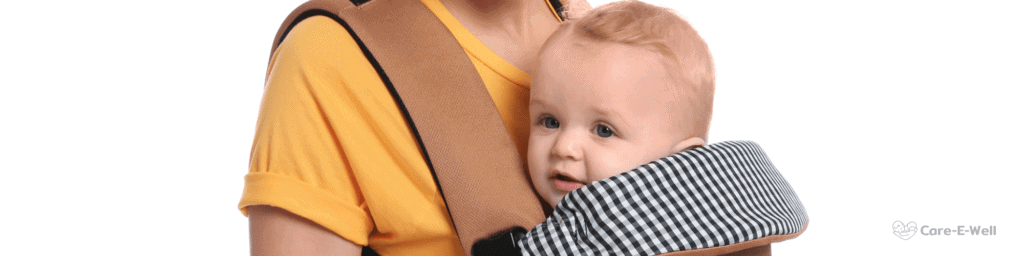
A high front inward carry is often the most practical starting point because it keeps the baby's weight close to the torso and can position the carrier waistband above the incision rather than directly on it. However, whether this works depends on your torso length, incision location and carrier design.
A waistband that sits exactly across a tender scar may be intolerable. In that case, a different carrier style, a higher waistband setting or a wrap that distributes pressure differently may feel better.
Should the waistband sit above the scar?
Usually, avoiding direct pressure on a tender incision makes sense. For many parents, that means positioning the waistband high on the natural waist so the lower edge does not rub the scar.
Do not solve incision pressure by loosening the waistband so much that the baby sags. A low, unstable carrier can increase strain on your back and create an unsafe position for the baby. If the carrier cannot be both secure and comfortable, stop and try again later or use a different style.
Are wraps better than structured carriers after a C-section?
Neither is universally better. A soft wrap can sometimes avoid a rigid buckle or waistband across the abdomen and allows highly individualized tension. A structured carrier may be faster to put on and may distribute weight more predictably when fitted well.
The trade-off is technique. A wrap that is too loose can make the baby slump and require repeated tightening. A structured carrier with a stiff waistband may press exactly where you are sore. Choose the option you can fit securely without pain or awkward twisting.
How should I put the carrier on while recovering?
Reduce unnecessary bending and twisting. Prepare the carrier at waist height, use a chair or bed as a stable setup surface if needed, and ask another adult to help while you are learning.
- Put on and pre-adjust as much of the carrier as possible before picking up the baby.
- Stand close to a stable surface rather than bending repeatedly toward the floor.
- Bring the baby to your body using both arms and a controlled movement.
- Secure the carrier without holding your breath or bracing painfully through the abdomen.
- Check the baby's airway and position before walking.
- Start with a few minutes at home rather than a long outing.
What should the first babywearing sessions feel like?
Mild awareness of the healing abdomen is different from sharp, pulling or increasing pain. The first sessions should feel stable enough that you can stand naturally, breathe comfortably and walk without guarding the incision.
Stop if you notice progressive pain, a pulling sensation at the wound, increased pelvic or back pain, dizziness, weakness or the urge to lean far backward to counterbalance the baby's weight.
Short, successful sessions are more useful than pushing through a long carry that leaves the incision or back more painful afterward.
How long should I carry at first?
There is no evidence-based number of minutes specifically for post-C-section babywearing. Use symptoms and recovery as your guide. A brief indoor carry may be enough at first, followed by a period of rest and a check of how your incision feels later that day.
Increase duration only if the activity remains comfortable during and after use. Recovery is not linear; a carrier that feels fine one day may be too much after a poor night of sleep or on a day with more wound sensitivity.
What about back and pelvic-floor strain?
Postpartum changes are not limited to the incision. Pregnancy changes posture, abdominal function and pelvic-floor loading, and early infant care adds repetitive lifting and carrying.
Keep the baby's weight close to your centre of mass. Avoid a low, hanging carrier that makes you lean backward, and do not compensate for abdominal discomfort by exaggerating your lower-back arch. Persistent back, pelvic or pelvic-floor symptoms deserve assessment rather than simply tightening the carrier more.
Can I babywear while using pain medication?
Many parents appropriately use prescribed or recommended analgesia after caesarean birth. The key question for carrying is not simply whether you have taken pain medication but whether you are alert, steady and able to respond safely to the baby.
If any medication makes you sleepy, dizzy or impaired, do not use a carrier while affected. Follow the medication instructions and ask your healthcare team if you are unsure.
What if I had complications?
Recovery advice changes when there has been wound infection, major blood loss, anaemia, pre-eclampsia, readmission, thromboembolic risk, significant pain or another complication. In these situations, generic postpartum timelines are especially unreliable.
Ask the clinician managing your recovery when carrying additional load is appropriate and whether any symptoms should limit activity.

Can I babywear after a repeat C-section?
Possibly, but previous experience does not guarantee the same recovery. Scar sensitivity, surgical complexity and postpartum symptoms can differ from one birth to another.
Use your current function rather than your memory of a previous recovery. If a particular waistband placement irritated an old scar, consider another carrier design or fitting method from the start.
How can another caregiver help?
Babywearing does not have to be done by the recovering parent. A partner or other caregiver can wear the baby during walks, settling or household transitions while you focus on healing.
This can preserve the practical benefits of close carrying without making you feel that recovery has to keep pace with the baby's need for contact.
A simple C-section babywearing readiness checklist
- My incision is closed and not showing concerning signs of infection or separation.
- I can stand and walk steadily while holding my baby.
- I can lift the baby without sharp or worsening abdominal pain.
- The carrier can be positioned without rubbing directly on a tender scar.
- I do not need to lean far backward or brace my abdomen painfully.
- I can breathe normally and adjust the carrier without dizziness.
- I can see and monitor my baby's face and airway easily.
- I can stop and remove the carrier without struggling.
Key takeaway
Babywearing after a C-section is best introduced according to function and healing rather than a fixed calendar date. The incision should not be under painful pressure, your posture should remain natural, and the carrier should still meet all normal babywearing safety requirements.
If a short trial feels comfortable and your recovery is uncomplicated, you can gradually build from there. If pain, wound problems or significant weakness are present, recovery comes first and another caregiver can carry the baby in the meantime.
Frequently asked questions
Can I wear my newborn before six weeks after a C-section?
Some parents can tolerate short babywearing sessions before six weeks, while others cannot. Six weeks is often used in post-surgical activity advice, but there is no universal babywearing start date. Follow your own recovery and clinician guidance.
Is a waistband-free carrier safer for a C-section scar?
It may be more comfortable for some parents, but safety depends on the whole fit. The baby still needs secure trunk support, a clear airway and an appropriate position.
Should I use an abdominal binder under the carrier?
Only if the binder itself has been recommended or feels comfortable and does not interfere with breathing, circulation or carrier fit. Evidence on postpartum support garments is not specific enough to make them a routine babywearing requirement.
When should I stop and try again later?
Stop if carrying increases incisional, pelvic or back pain, causes dizziness or weakness, or makes you adopt an awkward posture. A painful session is a sign to reduce the load or wait, not something to train through.
Sources and references
- Mazzoni CRR, Meirelles MCC, Pitangui ACR et al. — Physiotherapy Protocol for Pain in the Immediate Postcesarean Postpartum: Randomized Clinical Trial
- Weckesser A, Farmer N, Dam R et al. — Women’s perspectives on caesarean section recovery, infection and the PREPS trial: a qualitative pilot study
- da Rosa CM, Dockhorn TH, Cardoso JR et al. — Evaluation and Comparison of Respiratory Muscular Strength, Functionality, and Pelvic Floor in the Immediate Postpartum of Normal and Cesarean Birth
- Filipec M, Blagaić V, Jadanec Đurin M et al. — New Assessment Tool—Postpartum Functional Assessment Questionnaire
- Kateera F, Hedt-Gauthier B, Luo A et al. — Safe recovery after cesarean in rural Africa: Technical consensus guidelines for post-discharge care
- Barega MT, Hemba Y, Redela A et al. — Incidence, risk factors, and quality of life of low back pain after cesarean delivery and vaginal delivery: a prospective cohort study
- Lovell-Kennedy SR, Strong RLJ, Grieve LM et al. — Safety and benefits of adult-worn slings and baby carriers: a narrative systematic review to inform guidance for parents
- Taboada-Iglesias Y, Domínguez-Estévez A, Rodríguez-Gude C et al. — Physical and Physiological Consequences of Babywearing on the Babywearer: A Systematic Review
Did this Insight help?
A little love for something worth reading.


