
Care-E-Well Insights
Babywearing: Complete Guide to Safe, Comfortable Carrying
Babywearing can be practical and safe when fit, airway and positioning are right. Learn the essentials from newborn carrying onward.
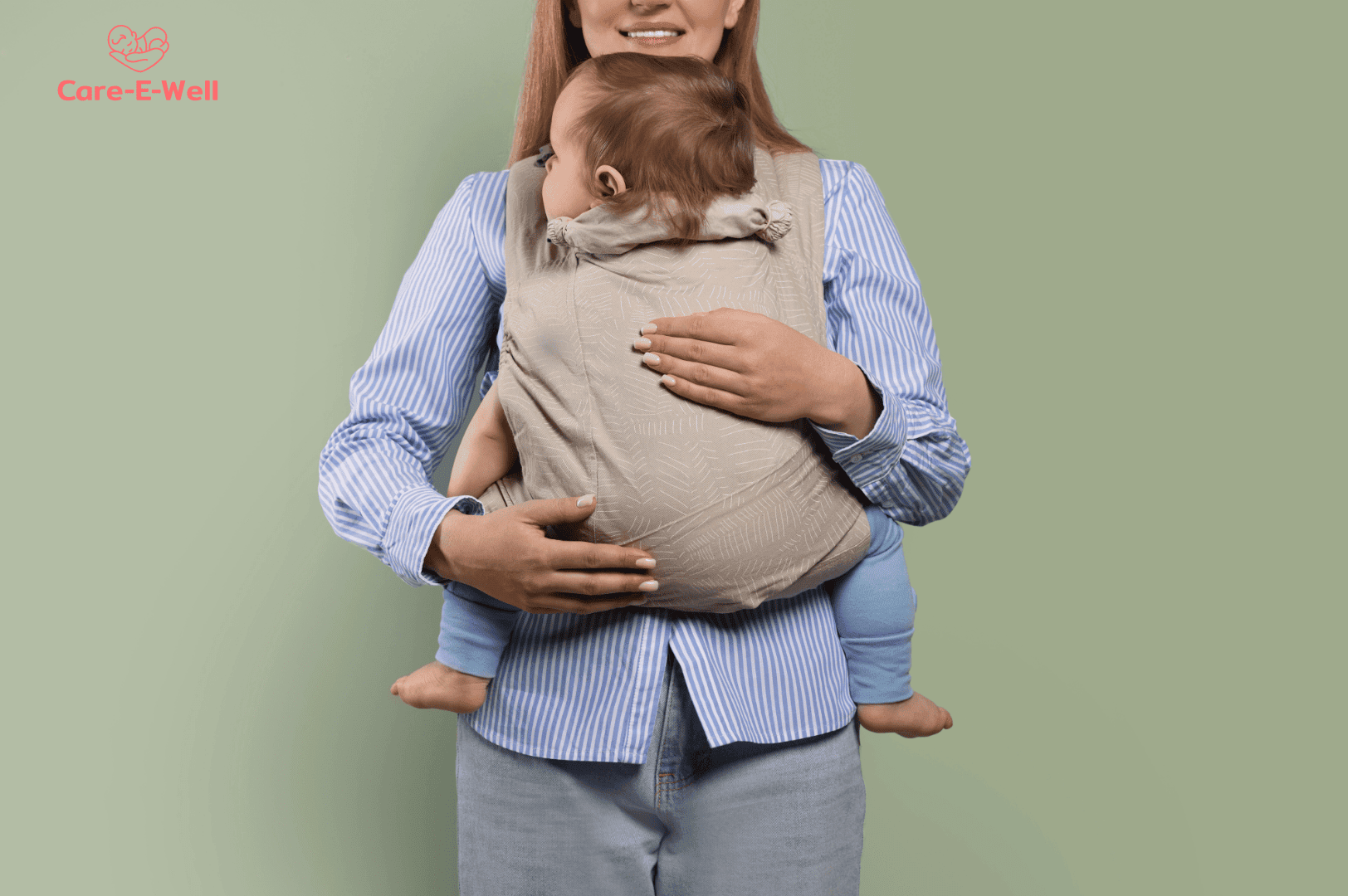
Babywearing can make everyday life easier while keeping a baby close, but safe carrying depends more on fit and positioning than on how “ergonomic” a carrier looks. The priorities are clear: keep the baby’s face visible, nose and mouth unobstructed, head and trunk supported for age, and body held securely against the wearer without slumping.
Newborns need especially careful positioning because they have limited head control and can fall into a chin-to-chest posture that narrows the airway. As babies grow, fit still matters, but comfort, movement and developmental readiness become increasingly important.
Start with breathing and stability. Hip support and comfort matter too, but they come after the airway is protected.
What does safe babywearing mean?
Safe babywearing means using a wrap, sling or carrier suitable for the baby’s size and stage, then adjusting it so the baby stays supported, visible and able to breathe freely.
Research on adult-worn slings and carriers identifies asphyxiation as the main serious hazard. Reported mechanisms include fabric covering the face, the nose or mouth being pressed against the adult or carrier, and excessive neck flexion bringing the chin toward the chest.
Reposition immediately if the face becomes covered, the chin presses onto the chest, breathing changes, or the baby appears unusually floppy, pale, blue or distressed.
How should a newborn sit in a carrier?
For many healthy term newborns, an upright inward-facing carry is the simplest position to monitor. The baby should be close to the wearer, with the face uncovered, nose and mouth clear, chin away from the chest and the trunk supported enough to prevent collapsing sideways or downward.
The head can rest against the wearer’s chest, usually turned to one side. Support should prevent the head from falling backward or forward without forcing it tightly into one position. WHO guidance for prolonged skin-to-skin positioning of small newborns also avoids a flexed head because airway protection is central.
Some carriers require a newborn adjustment or insert; others are not designed for newborns. Stay within the product’s stated size and developmental limits.
Premature, low-birth-weight, medically fragile or low-tone babies may need individual clinical advice before routine carrier use because maintaining an open airway can be more difficult.
Why is chin-to-chest positioning dangerous?
A young infant’s airway can narrow when the neck is strongly flexed. A baby may therefore have breathing difficulty even when the nose and mouth look uncovered.
Case reports of deaths in baby carriers describe positional asphyxia involving chin-to-chest collapse, fabric obstruction or the face being compressed against the adult or carrier. A rounded newborn back can be normal; a folded neck is not.

You should be able to see the baby’s face and check breathing without moving fabric or changing the baby’s position.
What is the M-position?
The M-position describes hips and knees held in flexion with the thighs supported, so the knees sit roughly level with or somewhat higher than the bottom. Viewed from the front, the legs may resemble the letter M.
Biomechanical and ultrasound studies show that some inward-facing carriers can hold healthy infant hips in flexion-abduction positions resembling those used in orthopaedic treatment of developmental dysplasia of the hip.
That does not prove babywearing prevents hip dysplasia, and every baby does not need an identical M shape. Developmental dysplasia is multifactorial, and babies with diagnosed hip instability need individual orthopaedic guidance.
How wide should the carrier support the thighs?
The seat should support the baby without forcing the legs straight down or spreading them beyond a comfortable range. A panel that is too wide for a small baby can over-spread the legs; one that is too narrow may leave most of the thighs unsupported.
Aim for comfortable thigh support with naturally flexed hips and knees. The baby should not look suspended mainly from the crotch with rigidly hanging legs.
Recheck panel width as the baby grows. A fit that worked several weeks ago may no longer be appropriate.
How tight should the carrier be?
The carrier should be snug enough that the baby moves with the wearer rather than bouncing, sagging or folding away from the torso. Excess slack can allow the head and trunk to collapse into unsafe positions.
Snug does not mean compressive. The baby should breathe freely, maintain normal colour and move the head appropriately for age. If tightening forces the face into the wearer’s chest, recheck height, panel position and the baby’s alignment rather than simply pulling harder.
Can a baby sleep in a carrier?
Babies often fall asleep while being carried, but a carrier is not an unsupervised sleep surface. When a baby sleeps, muscle tone falls and a previously acceptable position can become slumped.
Keep checking the face, airway and head position. If continuous supervision is ending, transfer the baby when practical to a safe sleep surface. WHO safe-sleep guidance recommends a firm, flat surface with babies placed on their back for routine sleep.
How long can a baby stay in a carrier?
Research does not establish one universal maximum number of minutes for every healthy baby and every carrier. Tolerance depends on age, temperature, feeding, health, fit and the wearer’s comfort.
Give the baby regular opportunities to change position, feed, have a nappy change and move freely outside the carrier. Younger babies who cannot reposition themselves need more frequent checking.
The wearer matters too. Systematic-review evidence shows that carrying changes posture, gait and muscular demand, so persistent back, neck or shoulder pain is a reason to adjust fit, change carrying method or take breaks.
Which carrier type is safest?
No carrier category is automatically safest for every family. A wrap, ring sling or structured carrier can all be used well or poorly.
- Wraps offer highly adjustable support but require consistent tying and tightening.
- Ring slings are compact and quick once learned but load the adult asymmetrically and need careful fabric adjustment.
- Structured carriers can be reproducible and convenient but differ substantially in minimum size, panel shape and adjustment range.
Choose the option that lets you achieve a stable, visible, airway-safe position every time without improvised padding, knots or workarounds.
What are signs that a carrier does not fit correctly?
- The face repeatedly disappears into fabric or the wearer’s body
- The chin falls onto the chest
- The baby slumps sideways or downward
- The head is unsupported for the baby’s stage
- The panel covers the face
- The seat forces the legs straight or spreads them uncomfortably
- Large gaps let the baby bounce away from the wearer
- One side of the pelvis or trunk is consistently twisted
- The baby develops persistent pressure marks, distress or colour changes
A well-made carrier can still be the wrong fit for a particular baby at a particular stage.
How should you dress a baby in a carrier?
The carrier adds fabric and places the baby close to the adult’s body heat. Dress for the actual environment rather than automatically adding the same layers you would use in a stroller.
Keep the face uncovered and check the chest or upper back for heat and sweating. In cold weather, warming around the carrier often preserves fit better than a very bulky snowsuit. In hot weather, reduce unnecessary layers, seek shade and take breaks.

What activities should you avoid while babywearing?
A carrier frees the hands but does not make high-risk activities safe. The baby’s head and body can still be exposed to impact, heat and falls.
- Avoid cooking over open flames or hot pans
- Keep hot drinks away from the baby
- Avoid cycling, skating, ladders and activities with significant fall risk
- Take extra care on stairs and uneven ground
- Bend at the knees rather than folding sharply over the baby
If an activity would be unsafe while carrying the baby in your arms, a carrier usually does not make it safe.
When should parents seek extra help?
Get hands-on carrier help if you cannot keep the airway visible, the baby repeatedly slumps, the carrier seems incompatible with the baby’s size, or the wearer develops significant pain.
Medical guidance is appropriate for prematurity, low muscle tone, breathing problems, known hip dysplasia, neuromuscular conditions or other conditions that affect positioning.
Babywearing advice cannot replace medical assessment for breathing difficulty, blue or grey colour, unusual limpness, repeated choking or a known orthopaedic problem.
Frequently asked questions
Is babywearing safe from birth?
It can be for many healthy term newborns when the carrier is designed for their size and the baby can maintain a visible, unobstructed airway with supported head and trunk.
Should the knees always be above the bottom?
A flexed, supported lower-limb posture is useful, but the exact visual height varies. Do not force a rigid shape.
Is a wide-base carrier always better?
No. The seat must match the baby. Excessive width can fit poorly just as inadequate thigh support can.
Does babywearing prevent hip dysplasia?
No. Flexion-abduction positioning is considered hip-friendly, but babywearing has not been proven to prevent developmental dysplasia.
The key takeaway
Safe babywearing is functional rather than photographic: the baby breathes freely, remains visible, stays securely supported and sits in a position appropriate for age and size.
Recheck the position whenever the baby sleeps, grows, changes clothing or starts moving differently. Airway first, then stability, hip support, temperature and wearer comfort.
Sources and references
- World Health Organization. Kangaroo mother care: a clinical practice guide. https://www.who.int/publications/i/item/9789240115910
- World Health Organization. Making sure newborns and children under 5 years sleep safely. https://www.who.int/tools/your-life-your-health/life-phase/newborns-and-children-under-5-years/making-sure-newborns-and-children-under-5-years-sleep-safely
- Lovell-Kennedy SR, Strong RLJ, Grieve LM, et al. Safety and benefits of adult-worn slings and baby carriers: a narrative systematic review to inform guidance for parents. https://doi.org/10.1136/bmjpo-2026-004693
- Strong RLJ, Lovell-Kennedy S, Grieve LM, et al. Adult-worn sling and baby carrier safety: exploring parental practices, knowledge and information needs. https://doi.org/10.1136/bmjpo-2026-004696
- Sidharthan S, Kehoe C, Dodwell ER, et al. Post-Natal Positioning through Babywearing: What the Orthopaedic Surgeon Needs to Know. https://doi.org/10.55275/jposna-2020-131
- Siddicky SF, Wang J, Rabenhorst BM, et al. Exploring infant hip position and muscle activity in common baby gear and orthopedic devices. https://doi.org/10.1002/jor.24818
- Siddicky SF, Eckels J, Rabenhorst BM, et al. Ultrasonographic evaluation of infant hips in the Pavlik harness compared to body-worn commercial baby carriers. https://doi.org/10.1002/jor.25571
- Storz D, Dame C, Wendt A, et al. Sudden Unexpected Death of Two Infants in Baby Carriers. https://doi.org/10.1055/a-1545-4590
- Bigelow AE, Williams LR. To have and to hold: Effects of physical contact on infants and their caregivers. https://doi.org/10.1016/j.infbeh.2020.101494
- Taboada-Iglesias Y, Domínguez-Estévez A, Rodríguez-Gude C, et al. Physical and Physiological Consequences of Babywearing on the Babywearer: A Systematic Review. https://doi.org/10.3390/healthcare13172193
Did this Insight help?
A little love for something worth reading.


