
Care-E-Well Insights
Can You Refrigerate Prepared Formula?
You can refrigerate prepared formula safely at 5°C or below for up to 24 hours. Learn cooling, warming and leftover rules.
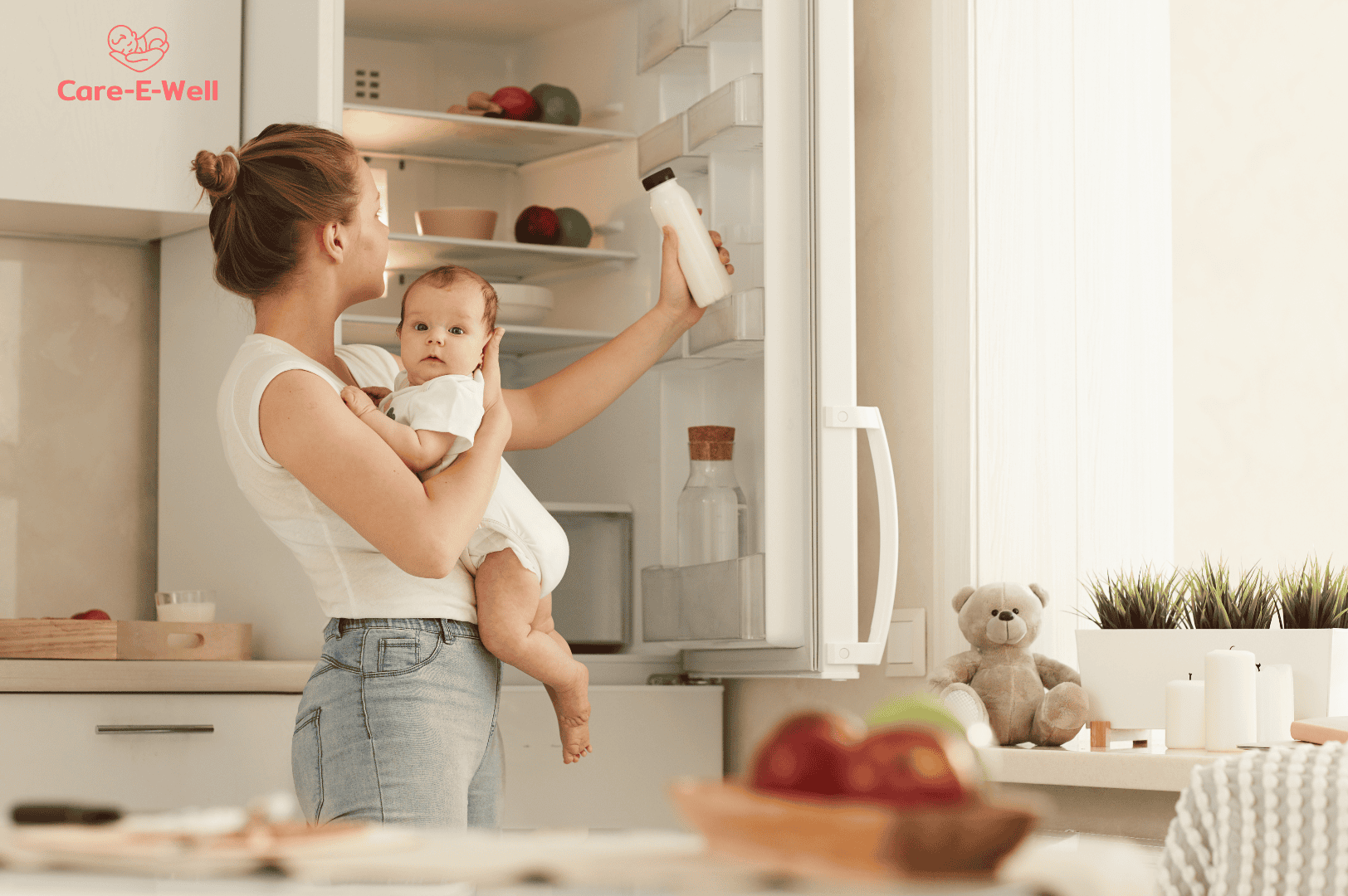
Can you refrigerate prepared formula? Yes, when advance preparation is genuinely necessary, but only if the formula is prepared hygienically, cooled promptly and stored in a refrigerator at 5°C or below. WHO guidance says refrigerated prepared powdered formula should be used within 24 hours.
Fresh preparation immediately before each feed is the safer default because powdered infant formula is not sterile. Refrigeration slows bacterial growth; it does not sterilise the feed, reset time already spent warm or make a partly used bottle safe for later.
Refrigeration is a controlled storage method for formula cooled promptly after preparation—not a way to rescue a bottle that has already been sitting out.
Why might parents need to refrigerate prepared formula?
WHO recommends preparing feeds fresh whenever possible. In real life, there are situations in which advance preparation may be necessary, including childcare arrangements, limited preparation opportunities or a clinical feeding plan.
When formula must be made ahead, the safety goal is to minimise the time it spends warm, where bacteria can multiply more quickly. That means preparing carefully, cooling promptly and moving the feed into reliable refrigeration rather than leaving it on a counter.
A batch-preparation routine should never replace exact hygiene and temperature control.
What temperature should the refrigerator be?
WHO guidance specifies a refrigerator temperature no higher than 5°C for prepared powdered infant formula stored in advance.
A refrigerator that is warmer than this does not meet the recommended storage condition. If you routinely store prepared formula, knowing that the fridge reliably stays at or below 5°C is more useful than assuming any cold-feeling shelf is adequate.
Avoid leaving the refrigerator door open unnecessarily when handling feeds, particularly in hot weather.
How long can refrigerated prepared formula be stored?
WHO guidance sets a maximum of 24 hours when formula has been prepared hygienically, cooled quickly and kept at 5°C or below.
Twenty-four hours is an upper limit, not a target. Using formula sooner reduces the time available for any surviving or introduced bacteria to multiply.
Discard refrigerated prepared formula once 24 hours has passed, even if it looks and smells normal.
When does the 24-hour clock start?
Count from when the formula was prepared, not from when it became fully cold or when it was first removed from the refrigerator.
Refrigeration slows growth; it does not create a new storage clock. Label bottles with preparation time if several feeds are being stored so the oldest one can be identified accurately.
If the preparation time is uncertain, discard the feed.
Can you refrigerate formula after it has been sitting out?
Formula intended for later refrigeration should be cooled promptly after preparation. Do not leave a bottle at room temperature for a prolonged period and then move it to the refrigerator as a way to gain a new 24-hour storage period.
WHO’s room-temperature guidance states that prepared formula not consumed within two hours should be discarded. The refrigerated pathway is designed to limit warm holding time from the start.
If you do not know how long prepared formula has been unrefrigerated, do not refrigerate it for later. Discard it.
How should prepared formula be cooled before refrigeration?
After preparing powdered formula according to current safety instructions, cool feeds intended for storage as quickly as practical and place them into a refrigerator at 5°C or below.
WHO guidance describes rapid cooling using cold running water or a container of cold or iced water while keeping cooling water away from the bottle opening. The aim is to lower the feed temperature without introducing contamination.
Do not leave prepared bottles on the kitchen counter until they slowly reach room temperature.

Can you prepare a whole day's formula at once?
From a food-safety perspective, preparing each feed fresh is preferred. If advance preparation cannot be avoided, multiple feeds may be prepared only when careful hygiene, rapid cooling and reliable refrigeration can be maintained.
Each bottle should be prepared at the correct concentration and stored covered in clean feeding equipment. Do not make one concentrated batch and dilute portions later unless a clinical service has given a specific medically supervised preparation method.
For premature or medically vulnerable infants, follow the baby’s clinical team because hospital and high-risk feeding protocols may be stricter than general household guidance.
Can you refrigerate a bottle the baby has already drunk from?
No. Once a baby sucks from the teat, saliva can enter the formula and introduce oral bacteria. The remaining feed should be discarded after the feeding session rather than refrigerated for another feed.
This applies even if the baby only took a few sips. The amount left in the bottle does not change the contamination mechanism.
A clean untouched prepared bottle can follow safe refrigeration rules. A used bottle should not go back into the fridge.
Can you refrigerate a bottle the baby refused?
It depends on whether the bottle has been used and how it has been held. If the teat entered the baby’s mouth, treat it as a used feed and discard leftovers.
If the bottle has not been used, safe storage still depends on how promptly it was refrigerated after preparation. Do not use the refrigerator to extend a bottle that has already been held at room temperature for most of the two-hour limit.
When the history is uncertain, discard rather than estimate.
How do you warm refrigerated formula?
Remove only the feed you need. Formula does not have to be warmed if the baby accepts it cold or cool, but some babies prefer it gently warmed.
If warming is desired, warm the bottle using a safe method such as placing it in warm water. Swirl the bottle so the temperature is even and test it before feeding.
Do not microwave infant formula. Microwaves can heat unevenly and create hot spots that can burn a baby’s mouth.
Can warmed formula go back into the refrigerator?
Do not repeatedly warm, cool and refrigerate the same bottle. Once a refrigerated feed has been removed and warmed for use, offer it promptly and discard any remainder according to safe feeding-time rules.
Repeated temperature cycling creates more opportunities for bacterial growth and handling contamination.
If a baby often drinks less than expected, warming smaller portions can reduce waste while keeping the unused refrigerated formula within its original safe storage plan, provided it has not contacted the baby’s bottle or teat.
Can you use a bottle warmer to keep refrigerated formula warm?
A warmer is for bringing a feed to a comfortable temperature shortly before feeding, not for holding formula warm over an extended period.
Keeping formula continuously warm creates conditions that favour bacterial growth. Do not use a bottle warmer as a storage device.
Warming also does not reset the original 24-hour refrigerated limit.
Can you freeze prepared infant formula?
WHO’s household guidance focuses on fresh preparation and controlled refrigeration rather than using freezing as the standard storage method for reconstituted powdered formula.
Do not improvise a freezing routine to extend storage. Follow the manufacturer’s instructions for the specific formula, and use fresh or correctly refrigerated feeds instead unless a clinical team has provided another method.
Texture and component stability can also change with freezing and thawing, depending on the product.
What if the refrigerator loses power?
Refrigerated formula is only within the WHO storage pathway while it remains at 5°C or below. A prolonged power failure can allow the feed to warm into a range where bacteria multiply more readily.
If you cannot verify that the required cold temperature was maintained, discard the prepared formula rather than relying on smell or appearance.
Sealed ready-to-feed formula may be a useful backup during emergencies if it is appropriate for the baby and can be handled safely after opening.
Can prepared formula be transported cold?
Formula that has been cooled and refrigerated can be transported only if the cold chain can be maintained. A properly packed cool bag with adequate ice packs may help, but the formula still needs to remain safely cold.
If transported feed warms and you cannot confirm its temperature history, do not return it to the refrigerator for later use.
For travel, freshly prepared feeds or sealed ready-to-feed formula can simplify the process depending on the baby’s needs and local guidance.
Does refrigeration kill Cronobacter?
No. Refrigeration slows bacterial multiplication but does not reliably kill Cronobacter or make contaminated formula sterile.
That is why safe formula feeding uses several controls together: hygienic preparation, sufficiently hot water for powdered formula, rapid cooling when storage is necessary, low refrigerator temperature and strict time limits.
No single step removes all risk.

What about ready-to-feed formula in the refrigerator?
Unopened ready-to-feed formula is commercially sterile and follows its own unopened storage instructions. Once opened, the manufacturer specifies how long the remaining liquid can be refrigerated.
Do not automatically apply the 24-hour prepared-powder rule to every opened ready-to-feed container. Product format, packaging and manufacturer instructions matter.
Ready-to-feed formula that has been poured into a bottle and then fed to the baby should not be saved for another feed.
How can parents organise refrigerated feeds safely?
- Wash hands and clean the preparation surface.
- Use properly cleaned feeding equipment.
- Prepare powdered formula exactly according to current instructions.
- Cool bottles intended for storage promptly.
- Refrigerate at 5°C or below.
- Mark the preparation time when several bottles are stored.
- Use the oldest safe bottle first and discard any bottle once 24 hours has passed.
- Remove and warm only the feed needed.
- Never return a partly used bottle to the refrigerator.
A simple system reduces uncertainty. Formula safety becomes harder when several unlabelled bottles have different preparation times or have moved in and out of the refrigerator.
Is batch preparation safer than making formula fresh?
No. Fresh preparation followed by prompt feeding is the preferred approach because it avoids storage time. Refrigerated preparation is a risk-management option when advance preparation is necessary.
The fact that WHO provides a refrigerated pathway does not mean parents need to prepare a full day of bottles in advance.
Choose the simplest routine that meets the baby’s feeding needs while keeping preparation and storage safe.
When should you use ready-to-feed instead?
Ready-to-feed formula can reduce preparation complexity because the unopened liquid is commercially sterile and requires no water or scooping. This can be valuable when reliable hot-water preparation or refrigeration is difficult.
For some premature or immunocompromised infants, a clinical team may specifically recommend sterile liquid formula rather than powder.
Ready-to-feed is not automatically necessary for every healthy baby, and after opening it still requires careful handling and product-specific storage.
Frequently asked questions
Can you refrigerate prepared formula for 48 hours?
No. WHO guidance sets a maximum of 24 hours at 5°C or below for prepared powdered formula that has been cooled promptly and stored safely.
Can I refrigerate formula immediately after making it?
If a feed is being prepared in advance, cool it promptly and refrigerate it at 5°C or below. Do not leave it warm on the counter first.
Can I refrigerate formula after my baby drank from it?
No. Saliva can contaminate the remaining formula. Discard leftovers from a used bottle rather than refrigerating them.
Is cold formula safe to feed?
Formula does not need to be warm if it has been prepared and stored safely and the baby accepts it. Temperature preference is separate from food safety.
Can I warm refrigerated formula twice?
Repeated warming and cooling is not recommended. Warm only the amount needed for the feed and discard leftovers rather than returning a warmed bottle to storage.
The key takeaway
Can you refrigerate prepared formula? Yes, when advance preparation is necessary: prepare it hygienically, cool it promptly, keep it at 5°C or below and use it within 24 hours. Freshly prepared formula used promptly remains the preferred routine.
Never refrigerate a partly used bottle, do not use refrigeration to rescue formula that has already sat out, and discard a feed whenever its preparation time or temperature history is uncertain.
Sources and references
- World Health Organization. Safe Preparation, Storage and Handling of Powdered Infant Formula: Guidelines. https://www.who.int/publications/i/item/9789241595414
- UNICEF UK Baby Friendly Initiative. Guide to Bottle Feeding. https://www.unicef.org.uk/babyfriendly/baby-friendly-resources/bottle-feeding-resources/guide-to-bottle-feeding/
- Agostoni C, Axelsson I, Goulet O, et al. Preparation and Handling of Powdered Infant Formula: A Commentary by the ESPGHAN Committee on Nutrition. https://doi.org/10.1002/j.1536-4801.2004.tb00858.x
- Fischer M, Buschulte A. Hygiene Aspects of Premature Nutrition. https://doi.org/10.5772/intechopen.107861
- Grant A, Jones S, Ellis R, et al. The safety of at home powdered infant formula preparation: A community science project. https://doi.org/10.1111/mcn.13567
- Losio MN, Pavoni E, Finazzi G, et al. Preparation of Powdered Infant Formula. https://doi.org/10.1097/MPG.0000000000002100
- Redmond EC, Griffith CJ. The importance of hygiene in the domestic kitchen: Implications for preparation and storage of food and infant formula. https://doi.org/10.1177/1757913908101604
- Kent RM, Fitzgerald GF, Hill C, et al. Novel Approaches to Improve the Intrinsic Microbiological Safety of Powdered Infant Milk Formula. https://doi.org/10.3390/nu7021217
- Gibson SL, Sahanggamu D, Fatmaningrum D, et al. ‘Unfit for human consumption’: a study of the contamination of formula milk fed to young children in East Java, Indonesia. https://doi.org/10.1111/tmi.12927
Did this Insight help?
A little love for something worth reading.


