
Care-E-Well Insights
Car Seat Recline Angle for a Newborn: Why It Matters
Learn why newborn car seat recline matters, how to use the seat's approved angle and what to check if your baby's head falls forward.
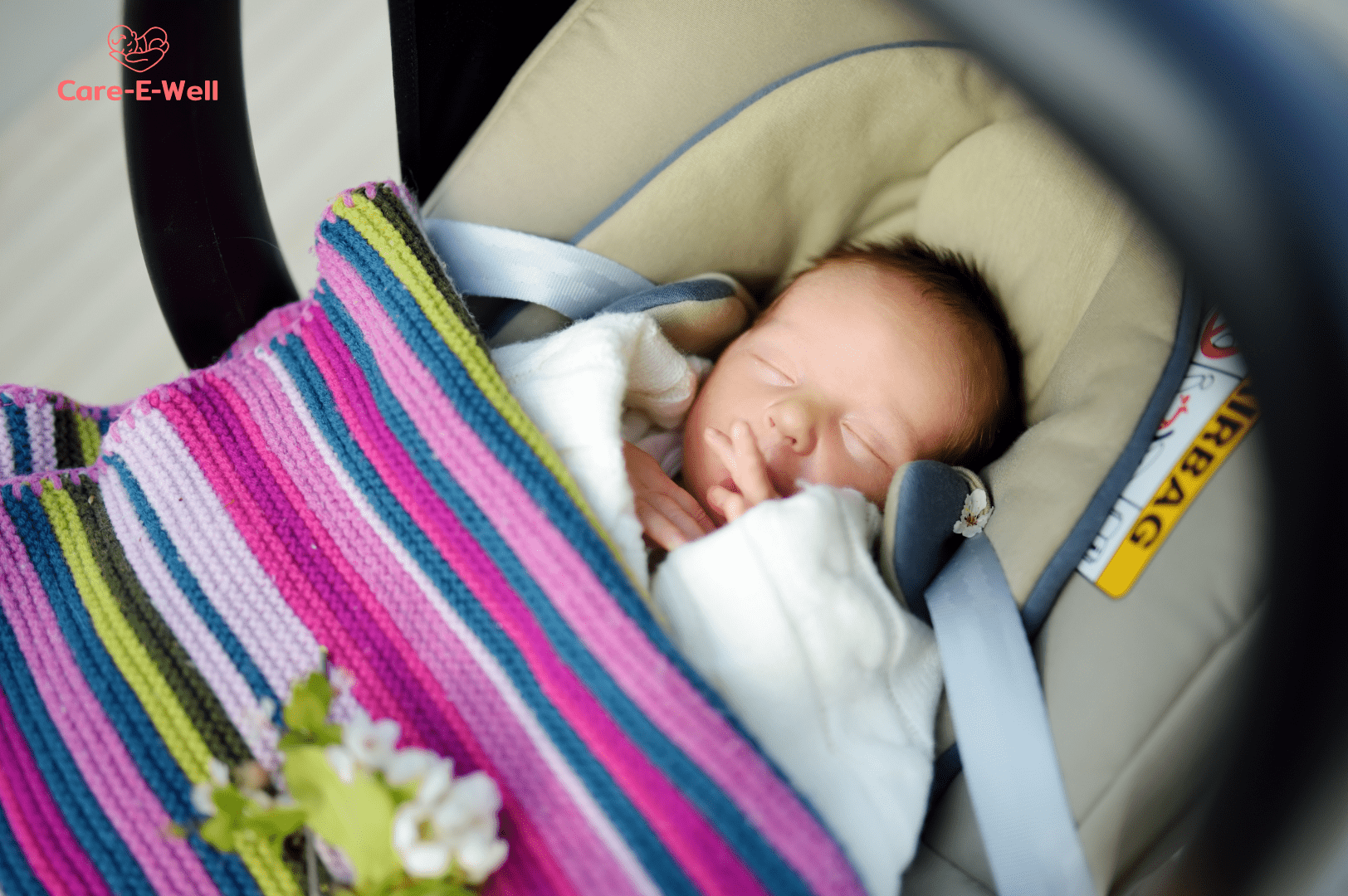
The recline angle of a newborn's car seat matters because a young baby has a relatively large head, limited neck control and a more vulnerable airway. If a rear-facing seat is installed too upright, the baby's head may fall forward and the chin may move toward the chest. If it is reclined outside the approved range, the restraint may not perform as designed in a crash.
There is no single angle that parents should impose on every car seat. Use the recline indicator and instructions for the exact restraint and vehicle. Some research and older clinical guidance refer to about 45 degrees for young infants, but modern seats have their own tested ranges and indicators, which take priority.
For a newborn, the correct recline angle is the angle approved by the car-seat manufacturer—not a universal number copied from another seat.
Why does recline matter so much for a newborn?
Newborns cannot reliably hold their head in line with the torso. In a semi-upright restraint, gravity can allow the head to fall forward if the seat is too upright or if the baby slumps.
Research has linked head flexion with narrowing of the upper airway in some infants. Tonkin and colleagues demonstrated in preterm infants that positioning the head more neutrally could reduce airway narrowing. Studies of term and near-term babies have also documented mild oxygen desaturation in car seats, although the clinical significance varies and healthy babies do not all respond in the same way.
The recline setting is therefore both a positioning issue and part of correct restraint use.
Is 45 degrees the correct car seat angle?
Not as a universal rule. Around 45 degrees appears frequently in neonatal literature because many earlier infant seats and hospital car-seat tolerance protocols used that semi-reclined position. Pilley and McGuire, for example, described a 45-degree semi-reclined setup in guidance for preterm infants.
But child restraints differ. Under UN Regulation No. 129, the approved restraint is a tested system with its own geometry, installation instructions and permitted configurations. A seat may have a bubble level, line, dial, mechanical indicator or multiple recline positions.
Follow that indicator. Do not use a phone angle app to override the manufacturer's instructions.

What can happen if the seat is too upright?
A very young baby's head may fall forward, increasing neck flexion. In some infants, especially those born prematurely or with low muscle tone or cardiorespiratory vulnerability, this can contribute to airway or oxygenation problems.
Studies of preterm infants have reported episodes of oxygen desaturation, apnoea or bradycardia in semi-upright car-seat positions. Research in healthy term infants has also found that oxygen saturation can sometimes fall compared with lying flat, although serious events are uncommon and study methods vary.
A baby who is too upright may also visibly slump, with the pelvis sliding forward and the trunk rounding. That can further alter head position.
Can the seat be too reclined?
Yes. More recline is not automatically safer. A child restraint is designed to manage crash forces within its approved installation range. Reclining it beyond that range can change how the seat loads against the vehicle and how the harness restrains the child.
This is why improvised wedges, towels or foam should only be used if the restraint manufacturer specifically permits them and explains exactly where they belong. Some seats allow a rolled towel or approved levelling method; others do not.
Correct installation means following both the car-seat manual and the vehicle manual.
How do you set the recline correctly?
- Park the vehicle on reasonably level ground.
- Place the restraint in an approved rear seating position.
- Select the newborn or rear-facing recline position specified by the manual.
- Install the restraint using the approved ISOFIX or seat-belt method.
- Check the built-in recline indicator after the installation is tightened.
- Put the baby in the seat and secure the harness according to the manufacturer's instructions.
- Recheck the indicator after loading the baby because the vehicle seat cushion may compress.
Some vehicles have steep or unusually soft rear seats. If you cannot achieve the approved angle using the permitted method, do not improvise. Ask the restraint manufacturer or an appropriately trained local child-restraint professional whether the seat is compatible with that vehicle position.
Does the correct angle change as the baby grows?
It can. Many restraints allow a more upright rear-facing position for an older baby or toddler with stronger head and trunk control. The manual will specify when different recline positions become available.
Do not make the seat more upright merely to create legroom or because the baby looks more “grown up.” Change the recline only within the approved range for the child's current size or stage.
Conversely, do not keep using the newborn recline if the manual says it must change after a certain limit.
What if the baby's head still falls forward?
First check installation and recline. Then check that any newborn insert is the correct approved configuration, that the baby's bottom is fully back in the seat and that the harness is positioned and tightened correctly.
Do not put a pillow behind the baby's head or neck. Extra padding can push the head farther forward and alter restraint geometry.
If a full-term newborn repeatedly slumps markedly forward despite correct installation, ask for the seat fit to be checked. If the baby was premature, has low muscle tone or has a respiratory or neurological condition, discuss car-seat positioning with the medical team.
Why are premature babies a special case?
Premature infants can have immature respiratory control and may be more sensitive to semi-upright positioning. Ojadi and colleagues found cardiorespiratory abnormalities during car-seat testing in some preterm infants, and later studies have continued to investigate who is most at risk.
A simulated moving-vehicle study by Arya and colleagues found that motion and a more realistic travel environment could affect physiological measures, highlighting that a stationary seat check does not capture every aspect of travel.
This does not mean every premature baby is unsafe in a car seat. It means positioning should be individualized and unnecessary time in the restraint should be minimized for medically vulnerable infants.
If a newborn shows breathing difficulty, repeated pauses in breathing, blue or grey colour, marked limpness or reduced responsiveness while in a car seat, stop the journey safely and seek urgent medical help.
Does a more upright seat provide better crash protection?
Parents sometimes assume that “more upright” means “more secure.” That is not a reliable rule. Crash performance depends on the restraint's tested design, installation method, anti-rotation features, shell geometry and harness system.
UNECE approval requirements are based on testing the restraint in defined configurations. Parents should therefore use the manufacturer-approved recline setting rather than trying to optimize the seat independently.

Should the handle position affect recline?
Some infant carriers require the carry handle to be in a specific travel position; others allow several positions. The handle can be part of the restraint's crash-management design.
Always check the manual before driving. Do not assume the handle must always be up or always be down based on another brand.
How often should you recheck the angle?
Recheck after reinstalling the seat, moving it between vehicles, changing the base setting, changing the child's approved recline stage or noticing new head slumping. Also check after someone else has moved the seat.
A quick look at the built-in indicator before a journey can catch installation changes early.
The key takeaway
The car seat recline angle for a newborn matters because it affects both positioning and the baby's ability to maintain a stable head and airway. Use the exact angle range approved for your restraint, not a generic degree target. If the baby repeatedly slumps forward despite correct installation, seek a fit check or medical advice rather than adding padding.
Frequently asked questions
Is a 45-degree angle always correct for a newborn?
No. Around 45 degrees is common in older clinical literature, but the correct angle is the range specified by the manufacturer for your exact seat.
Can I use a rolled towel to change the angle?
Only if the car-seat manufacturer explicitly allows it and explains how to use it.
Should a newborn's head be perfectly straight?
No. A gentle turn to one side can be normal. The main concern is marked forward flexion or slumping that may compromise breathing.
Can I make the seat more upright when my baby is awake?
Only within the approved recline options for your baby's size and stage. Do not change the angle outside the manual's instructions.
Sources/References
- UNECE — UN Regulation No. 129 – Rev.4
- World Health Organization — Occupant Restraints: A Road Safety Manual for Decision-Makers and Practitioners
- Tonkin S et al. — Simple Car Seat Insert to Prevent Upper Airway Narrowing in Preterm Infants: A Pilot Study
- Merchant JR et al. — Respiratory Instability of Term and Near-Term Healthy Newborn Infants in Car Safety Seats
- Pilley E, McGuire W — The car seat: a challenge too far for preterm infants?
- Ojadi VC et al. — Risk of cardio-respiratory abnormalities in preterm infants placed in car seats: a cross-sectional study
- Arya R et al. — Is the infant car seat challenge useful? A pilot study in a simulated moving vehicle
- Petrova A, Mehta R — Alteration in regional tissue oxygenation of preterm infants during placement in the semi-upright seating position
- DeGrazia M — Stability of the Infant Car Seat Challenge and Risk Factors for Oxygen Desaturation Events
Did this Insight help?
A little love for something worth reading.


