
Care-E-Well Insights
Child CPR: Key Steps for Children Over One Year
Child CPR essentials: when to start, rescue breaths, chest compression depth and rate, AED use and the key steps parents should practise.
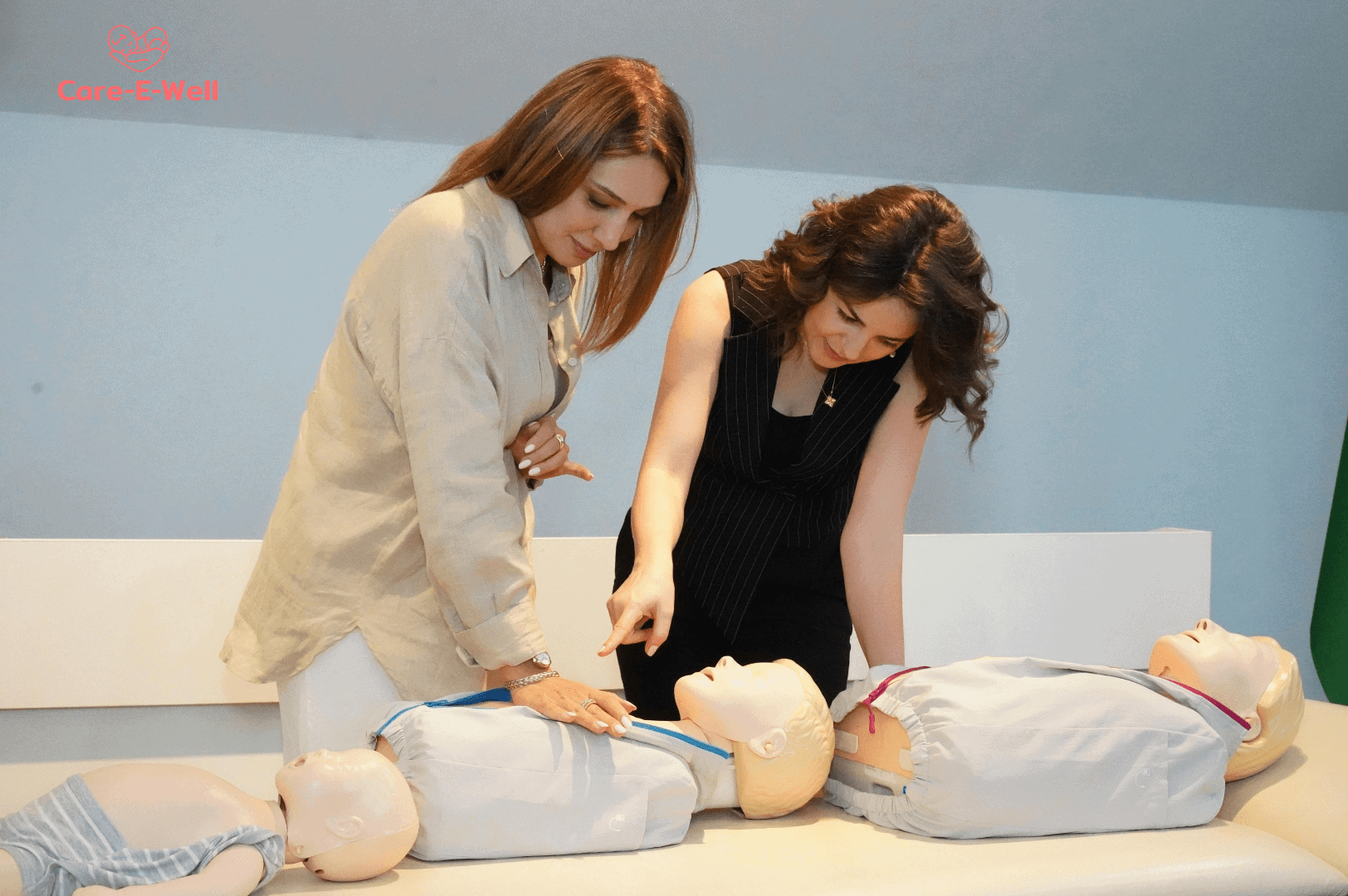
Child CPR is needed when a child over one year is unresponsive and not breathing normally. Call the local emergency number, use speakerphone if possible, and begin resuscitation promptly. Do not wait to identify the cause of the collapse before starting lifesaving care.
Children are not simply small adults. Cardiac arrest in childhood often develops after breathing failure, drowning, choking, severe illness or trauma, so rescue breaths remain important in paediatric CPR. Chest compressions must also be deep and fast enough to create blood flow while allowing the chest to recoil fully.
An unresponsive child who is not breathing normally needs emergency activation and CPR. Start rather than waiting for certainty.
When should you start child CPR?
Start CPR when a child is unresponsive and not breathing normally. Abnormal occasional gasps should not be mistaken for normal breathing.
A lay rescuer does not need to diagnose cardiac arrest with medical precision. Current paediatric resuscitation guidance focuses on rapid recognition of unresponsiveness and abnormal breathing so that bystander CPR is not delayed.
If a child is unresponsive and not breathing normally, call emergency services and start child CPR according to current paediatric training or dispatcher instructions.
What should you do in the first moments?
Check that it is safe to approach. Electricity, traffic, water, fire, smoke or unstable structures can endanger both the child and rescuer.
- Check for a response using your voice and gentle stimulation.
- Open the airway using the technique taught in current paediatric first-aid training.
- Check for normal breathing for no more than about 10 seconds.
- Activate emergency services or ask another person to call and bring an AED.
- Begin the paediatric basic-life-support sequence you have been trained to use.
European paediatric basic life support includes initial rescue breaths because hypoxia is a common pathway to cardiac arrest in children. If a dispatcher is guiding you, follow their sequence rather than pausing to compare written algorithms.
Why are rescue breaths still important after age one?
In adults, a sudden primary cardiac event is a common cause of arrest. In children, respiratory and asphyxial causes are relatively more important. A child may deteriorate from airway obstruction, drowning, severe asthma, infection or another process that first reduces oxygen.
Observational studies of paediatric out-of-hospital cardiac arrest consistently support early bystander CPR. Research also supports conventional CPR with rescue breaths for many paediatric arrests, particularly when the cause is asphyxial.
If a rescuer cannot provide rescue breaths, chest compressions are still better than doing nothing. But a trained rescuer should include ventilation in paediatric CPR.
For children, “hands-only” CPR is a fallback when breaths cannot be given, not the preferred trained response for most arrests.
How do you give rescue breaths to a child?
Place the child flat on a firm surface and open the airway. Pinch the nose closed, make a seal over the mouth and give a breath sufficient to make the chest visibly rise, using the technique taught in your course.
Do not give large forceful breaths. Excessive ventilation can inflate the stomach, cause regurgitation and create longer interruptions in chest compressions.
If the chest does not rise, reposition the airway and check the mouth for a clearly visible object. Remove an object only if it can be seen and reached safely; do not sweep blindly.

How should chest compressions be performed on a child?
Place the heel of one hand on the lower half of the breastbone. Depending on the child's size and the rescuer's strength, one or two hands may be used according to current paediatric CPR training.
Major paediatric guidelines target approximately 100–120 chest compressions per minute. Compress the chest by about one-third of its front-to-back depth, approximately 5 cm for a typical child, while avoiding excessive depth. Allow full chest recoil after each compression and keep pauses as short as possible.
Quality matters more than rigidly choosing one hand or two. A larger child may require two hands to achieve adequate depth; a smaller child may be effectively compressed with one.
CPR is for an unresponsive child who is not breathing normally. Never practise real chest compressions on a healthy child.
What compression-to-breath ratio should parents use?
The compression-to-ventilation ratio depends on the rescuer's training and whether one or two trained rescuers are present. Paediatric protocols commonly use 30 compressions to 2 breaths for a single lay rescuer in some systems and 15 to 2 for paediatric-trained or two-rescuer CPR.
Follow the ratio taught in your current accredited course or given by the emergency dispatcher. This avoids confusion between national training systems while preserving the priorities that do not change: early CPR, effective rescue breaths, adequate compression depth and rate, full recoil and minimal interruption.
In a real emergency, do not stop to search online for a ratio. Call on speaker and continue care.
What if you are alone with the child?
If a phone is immediately available, activate emergency services on speaker so you can stay with the child and begin CPR. If another person is nearby, send them to call and retrieve an AED while you start resuscitation.
Some paediatric BLS algorithms give specific instructions to a lone rescuer about providing CPR before leaving an unwitnessed child to seek help. Because these branches depend on circumstances and local systems, learn them through local hands-on training and follow dispatcher guidance during a real event.
When should an AED be used on a child?
Use an automated external defibrillator as soon as one is available. The AED analyses the rhythm and delivers a shock only when appropriate.
Use paediatric pads or a paediatric attenuation mode when available and recommended for the child's size. If they are unavailable, current resuscitation systems generally prioritise using an available AED rather than withholding defibrillation; follow the device instructions and dispatcher or local training.
Place pads exactly as the device shows and make sure they do not touch. Continue CPR while the AED is being prepared when another rescuer can operate it, pausing only when the device instructs everyone to stand clear.
The AED makes the rhythm decision. Your role is to attach it correctly, follow its prompts and resume CPR immediately when told.
What if the child collapsed during sport?
Sudden collapse during exercise can raise concern for a primary cardiac cause, particularly in an older child. If the child is unresponsive and not breathing normally, start CPR and get an AED immediately.
A witnessed sudden collapse with early defibrillation is one scenario in which rapid AED use can be especially important. Do not assume the child is simply fainting if responsiveness and normal breathing do not return.
Unresponsiveness with abnormal breathing after sudden collapse is a resuscitation emergency, whatever the child's previous health or fitness.
What if choking caused the cardiac arrest?
If a choking child becomes unresponsive, place them on a firm surface, activate emergency services and start paediatric CPR. Each time the airway is opened for breaths, look for a clearly visible object and remove it if it can be reached safely.
Do not continue standing back blows and abdominal thrusts once the child is unresponsive, and do not perform blind finger sweeps.
What if drowning caused the collapse?
Drowning is primarily an oxygen-deprivation emergency. Rescue breaths are particularly important. Remove the child from the water only when it is safe, call emergency services and begin paediatric resuscitation if the child is unresponsive and not breathing normally.
Do not try to drain water from the lungs. This delays ventilation and compressions.
What if the child starts breathing normally again?
Stop chest compressions when there are clear signs of life and normal breathing. Continue monitoring until emergency clinicians arrive because the cause of the arrest or respiratory collapse still requires urgent assessment.
If the child is unresponsive but breathing normally, maintain the airway and position them safely according to your training, unless an injury makes movement unsafe. Keep checking breathing.
A child who has required CPR needs emergency medical assessment even if they appear to recover quickly.
Can CPR cause injury?
Rib, chest or other injuries can occur during effective CPR. In true cardiac arrest, however, the immediate threat is the absence of adequate blood flow and oxygen to the brain and organs.
Do not let fear of injury prevent you from compressing adequately. Correct technique and appropriate depth matter, but under-compressing because you are afraid of hurting the child can make CPR ineffective.

Does bystander CPR really make a difference for children?
Yes. Large observational studies have found that paediatric out-of-hospital cardiac arrest outcomes are better when bystanders provide CPR than when no CPR is given. Dispatcher-assisted CPR can also increase the likelihood that a bystander begins treatment.
Outcomes vary according to the cause of arrest, age, time to CPR, emergency response and access to defibrillation. No individual result is guaranteed, but early action gives the child a better chance than waiting.
What mistakes commonly reduce CPR quality?
- confusing gasping with normal breathing
- delaying CPR for a prolonged pulse check
- giving very shallow compressions
- compressing too slowly or with long pauses
- leaning on the chest and preventing full recoil
- giving breaths that are too large or too fast
- stopping repeatedly to check whether CPR is working
- delaying AED use
- stopping because a rib injury is feared
CPR quality deteriorates under stress, which is why structured practice matters. A manikin with feedback can help parents learn the feel of adequate depth and recoil.
What should parents practise in a child CPR course?
- recognising unresponsiveness and abnormal breathing
- airway opening and rescue breaths
- one-hand and two-hand compression positioning
- compression depth and a 100–120-per-minute rhythm
- the ratio used in the local course
- AED pad placement and prompts
- switching between rescuers to reduce fatigue
- choking-to-CPR transition
Skills fade over time. Refresher training, even when brief, can improve confidence and reinforce the sequence.
Knowing CPR is not about being fearless. It is about having a practised sequence to follow while emergency help is travelling.
Frequently asked questions
Is child CPR the same as adult CPR?
The principles overlap, but paediatric cardiac arrest has different common causes, rescue breaths have greater emphasis and compression technique and depth are adapted to body size.
Should I check for a pulse?
Lay rescuers should not delay CPR with a prolonged pulse check. An unresponsive child who is not breathing normally should trigger emergency activation and the paediatric BLS response.
Can I use two hands on a small child?
Use one or two hands according to the child's size and the technique taught in your current course. The aim is to achieve approximately one-third chest depth with full recoil without excessive compression.
What if I cannot give rescue breaths?
Give chest compressions rather than no CPR. If you can provide rescue breaths safely and have been trained, conventional CPR with ventilation is preferred for children.
Should every parent learn AED use?
Yes. AEDs are designed to guide users with prompts, and practising with a trainer makes the process much less unfamiliar during an emergency.
The key takeaway
Child CPR for children over one year starts when the child is unresponsive and not breathing normally. Activate emergency services, give rescue breaths when trained and able, compress at about 100–120 per minute to roughly one-third of chest depth—around 5 cm for a typical child—and use an AED as soon as possible. Follow the compression-to-breath ratio taught in your current local course or by the dispatcher. Hands-on training turns these principles into a skill you can actually use.
Sources and References
- Djakow J, Turner NM, Skellett S, et al. — European Resuscitation Council Guidelines 2025 Paediatric Life Support
- Joyner BL, Dewan M, Bavare A, et al. — Part 6: Pediatric Basic Life Support: 2025 AHA and AAP Guidelines for CPR and Emergency Cardiovascular Care
- Lee J, Kim DK, Kim J-T, et al. — 2025 Korean Guidelines for Cardiopulmonary Resuscitation: Part 7. Pediatric basic life support
- Lee JE, Kim M, Choi EK, et al. — Updated pediatric cardiopulmonary resuscitation: a comprehensive review of the 2025 guidelines
- Naim MY, Burke RV, McNally B, et al. — Association of Bystander Cardiopulmonary Resuscitation With Overall and Neurologically Favorable Survival After Pediatric Out-of-Hospital Cardiac Arrest
- Goto Y, Funada A, Maeda T, et al. — Dispatcher-assisted conventional cardiopulmonary resuscitation and outcomes for paediatric out-of-hospital cardiac arrests
- Murasaka K, Yamashita A, Owada H, et al. — Association between the types of bystander cardiopulmonary resuscitation and survival with good neurologic outcome of preschool pediatric out-of-hospital cardiac arrest
- Morimoto M, Kiyohara K, Kitamura T, et al. — Impact of Dispatcher-Assisted Bystander Cardiopulmonary Resuscitation on Neurological Outcomes in Children With Out-of-Hospital Cardiac Arrests
- Hsu CH, Neumar RW — To Breathe or Not to Breathe
- Peters MA, Stipulante S, Cloes V, et al. — Can Video Assistance Improve the Quality of Pediatric Dispatcher-Assisted Cardiopulmonary Resuscitation?
Did this Insight help?
A little love for something worth reading.


