
Care-E-Well Insights
Finger Foods for Babies: Safe Shapes, Sizes and Textures
Learn when babies can start finger foods and how to choose safer shapes, sizes and textures while supporting self-feeding skills.
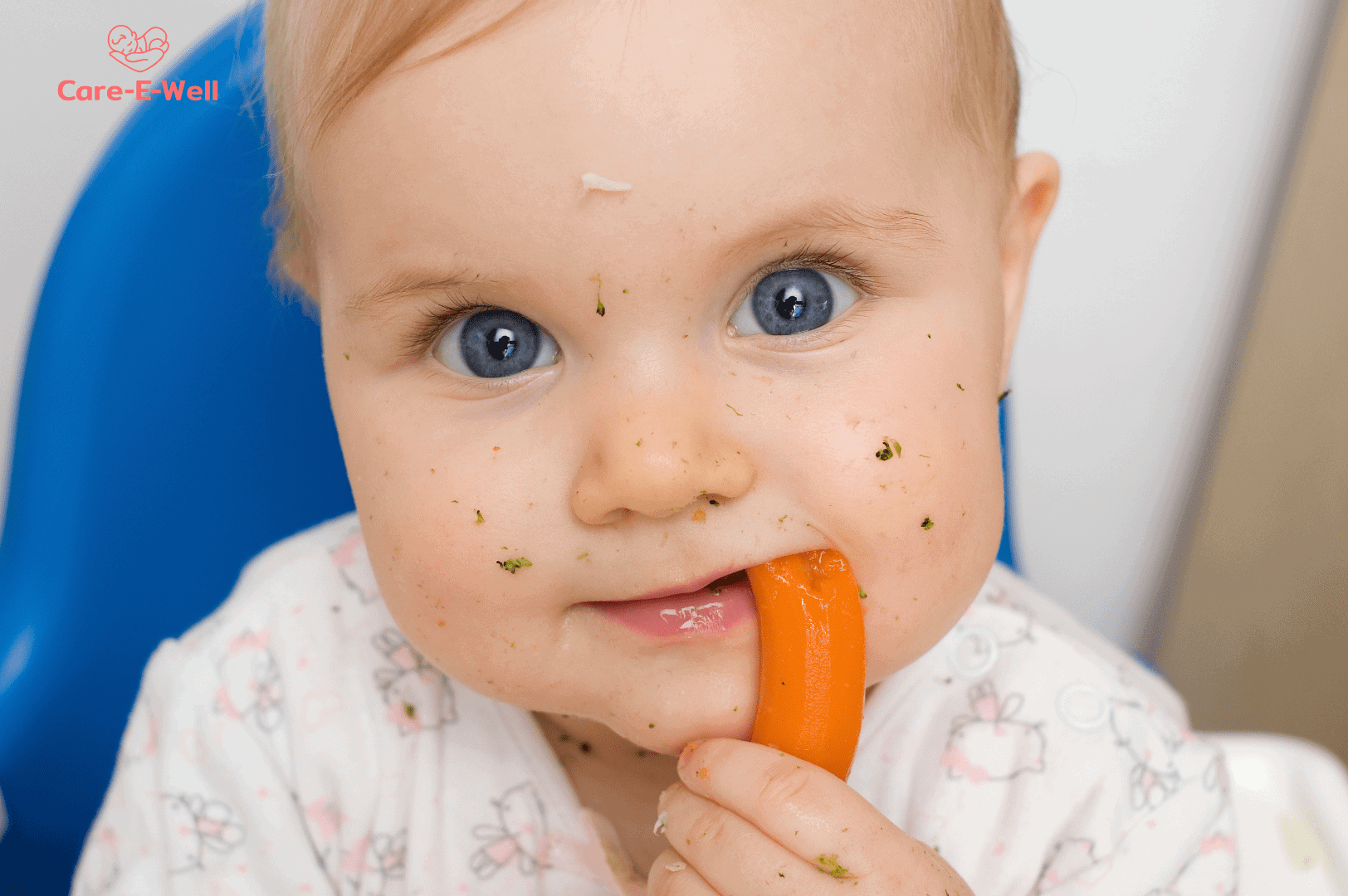
Finger foods for babies can be introduced when a baby is ready for complementary feeding and can sit upright with good head control, reach for food and bring it to the mouth. The safest starting pieces are usually soft enough to squash easily and large enough for a young baby to grasp without the food disappearing completely inside the hand.
There is no single perfect shape or size for every baby. What matters is matching food texture and presentation to the child’s current motor and oral skills, while keeping the baby upright and closely supervised. WHO recommends gradually increasing food consistency and variety as skills develop, and notes that by around eight months most infants can manage some finger foods.
A useful rule is to adapt the food to the baby, not the baby to a feeding method. Soft texture, stable upright posture and active supervision matter more than following a rigid finger-food chart.
What are finger foods for babies?
Finger foods are pieces of food that a baby can pick up and bring to the mouth independently. They can be part of baby-led feeding, spoon feeding or a mixed approach. A baby does not need to follow strict baby-led weaning to benefit from practising self-feeding.
Finger foods can help babies explore textures, hand-to-mouth coordination and self-feeding. Research on complementary feeding shows substantial variation in when babies acquire these skills, so readiness should guide progression rather than a fixed birthday alone (Wright et al., 2011; Correia et al., 2024).
When can babies start finger foods?
Most babies become ready for complementary foods at around six months. Before offering finger foods, look for enough postural stability to sit upright during eating, good head control, the ability to reach and grasp, and coordinated hand-to-mouth movement.
Some babies acquire grasping and self-feeding skills earlier or later than others. EFSA’s assessment of complementary feeding emphasises that developmental skills for different textures emerge over a range of ages and that showing a skill does not automatically mean a baby nutritionally needs complementary food before around six months.
Does a baby need teeth for finger foods?
No. Many suitable first finger foods are soft enough to be broken down with the gums and tongue. Teeth are not the main readiness test; texture, posture, coordination and the ability to manage food in the mouth matter more.

What size should first finger foods be?
In the early stage, many babies use a whole-hand or palmar grasp rather than a neat pincer grip. Longer, graspable pieces can therefore be easier to hold because part of the food remains outside the fist.
As fine-motor control improves and a baby develops a more precise pincer grasp, smaller soft pieces can become practical. This is a progression, not an age deadline. A baby who still struggles to grasp small pieces can continue using larger graspable shapes.
Are finger-sized strips always safest?
No single shape is automatically safe. Shape has to be considered together with hardness, compressibility, slipperiness and the baby’s developmental skill. A soft strip of ripe pear is very different from a hard strip of raw apple.
Foods that are small, hard, round, smooth or difficult to break down are particularly concerning because they can obstruct the airway. Preparation should change the structure of these foods before they are offered.
What texture should finger foods have?
Early finger foods should generally be soft and easy to break apart in the mouth. As a practical check, many suitable foods can be squashed between the fingers with modest pressure. This is not a formal medical test, but it helps parents notice whether a food is much harder than the baby can reasonably manage.
Texture should then progress gradually. Prolonged reliance on smooth purées can limit opportunities to practise more complex oral skills, while moving too quickly to hard or difficult textures can increase feeding difficulty and choking risk. Research supports progressive texture exposure during the first year (da Costa et al., 2017; Coulthard et al., 2009).
Examples of safer first finger-food shapes
- Soft-cooked vegetable batons that are easy to squash, such as carrot, courgette, sweet potato or broccoli stems.
- Ripe soft fruit in graspable pieces, with stones, pips, tough skin and hard cores removed.
- Soft strips or flakes of well-cooked meat or fish, carefully checked for bones.
- Soft omelette strips or well-cooked egg pieces once egg has been introduced safely.
- Soft toast fingers or other bread products chosen with attention to sodium and texture.
- Soft cooked pasta shapes that are large enough to grasp and not hard or rubbery.
The nutritional value of finger foods matters too. Complementary foods should contribute iron, energy, protein and other nutrients rather than consisting mainly of low-nutrient snack products. The BLISS research programme specifically incorporated iron-rich and energy-rich foods while modifying food preparation to reduce choking risk (Cameron et al., 2015).
Foods that need special preparation
Some nutritious foods can become appropriate only after their shape or texture has been changed. Whole grapes, hard raw apple, hard raw carrot, whole nuts and similar foods should not simply be handed to a baby in their original form.
- Cook hard vegetables until soft.
- Soften or cook firm fruit when necessary.
- Change round foods so they are no longer smooth, firm spheres.
- Use nuts only in age-appropriate forms such as a smooth nut paste thinned or spread safely, not whole nuts.
- Remove bones, stones, pits and hard seeds.
- Avoid hard chunks of food that cannot be easily broken down.
Finger foods and choking risk
Choking is different from gagging. Gagging is a protective reflex and may be noisy; true airway obstruction can be quiet and requires immediate action. Parents and caregivers should know infant choking first aid before or soon after solids begin.
A 2024 systematic review found that available evidence does not show that a properly managed baby-led approach necessarily causes more choking than traditional feeding, but choking-risk foods remain a concern across feeding methods (Correia et al., 2024). In the BLISS trial, safety education focused heavily on avoiding high-risk foods and adapting texture (Fangupo et al., 2016).
Never leave a baby alone with food. If a baby cannot breathe, cough effectively or make sound, treat this as choking and begin age-appropriate first aid while arranging emergency help.
How should a baby sit for finger foods?
Feed with the baby upright and well supported rather than reclined. Stable trunk and head control make it easier to coordinate reaching, chewing and swallowing. Avoid feeding finger foods in car seats, bouncers or other reclined equipment that was not intended as an eating position.
Stay close enough to observe the baby’s face and breathing throughout the meal. Active supervision means watching the baby, not merely being in the same room.
What if the baby stuffs too much food into the mouth?
Mouth stuffing can happen while babies learn. Reduce the number of pieces available at once, slow the pace of offering food and allow time to finish one mouthful before more food is presented.
Avoid routinely sweeping a finger blindly inside the mouth, because this can push food farther back. If repeated stuffing, coughing, choking, distress or inability to progress with textures occurs, discuss feeding with a qualified healthcare professional.
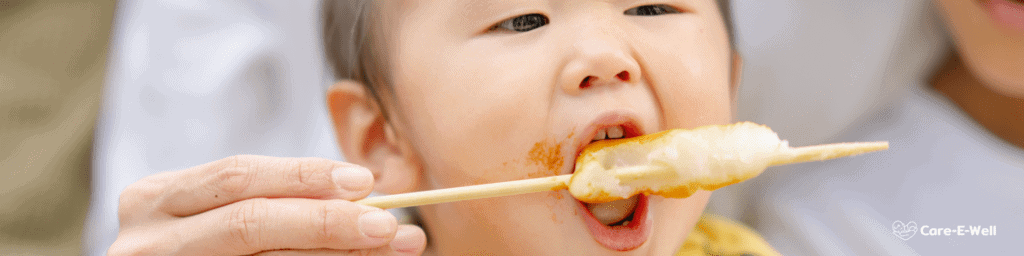
How should finger foods progress?
The progression should follow skill. Early graspable pieces may gradually give way to smaller soft pieces as pincer grasp develops. Textures can become more varied as chewing and tongue movements mature, while remaining appropriate for the baby’s ability.
WHO recommends gradually increasing consistency and variety and practising responsive feeding. That means adults choose safe, nutritious foods and the child is allowed to decide whether and how much to eat, without pressure.
Safe finger feeding is not about eliminating every gag or mess. It is about giving developmentally appropriate food while keeping preventable choking hazards out of reach.
When to seek professional feeding advice
Ask for professional assessment if your baby repeatedly coughs or chokes with meals, seems unable to swallow safely, has persistent wet or gurgly breathing after eating, struggles to gain weight, cannot progress beyond very limited textures, or has a known neurological, structural or swallowing condition.
Babies born very prematurely or with significant developmental or feeding problems may need an individual texture plan rather than standard age-based advice.
Frequently asked questions
Can a six-month-old have finger foods?
Many babies around six months can begin suitable finger foods if they are developmentally ready for complementary feeding and can sit upright with adequate head and trunk control. Readiness varies.
Are purées safer than finger foods?
Purées avoid some hazards associated with hard pieces, but they do not eliminate all feeding risks and should not be the only texture indefinitely. Safe progression to mashed, lumpy and finger foods supports developing eating skills.
Can babies have fruit as finger food?
Yes, when it is ripe or prepared to an appropriately soft texture and shaped to reduce choking risk. Hard raw apple and similarly firm fruit need modification.
What should I do if my baby gags?
Stay calm and observe. Gagging is usually a protective response while learning to manage food. Do not confuse it with choking, which can prevent effective coughing, breathing or sound.
Conclusion
Finger foods for babies should be soft, developmentally appropriate and prepared so that hard, round or difficult pieces do not enter the airway intact. Begin when your baby is ready for complementary feeding, keep them upright and supervised, and let shapes and textures evolve with their skills rather than a rigid age chart.
Sources/References
- World Health Organization. Complementary feeding. https://www.who.int/health-topics/complementary-feeding
- World Health Organization. WHO Guideline for complementary feeding of infants and young children 6–23 months of age. https://www.who.int/publications/i/item/9789240081864
- European Food Safety Authority. Appropriate age range for introduction of complementary feeding into an infant’s diet. DOI: https://doi.org/10.2903/j.efsa.2019.5780
- Correia L, Sousa AR, Capitão C, et al. Complementary feeding approaches and risk of choking: A systematic review. DOI: https://doi.org/10.1002/jpn3.12298
- Cameron SL, Taylor RW, Heath ALM. Development and pilot testing of Baby-Led Introduction to SolidS. DOI: https://doi.org/10.1186/s12887-015-0422-8
- Wright CM, Cameron K, Tsiaka M, Parkinson KN. Is baby-led weaning feasible? DOI: https://doi.org/10.1111/j.1740-8709.2010.00274.x
- Fangupo LJ, Heath ALM, Williams SM, et al. A Baby-Led Approach to Eating Solids and Risk of Choking. DOI: https://doi.org/10.1542/peds.2016-0772
- da Costa SP, Remijn L, Weenen H, et al. Exposure to texture of foods for 8-month-old infants: Does the size of the pieces matter? DOI: https://doi.org/10.1111/jtxs.12271
- Coulthard H, Harris G, Emmett P. Delayed introduction of lumpy foods affects food acceptance and feeding at 7 years. DOI: https://doi.org/10.1111/j.1740-8709.2008.00153.x
- Boswell N. Complementary Feeding Methods—A Review of the Benefits and Risks. DOI: https://doi.org/10.3390/ijerph18137165
Did this Insight help?
A little love for something worth reading.


