
Care-E-Well Insights
How Food Texture Should Progress During the First Year
Learn how baby food texture can progress from purées and mash to soft lumps, finger foods and family foods during the first year.
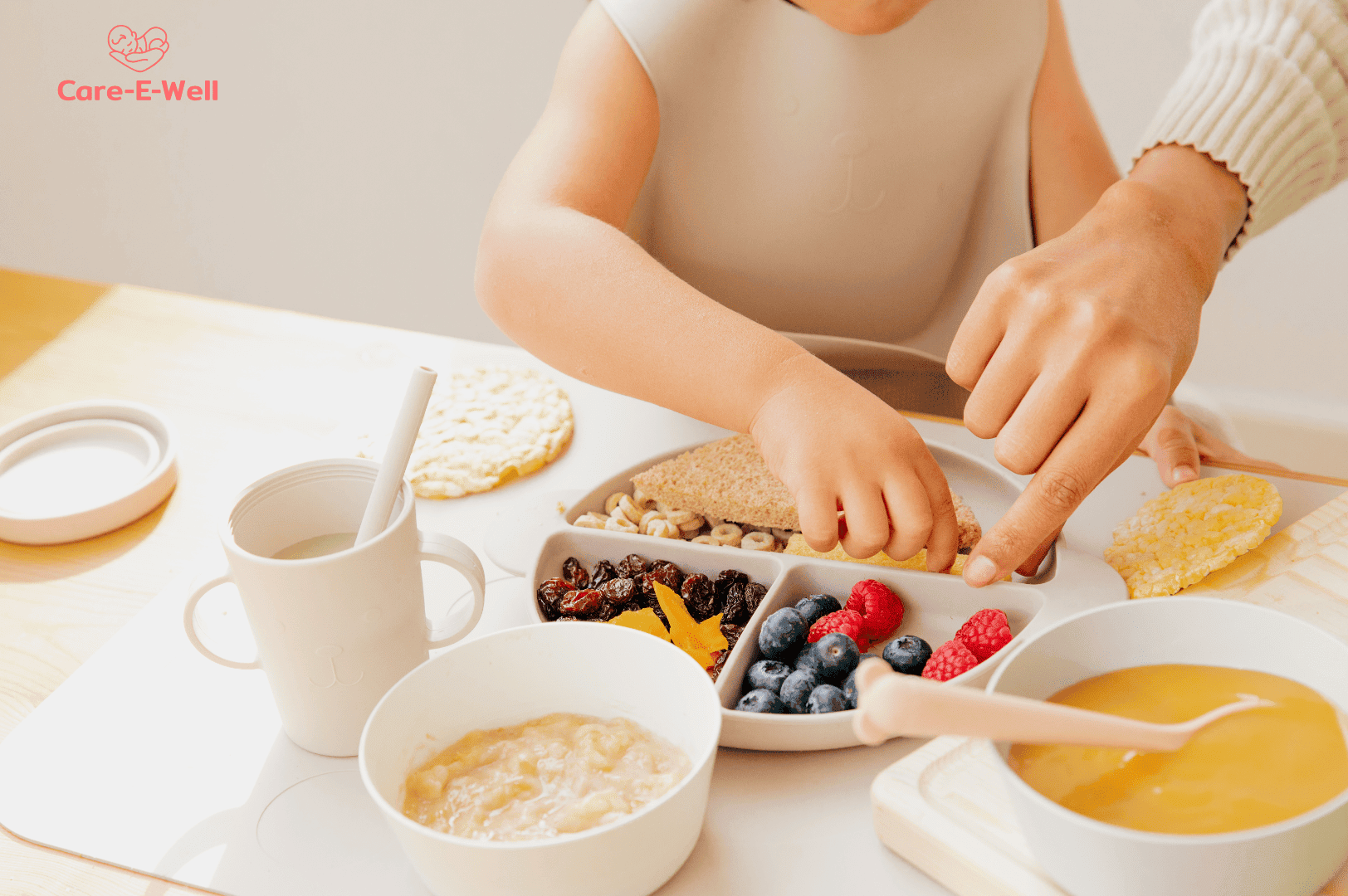
Food texture should progress gradually as a baby develops the skills to manage thicker, lumpier and more complex foods. Most babies do not need to remain on smooth purées for months. WHO advises beginning complementary feeding around 6 months, increasing consistency and variety with age, with many babies managing finger foods by around 8 months and family foods with appropriate modification by around 12 months.
These ages are guides, not deadlines. A baby’s head and trunk stability, hand-to-mouth coordination, oral-motor skills, medical history and experience with food all influence what they can manage safely.
Texture progression is a learning process, not a race. Offer the next manageable challenge before the current texture becomes the only texture your baby accepts.
Why does texture progression matter?
Eating is a developmental skill. Babies learn to move food around the mouth, use the tongue more efficiently, develop chewing movements and coordinate swallowing through both maturation and experience.
Research suggests that prolonged delay in introducing lumpy foods is associated with more feeding difficulties later in childhood. This does not prove that texture timing alone causes later problems, but it supports giving babies opportunities to practise developmentally appropriate textures during the first year.
Texture progression also expands dietary variety and makes it easier for babies to join family meals over time.
What textures can babies start with around 6 months?
WHO states that puréed, mashed and semi-solid foods can be offered from around 6 months. A baby does not have to start with perfectly smooth purée, and a family does not need to choose between purées and finger foods as mutually exclusive methods.
Early textures might include smooth thick purées, soft mash with small soft variations, thick porridge, mashed vegetables, mashed pulses, soft yoghurt-like textures and very soft graspable foods for a baby ready to self-feed.
Foods should not be thin and watery simply because they are first foods. Nutrient-dense complementary foods need enough substance to contribute nutrition while milk feeding continues.
When should food become thicker?
As the baby comfortably manages early foods, increase thickness. A thicker mash requires more tongue and jaw control than a thin purée and can be a useful next step.
There is no need to wait for teeth. Babies can manage many soft foods using gums and developing chewing movements.
Watch what your baby actually does: whether they can maintain an upright position, move food around the mouth, recover from occasional gagging and swallow without repeated coughing or distress.

When should babies try lumpy foods?
Evidence from cohort studies and feeding-development research suggests there may be a useful window during the later part of infancy for learning lumpier textures. Children introduced to lumpy foods after about 9–10 months have shown more feeding difficulties in later studies than children who encountered them earlier.
This does not mean every baby must eat the same lumps on a particular date. It does mean there is little reason to keep a typically developing baby on exclusively smooth purées once they are comfortably managing solids.
Progress from smooth to mashed, then to soft small lumps and chopped soft foods in ways that suit the baby’s skills.
What about finger foods?
WHO notes that by around 8 months most infants can also eat finger foods. Some babies are ready earlier and some later.
Early finger foods should be soft, easy to grasp and prepared to reduce choking risk. The baby should be able to sit upright with good stability and bring food to the mouth with control.
A practical softness check is whether the food squashes easily between your fingers. Examples include soft cooked vegetable sticks, ripe soft fruit, tender strips of omelette and other foods adapted for safe self-feeding.
How should texture progress from 9 to 12 months?
During this period many babies become more efficient at chewing, moving food laterally with the tongue, biting pieces and using a more precise finger grasp.
Meals can therefore progress toward chopped soft family foods, more varied mixed textures and smaller pieces when the baby can manage them. The baby may increasingly use hands, a preloaded spoon and an open or straw cup with support.
Continue to modify hard, round and choking-risk foods. Greater skill does not make whole nuts, whole grapes or hard raw carrot automatically safe.
What should meals look like by around 12 months?
WHO states that by 12 months most children can eat the same types of foods as the rest of the family, provided foods are nutrient-dense and prepared safely.
“Family food” does not mean an adult plate served unchanged. Texture, salt content, choking hazards and portion size still need adaptation.
A one-year-old may eat soft family casseroles, tender vegetables, pasta, rice, shredded meats, pulses, egg, soft fruit and other mixed meals with modifications for chewing and safety.
Is gagging part of texture learning?
Gagging can occur while babies learn to manage more complex textures. It is a protective reflex and is different from choking.
Occasional gagging does not automatically mean the texture is inappropriate. Watch whether the baby is breathing, coughing effectively and recovering.
Repeated severe gagging, frequent coughing with swallowing or recurrent choking is different and should prompt professional assessment.
Should you skip purées completely?
There is no evidence that every family must avoid purées. Smooth textures can be practical and nutritious, and many babies enjoy foods such as yoghurt, porridge and soup throughout childhood.
The concern is not purée itself; it is prolonged exclusive reliance on one smooth texture when the baby is developmentally ready to practise more complex textures.
Families can combine spoon feeding, self-feeding, mashed foods and finger foods without undermining development.
What if your baby refuses lumps?
Slow the progression without abandoning it completely. Make the step smaller: move from smooth purée to a thicker mash, then add very soft small lumps rather than jumping directly to a difficult mixed texture.
Offer repeated low-pressure exposure. Babies may need multiple encounters with a new texture before it feels familiar.
Avoid forcing the spoon into the mouth or tricking a baby into swallowing lumps. Feeding should remain responsive.
What if your baby has no teeth?
Teeth are not the main marker of readiness for texture progression. Babies use the tongue, gums and jaw movements to manage many soft foods.
Reserve hard foods for later skills even if teeth have erupted. The presence of teeth does not guarantee mature chewing or choking protection.

How do premature babies fit into the texture timeline?
Premature infants can have different developmental trajectories, and some have higher rates of oral-motor or feeding difficulties. Corrected age, medical history, respiratory status and previous tube feeding can all matter.
Research specifically in preterm infants supports individualized assessment rather than forcing them into a term-baby texture schedule.
If your baby was very premature or has ongoing developmental or swallowing concerns, ask the clinical team how to progress textures safely.
When should parents seek feeding or swallowing assessment?
Seek professional assessment if your baby repeatedly coughs or chokes during eating, has wet or gurgly breathing after swallowing, turns blue or has breathing difficulty with feeds, cannot progress beyond a narrow texture range, has very prolonged meals, loses previously acquired feeding skills, or has poor growth.
Strong distress with nearly every textured food, persistent food pocketing or repeated vomiting with texture changes also deserves discussion with a paediatrician or feeding specialist.
Early assessment can distinguish ordinary learning from oral-motor, sensory, anatomical or swallowing problems.
A simple texture progression framework
- Begin with developmentally manageable complementary foods around 6 months: puréed, mashed, semi-solid and soft options.
- Increase thickness as swallowing becomes comfortable.
- Add soft lumps and mixed textures rather than staying exclusively smooth.
- Introduce soft finger foods when sitting and hand-to-mouth skills support self-feeding.
- Progress toward chopped soft family foods through the later first year.
- Keep modifying choking hazards even as texture skills improve.
This framework is deliberately flexible. Developmental readiness and safe swallowing always matter more than meeting a calendar milestone.
The key takeaway
Food texture should progress from manageable early complementary foods toward thicker mash, soft lumps, finger foods and modified family foods during the first year. Avoid both extremes: there is no need to rush a baby who is struggling, but there is also little benefit in keeping a typically developing baby exclusively on smooth purées long after they can manage more.
Frequently asked questions
Do babies need purées before finger foods?
Not necessarily. Babies can use spoon-fed and self-fed textures in parallel if they are developmentally ready and foods are prepared safely.
By what age should a baby eat lumps?
There is no single deadline, but evidence suggests avoiding prolonged delay beyond roughly 9–10 months in typically developing babies.
Can babies chew without molars?
Yes. Babies can manage many soft foods using gums and developing jaw movements before molars appear.
Is gagging a reason to go back to smooth purées?
Not automatically. Occasional gagging can be part of learning. Recurrent choking, coughing or significant distress needs assessment.
Sources/References
- World Health Organization — Complementary feeding
- World Health Organization — WHO Guideline for complementary feeding of infants and young children 6–23 months of age
- European Food Safety Authority — Appropriate age range for introduction of complementary feeding into an infant’s diet
- Correia L et al. — Complementary feeding approaches and risk of choking: A systematic review
- da Costa SP et al. — Exposure to texture of foods for 8-month-old infants: Does the size of the pieces matter?
- Coulthard H et al. — Delayed introduction of lumpy foods to children during the complementary feeding period affects child's food acceptance and feeding at 7 years
- Hollis JL et al. — Age at introduction of solid foods and feeding difficulties in childhood
- Sdravou K et al. — Developmental Feeding Stages and Their Impact on Child Feeding Behavior
- Liotto N et al. — Complementary Feeding in Preterm Infants: A Systematic Review
- Guimarães HNCL et al. — Comparison of the introduction of consistencies in complementary feeding between preterm and full-term newborns
Did this Insight help?
A little love for something worth reading.


