
Care-E-Well Insights
How to Handle Public Toilets During Potty Training
Learn how to handle public toilets during potty training, including loud flushes, large seats, toilet fear, accidents and poop withholding.
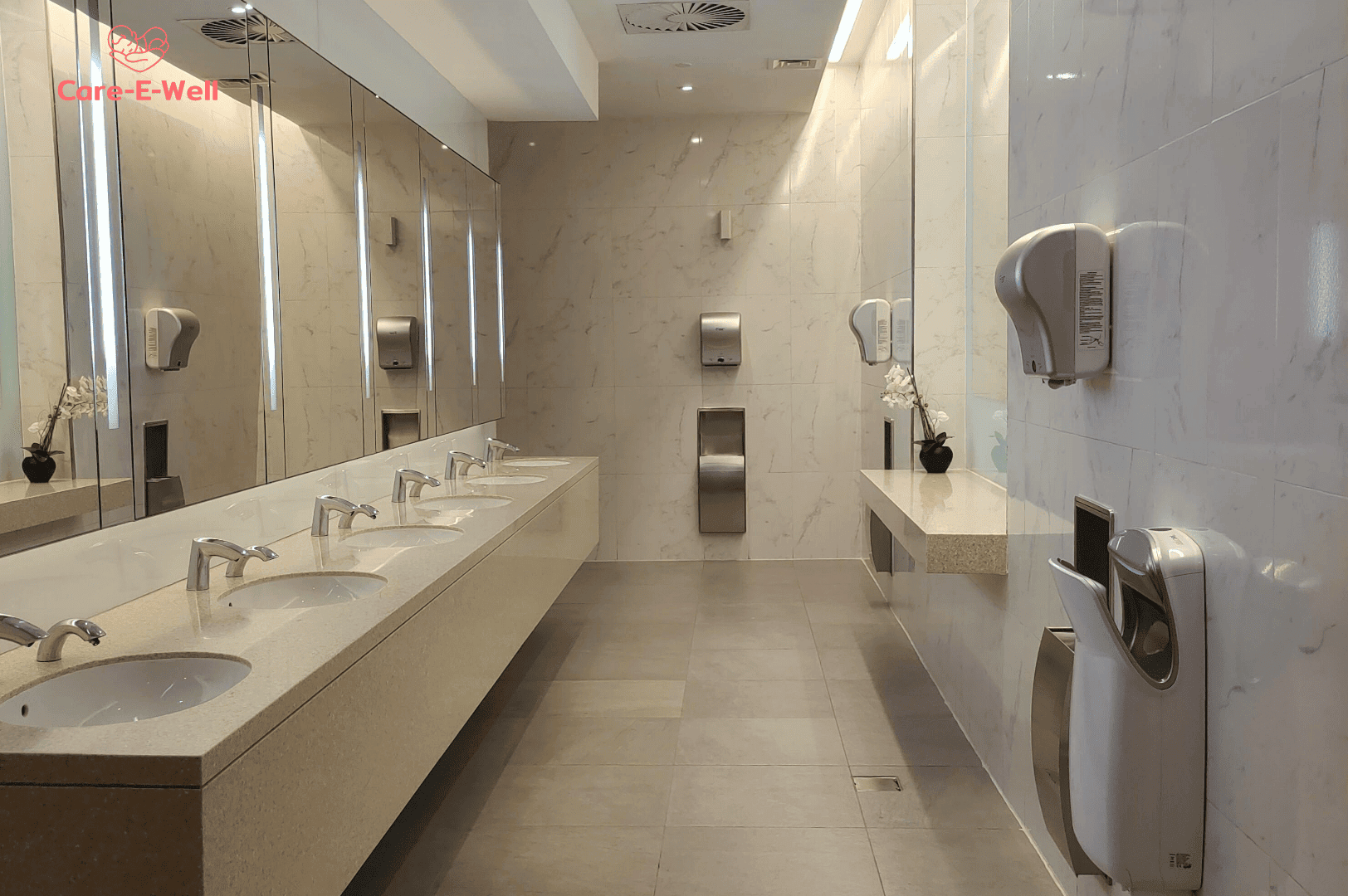
Learning how to handle public toilets during potty training is mostly about helping a child transfer a familiar skill into an unfamiliar bathroom. A toddler who happily uses the toilet at home may freeze in a public restroom because the seat feels huge, the flush is loud, the room echoes or the child does not feel secure.
Do not treat that hesitation as stubbornness. Prepare the child before you go in, make the physical setup stable, keep the first attempts brief and respond calmly if they choose not to use the toilet. The bigger concern is repeated withholding—especially poop—because avoiding unfamiliar toilets can contribute to constipation and make future toilet use harder.
Public-toilet confidence is a generalisation skill. The child may know how to use a toilet and still need time to feel safe using a different one.
Why can public toilets be difficult during potty training?
Home bathrooms are predictable. The child knows the seat, the sounds, the lighting and where you stand. Public toilets can change all of those cues at once.
- the adult toilet seat feels too large
- feet dangle without support
- automatic flushing happens unexpectedly
- hand dryers are very loud
- several toilets flush at once
- the room echoes
- other people are nearby
- the child worries about falling in
- the toilet looks or smells unfamiliar
- privacy is different from home
Research on children with toileting difficulties supports the idea that sensory and environmental features can matter. Studies of toilet avoidance in older children also identify cleanliness, privacy and bathroom conditions as reasons for withholding, although those findings cannot simply be assumed to apply identically to every toddler.
Prepare before you enter the bathroom
A short explanation can prevent surprise. Tell the child what will be different: “This toilet is bigger than ours. I will help you sit. It might flush loudly after you get off.”
If the child is worried about a specific feature, name it without building fear. Avoid saying that public toilets are scary, dirty or dangerous. You want to make the environment predictable, not confirm that there is something to fear.
For a child who has never used a public restroom, the first successful step may simply be entering, washing hands and leaving calmly.
Make a large toilet feel physically secure
Stability matters. A child who feels as though they could fall into the bowl may tense the pelvic floor, cling to the adult or refuse to sit.
A portable seat reducer can help if your child relies on one at home. If you do not have one, support the child securely according to their size and the toilet design.
For bowel movements, foot support can help the child adopt a more stable toileting position. In public bathrooms, a footstool is rarely available, so a toddler may need more physical support than at home.
Never force a frightened child to remain seated while they are struggling to get down.

What should you do about automatic flushing?
Automatic flushes can be startling because the child cannot predict when the noise will happen. If the sensor activates while the child is still sitting, fear can become linked with the toilet itself.
Where possible, position yourself so you understand where the sensor is and explain what may happen. Some parents temporarily cover a sensor when the design allows it without damaging the fixture, then uncover it after the child stands up.
If the toilet flushes unexpectedly, keep your reaction calm: “That was loud. You’re safe. The toilet flushed.”
Do not repeatedly activate the flush to make the child “get used to it” while they are distressed. Gradual exposure works better when the child feels in control.
What about loud hand dryers?
Some toddlers dislike powerful hand dryers. If your child reacts strongly, wash hands normally and use paper towels when available. If only a hand dryer is available, you can prepare the child before turning it on and keep some distance if the layout permits.
The goal is still appropriate hand hygiene. You do not need to make tolerating the loudest dryer part of toilet training.
Should you carry a portable potty instead?
A portable potty can be a useful bridge for a recently trained child, especially during car journeys, outdoor trips or when the child refuses adult toilets.
It is not a requirement, and relying on it forever can make generalisation slower for some children. Think of it as temporary equipment while you also give the child low-pressure opportunities to become familiar with ordinary toilets.
Use the portable potty only in safe, private and appropriate places, and plan how you will dispose of waste and clean the equipment hygienically.
Do not wait until the child is desperate
A toddler who is already urgently holding urine has less capacity to investigate a strange bathroom calmly. Offer the toilet at sensible transitions—before leaving a venue, after arriving somewhere, before a long journey segment or when the child shows familiar body signals.
Avoid constant prompting. The purpose is to create opportunities before urgency becomes overwhelming, not to spend the outing asking about pee every few minutes.
What if the child says no to the public toilet?
First decide how urgent the situation is. If the child does not need to go immediately, you can step back and try later. Let them look at the bathroom, watch you check the seat or practise sitting briefly with clothes on if that helps.
If the child genuinely needs to urinate but is frightened, simplify the demand. Offer physical support, a reducer or another available toilet. A portable potty may be useful if you have one and can use it appropriately.
Avoid threats such as “If you don’t go now, you’ll have an accident and everyone will see.” Shame can make the bathroom more emotionally charged.
Public-toilet fear and poop withholding
Refusing to poop in public deserves special attention. Research in young children with constipation and retentive fecal incontinence identifies avoidance of toilets outside the home, painful defecation and toilet fear as behaviours that can contribute to withholding.
Once a child holds stool, the stool can become harder and more painful to pass. Pain then gives the child another reason to hold, creating a self-reinforcing cycle.
If your child will urinate in public but waits to poop until home, that can be manageable if bowel movements remain soft, comfortable and regular. The concern rises when the child repeatedly suppresses the urge for long periods, develops hard stools or begins soiling.
Seek healthcare advice for persistent hard or painful stools, repeated withholding, fecal soiling, blood in the stool, significant abdominal swelling, vomiting, severe pain, poor growth or a child who appears unwell.
Use gradual practice for a child who is very hesitant
If public bathrooms have become a recurring problem, practise outside moments of urgency.
- Enter a quiet public bathroom with no expectation to use it.
- Let the child look around and identify the toilet, sink and dryer.
- Explain which sounds might happen.
- On another visit, invite a brief sit if the child is willing.
- Use a familiar seat reducer if needed.
- Keep the child physically supported and stable.
- Praise communication and trying rather than demanding elimination.
- Leave before distress escalates.
- Repeat in different bathrooms gradually.
- Reduce extra supports as confidence grows.
The pace can be slow. The purpose is to build familiarity and flexibility, not to prove bravery.
What if the child has an accident in public?
Keep the response practical. Find a suitable place to change, help the child get clean and continue the outing.
Carry spare underwear, trousers, socks and a sealable bag for wet clothing during the early months of training. Preparation allows you to respond neutrally rather than turning an accident into a crisis.
An accident in a new setting does not mean the child should automatically return to diapers everywhere. Review what happened: Was the toilet too far away? Did the child refuse because of noise? Was the adult prompt too late?
Hygiene without creating toilet anxiety
Teach ordinary handwashing after toilet use. Help the child avoid touching visibly soiled surfaces when practical and supervise according to age.
Avoid language suggesting that public toilets are full of dangerous germs or that touching anything is catastrophic. Strong contamination messages can make an already hesitant child more reluctant to use bathrooms away from home.
Calm, routine hygiene is enough for normal outings.

What can research on school toilets tell us?
A 2026 study of children aged 8 to 16 found that toilet avoidance and stool withholding at school were linked with concerns including cleanliness, privacy and facility conditions. This is useful evidence that bathroom environments can influence toilet behaviour.
However, those children were much older than toddlers in potty training. The study should not be used to claim a specific rate of public-toilet avoidance in preschoolers. It supports a broader point: the environment can matter, and a child’s reluctance deserves investigation rather than ridicule.
When public-toilet refusal needs more help
Occasional refusal is common during generalisation. Seek more support when the problem is persistent enough to restrict normal activities, when the child will only eliminate at home, or when avoidance is leading to withholding, constipation or repeated accidents.
A healthcare professional can assess bowel and urinary symptoms. When sensory or developmental factors are prominent, additional professional support may also be useful.
Seek healthcare advice for public-toilet refusal accompanied by persistent constipation, painful urination, recurrent urinary infections, marked urgency or frequency, fecal soiling, excessive thirst, unexplained weight loss or a significant loss of established continence.
A public-toilet plan to remember
- prepare the child for unfamiliar sounds and equipment
- offer the toilet before urgency becomes extreme
- provide a stable seat setup
- bring a reducer or portable potty if it helps
- keep automatic flushes predictable when possible
- use a quieter drying option if available
- never force a distressed child to remain seated
- keep accidents neutral
- watch carefully for poop withholding
- practise unfamiliar bathrooms gradually
Confidence usually grows through repeated ordinary experiences. The public toilet does not need to become a major training event every time you leave home.
Frequently asked questions
Why is my potty-trained child afraid of public toilets?
The equipment and sensory environment may be unfamiliar. A large seat, unexpected flush, loud dryer, echoing room or reduced privacy can make a child who toilets confidently at home hesitate elsewhere.
Should I cover an automatic flush sensor?
If the design allows you to do so safely and without damaging the fixture, temporarily blocking the sensor until the child stands may reduce surprise. Always restore normal operation afterward.
Is it okay to use a portable potty in public?
It can be useful when used in an appropriate, safe and private place. Plan waste disposal and cleaning, and continue gradual exposure to ordinary toilets as the child becomes more confident.
What if my child only poops at home?
If stools stay soft, painless and regular, this may be a preference you can work on gradually. Repeated withholding, hard stools, pain or soiling needs more attention because constipation can reinforce the refusal.
Should I reward my child for using a public toilet?
Encouragement can help, but focus on controllable steps such as entering, communicating fear, sitting briefly or trying. Avoid making a bowel movement a high-stakes performance.
The key takeaway
Learning how to handle public toilets during potty training means making an unfamiliar environment feel predictable, stable and low-pressure. Prepare for noise and automatic features, support the child physically, carry familiar equipment when useful and practise gradually. Most importantly, watch for stool withholding: a public-toilet preference becomes a health issue when fear or avoidance starts creating constipation, pain or persistent accidents.
Sources and References
- Beaudry-Bellefeuille I, Lane SJ, Ramos-Polo E — The Toileting Habit Profile Questionnaire: Screening for sensory-based toileting difficulties in young children with constipation and retentive fecal incontinence
- Beaudry-Bellefeuille I, Lane SJ — Examining Sensory Overresponsiveness in Preschool Children With Retentive Fecal Incontinence
- van Streun SP, ter Schure AC, Rook M, et al. — Stool Withholding at School Among Children in the Netherlands
- Taubman B, Blum NJ, Nemeth NM — Children Who Hide While Defecating Before They Have Completed Toilet Training
- Blum NJ, Taubman B, Osborne ML — Behavioral Characteristics of Children With Stool Toileting Refusal
- Walter A, Hovenkamp A, Devanarayana NM, et al. — Functional constipation in infancy and early childhood: epidemiology, risk factors, and healthcare consultation
- Rajindrajith S, Devanarayana NM, Benninga MA — Childhood constipation: Current status, challenges, and future perspectives
- Kiddoo D — Toilet training children: when to start and how to train
- Brazelton TB — A Child-Oriented Approach to Toilet Training
- Tabbers MM, DiLorenzo C, Berger MY, et al. — Evaluation and treatment of functional constipation in infants and children: evidence-based recommendations from ESPGHAN and NASPGHAN
Did this Insight help?
A little love for something worth reading.


