
Care-E-Well Insights
Handling a Premature or Very Small Newborn
Learn gentle, evidence-based ways to handle a premature or very small newborn, including lifting, skin-to-skin care and stress cues.
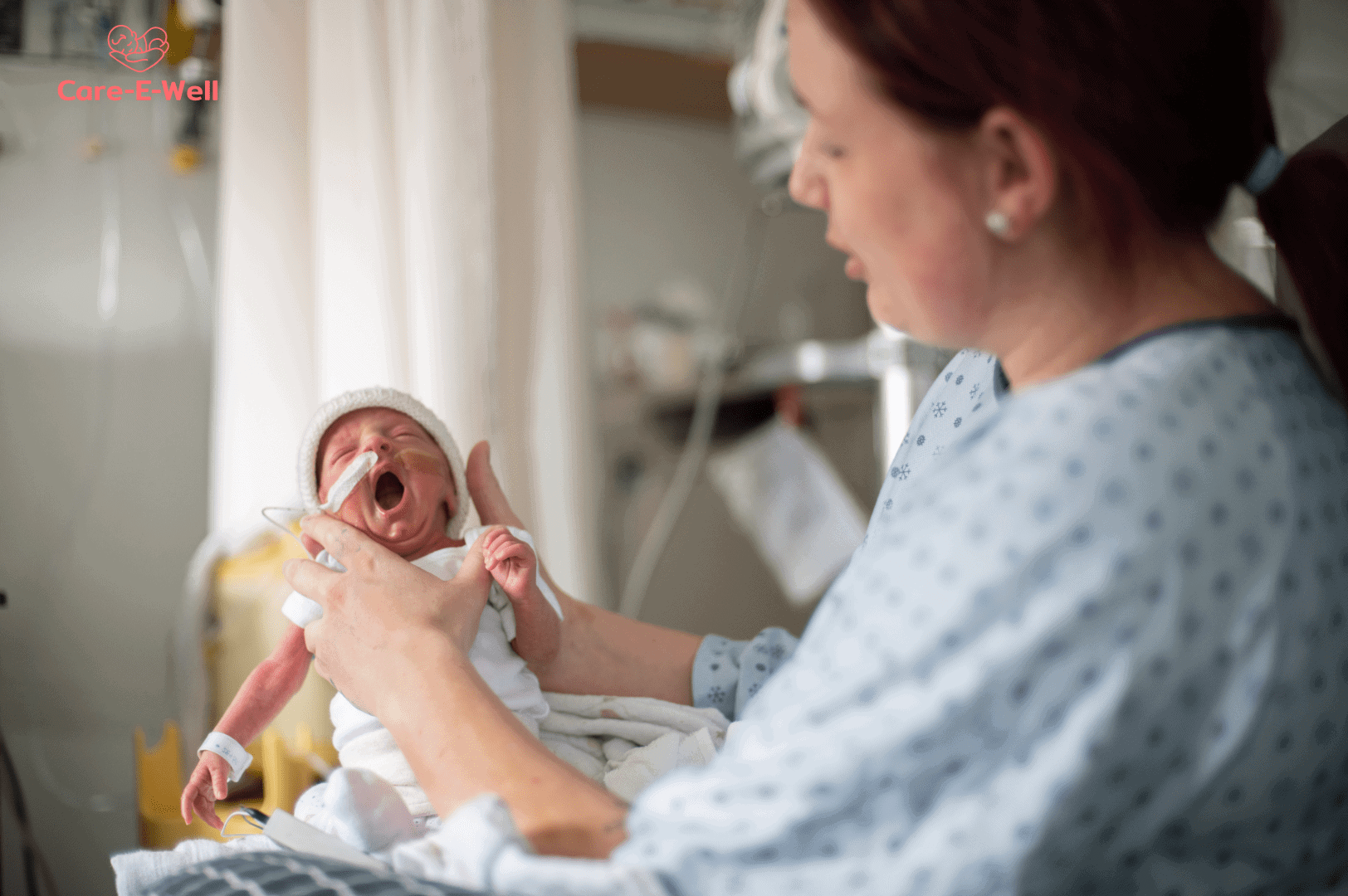
Handling a premature or very small newborn can feel intimidating because the baby may seem fragile, sleepy and less able to organise their movements than a full-term newborn. Gentle touch and close contact are valuable, but the safest approach depends on gestational age, current medical stability and what the neonatal team has advised.
Premature babies are not simply smaller full-term babies. Their respiratory control, temperature regulation, muscle tone, feeding coordination and ability to cope with stimulation may still be developing. Handling therefore works best when it is slow, supportive and responsive to the baby’s cues.
A premature baby usually benefits from closeness, not avoidance of touch. The key is to match handling to the baby’s medical stability and tolerance.
Why does handling a premature newborn need extra care?
Preterm infants can have less flexor tone, less organised movement and more difficulty maintaining physiological stability than term babies. In intensive care, research shows that medical handling and environmental stress can increase episodes of physiological instability in extremely preterm infants.
That does not mean parents should be afraid to touch their baby. Developmental care aims to reduce unnecessary stress while supporting parent involvement, comfortable positioning, sleep and skin-to-skin contact when medically appropriate.
Start with the neonatal team’s individual guidance
The baby’s gestational age alone cannot tell you what handling is safe today. A stable late-preterm baby at home has different needs from an extremely preterm infant receiving respiratory support in the NICU.
Ask the neonatal team how your baby should be lifted, positioned, transferred and held. If the baby has oxygen, a feeding tube, monitoring leads, a central line or other equipment, learn where your hands can go and who should assist with transfers.

How should you touch a very small baby?
Many premature infants tolerate still, contained touch better than light stroking. Rather than repeatedly brushing the skin, place a warm hand gently but firmly over the shoulders or trunk and another around the feet or pelvis if the clinical team recommends it.
Watch the baby rather than the clock. Stress cues can include colour change, hiccups, finger splaying, repeated yawning, frantic extension, desaturation, altered breathing, gaze aversion or escalating fussiness. Some cues are subtle, and your neonatal team can help you recognise your own baby’s pattern.
How do you pick up a premature newborn?
Move slowly and keep the head, shoulders and trunk aligned. Slide your hands underneath before lifting rather than pulling on the arms. Bring the baby close to your body as soon as possible so your chest helps provide a stable boundary.
- Prepare the destination before you lift.
- Support the head, neck and upper trunk with one hand or forearm.
- Support the pelvis and lower trunk with the other.
- Lift smoothly, keeping the baby close to the surface at first.
- Bring the baby against your chest before turning or walking.
- Check that the face remains visible and the airway is not flexed or compressed.
In hospital, ask for a nurse’s help until you feel confident managing any tubes or leads.
What is a supportive resting posture?
Premature infants often need help maintaining flexion and midline orientation because gravity can pull the shoulders and hips outward. In neonatal care, developmental positioning may use boundaries or nesting under professional supervision.
At home, sleep guidance is different. Once a medically stable infant is discharged for ordinary home sleep, use the safe sleep plan provided by the baby’s healthcare team. Do not recreate NICU nests, rolls or prone sleep arrangements unless a clinician has given a specific medical plan.
NICU therapeutic positioning should not automatically be copied into an unattended home sleep environment. Hospital monitoring and medical indications are different from home conditions.
What is the role of skin-to-skin contact?
Kangaroo mother care and skin-to-skin contact have strong evidence for preterm and low-birth-weight infants. WHO recommends kangaroo mother care as part of care for preterm or low-birth-weight babies, with implementation adapted to clinical stability and local protocols.
Skin-to-skin contact can support thermal regulation, breastfeeding, parent-infant connection and physiological stability. Meta-analyses also report benefits for survival and other outcomes in preterm or low-birth-weight infants.
Position still matters. Keep the baby’s head turned to the side, neck in a neutral or slightly extended position, face visible and airway clear. Staff should help you position a very small or medically supported baby.
Is ordinary babywearing the same as kangaroo mother care?
No. Kangaroo mother care has a specific clinical evidence base and typically centres on prolonged skin-to-skin contact plus feeding and follow-up components. Ordinary babywearing in a clothed commercial carrier is not automatically equivalent.
If your baby was premature, has low muscle tone, respiratory vulnerability or is below the carrier manufacturer’s minimum size, ask the neonatal or paediatric team before using a carrier. Meeting a product’s minimum weight is not the same as medical readiness.
How much stimulation is enough?
Premature babies benefit from interaction, but more is not always better. Try short periods of talking, eye contact, contained touch and holding, then allow recovery and sleep. Cluster care where practical so the baby is not repeatedly disturbed for separate tasks.
Follow the baby’s state. An alert, stable baby may tolerate more interaction than a sleepy baby just after feeding or a baby recovering from a hospital procedure.
What about feeding and handling?
Preterm infants can have immature suck-swallow-breathe coordination. Feeding positions and pacing may therefore need to be individualised. If your baby coughs, chokes, changes colour, has repeated desaturations, tires markedly or takes very long feeds, discuss this with the neonatal or feeding team.
After feeding, hold the baby in the position recommended by the clinical team. Avoid assuming that every premature baby needs prolonged upright holding or reflux treatment.

How can parents become more confident?
Repetition helps. Ask staff to demonstrate a transfer, then perform it yourself with supervision. Learn the baby’s signs of stability and stress rather than relying only on generic rules.
- Prepare diapers, clothes and feeding supplies before handling.
- Keep the environment calm and warm.
- Use two-handed support for transfers until the baby shows stronger control.
- Pause when the baby shows stress cues.
- Protect sleep between care periods.
- Ask for help with equipment instead of improvising around tubes or lines.
Confidence grows from reading your baby’s cues and practising safe routines—not from trying to make a premature baby behave like a full-term newborn.
When should handling concerns be discussed urgently?
Seek prompt medical help for breathing difficulty, blue or markedly pale colour, repeated apnea, significant temperature instability, unusual lethargy, sudden floppiness or rigidity, repeated choking, poor feeding with dehydration concerns, or a clear deterioration from your baby’s usual state.
Premature infants may have individual discharge instructions about oxygen saturation, feeding volumes, temperature or follow-up. Those personalised instructions take priority over general online guidance.
Frequently asked questions
Are premature babies too fragile to be held often?
Usually no. Parent contact, including skin-to-skin care, is an important part of modern neonatal care when the baby is medically stable enough. The neonatal team should help decide timing and positioning.
Should I move a premature baby as little as possible?
Avoid unnecessary repeated disturbance, but do not avoid normal responsive care. Gentle transfers, feeding, skin-to-skin contact and age-appropriate interaction are all part of development.
Can I use a baby carrier after NICU discharge?
Possibly, but medical readiness, airway control, tone and product fit matter. Ask the baby’s healthcare team if your infant remains very small, has respiratory problems or has not reached the product’s developmental requirements.
Should I correct a premature baby’s arms and legs into a certain position?
Do not force joints or hold the body rigidly. Support comfortable flexion and midline movement as advised by the neonatal team, and allow spontaneous movement.
Key takeaway
Handling a premature or very small newborn should be gentle, close and individualised. Support the head and trunk, move slowly, protect the airway, watch for stress cues and use skin-to-skin contact when the neonatal team says it is appropriate. Medical stability and the baby’s own response should guide how much handling they can comfortably manage.
Sources/References
- World Health Organization — WHO recommendations for care of the preterm or low-birth-weight infant
- World Health Organization — Kangaroo mother care: a clinical practice guide
- Sivanandan S, Sankar MJ — Kangaroo mother care for preterm or low birth weight infants: a systematic review and meta-analysis
- Cristóbal Cañadas D, Bonillo Perales A, Galera Martínez R, et al. — Effects of Kangaroo Mother Care in the NICU on Physiological Stress Parameters: A Meta-Analysis of RCTs
- Mueller SM, Ackermann B, Martin S, et al. — Incidence of Intermittent Hypoxemia Increases during Clinical Care and Parental Touch in Extremely Preterm Infants
- Franck LS, O’Brien K — The evolution of family-centered care: From supporting parent-delivered interventions to family integrated care
- Reynolds-Miller RL, Bedwell S, Laubach LL — What Is the Experience of Babywearing a NICU Graduate?
- Shrestha T, Bista AP, Shrestha S, et al. — Preterm Infant Care Practice among Nurses in Neonatal Care Units
- Madlinger-Lewis L, Reynolds L, Zarem C, et al. — The effects of alternative positioning on preterm infants in the neonatal intensive care unit
Did this Insight help?
A little love for something worth reading.


