
Care-E-Well Insights
Hidden Choking Hazards Around the Home
Find hidden choking hazards around the home, from coins and toy parts to balloons, and learn practical ways to keep them out of reach.

Hidden choking hazards around the home are often ordinary objects that adults barely notice: a coin under the sofa, a loose toy wheel, a pen cap, a broken balloon or a bead dropped by an older child. Young children are especially vulnerable because they explore with their mouths, have narrower airways and are still developing chewing, swallowing and hazard awareness.
The most useful prevention strategy is to control the child’s environment rather than trying to predict every object they might pick up. Regular floor-level checks, age-appropriate toys, prompt removal of broken parts and clear rules for older siblings can reduce access to small objects before they reach a baby’s mouth.
The safest small object is one a baby or toddler cannot reach. Think beyond the toy box: floors, bags, sofas, craft tables and older siblings’ belongings all deserve a quick check.
Why are young children at higher risk of choking?
Choking happens when an object blocks the airway. Children younger than about three years feature prominently in the pediatric choking literature because their airway diameter is small, their chewing is less mature and mouthing is a normal part of exploration. A small object that an adult would never consider food may therefore go straight into a toddler’s mouth.
Shape and material matter as well as size. Round or smooth objects can seal an airway, while soft flexible material may mould to the airway. Balloons and balloon fragments are a particular example: despite being lightweight, they have been associated with fatal choking because flexible material can be difficult to dislodge.
Risk also changes quickly with development. A baby who once stayed on a play mat may soon crawl beneath furniture, open a low drawer or follow an older sibling into a room containing small construction pieces.
Where do hidden choking hazards collect in a home?
Start by getting down to the child’s level. Small objects frequently disappear into places adults do not inspect during normal cleaning. The purpose is not to make the home empty; it is to notice the objects that become accessible as mobility expands.
- beneath sofas, beds and cabinets
- between sofa cushions
- under dining tables and highchairs
- beside skirting boards and radiators
- in handbags, backpacks and coat pockets
- in low drawers and bedside tables
- around craft, sewing and home-office areas
- in older siblings’ bedrooms and play areas
- near entrances where coins, keys or small hardware may be dropped
- after parties, birthdays or toy unboxing
Vacuuming helps with tiny debris, but a visual and hand check is still useful because coins, screws, toy components and other solid objects may remain behind or be pushed into corners.
Which everyday objects can become choking hazards?
The exact list varies by household, but the recurring principle is any small object or detachable component that a young child can put into the mouth. Pediatric foreign-body literature includes coins, toy parts, balloons, pen caps, pins and other consumer products among non-food items involved in aspiration or ingestion.
- coins and tokens
- beads, marbles and small game pieces
- toy wheels, eyes, buttons and detachable accessories
- building-brick pieces intended for older children
- pen and marker caps
- jewellery, earrings and small charms
- screws, nuts, bolts and wall-fixing pieces
- craft sequins, pom-poms and decorative parts
- broken balloon pieces and uninflated balloons
- small caps from cosmetics or household products
- loose buttons from clothing
- small stones or decorative items
Batteries and high-powered magnets may also be small enough to enter the mouth, but they are not merely ordinary choking hazards. Swallowing them can cause severe internal injury even when breathing remains normal, so suspected ingestion needs urgent medical assessment.
Why are broken toys more dangerous than intact toys?
A toy may have been appropriate when purchased but become unsafe after wear, impact or repeated use. A cracked wheel, loose eye, separated battery cover or damaged seam can release components that were never meant to be accessible.
Inspect toys regularly, particularly those used heavily or shared across age groups. Remove a toy from use when a part has loosened until it can be repaired according to the manufacturer’s instructions or safely discarded.
- Pull gently on parts that are designed to stay attached.
- Check seams, wheels, decorative pieces and fasteners.
- Look for cracked plastic or exposed internal components.
- Confirm battery compartments remain securely closed.
- Remove loose pieces immediately rather than placing them on a nearby table.
- Recheck second-hand toys before giving them to a younger child.
Do not glue a small part back onto a baby toy unless the manufacturer specifically supports that repair. A home repair may fail again without warning.
How can older siblings create accidental choking hazards?
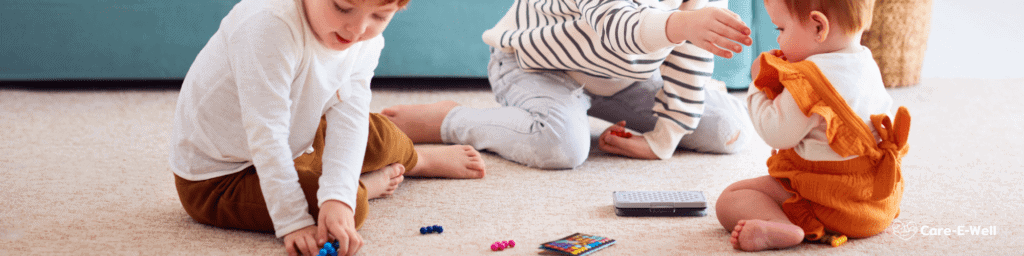
Mixed-age households need two safety zones. A preschooler or school-age child may safely use construction sets, beads or game pieces that are inappropriate for a crawling sibling. Problems arise when those objects migrate into shared spaces.
Give older children a defined place for small-part activities and a simple clean-up routine. A tray, table or room that the baby cannot access is easier to manage than repeatedly telling the older child to watch every piece.
- count pieces when practical before and after a craft or game
- keep small-part toys in closed storage when not in use
- do not allow older children to hand small objects to the baby
- clean the floor immediately after beads or pieces spill
- keep sibling backpacks and pencil cases out of toddler reach
- check shared play spaces before the baby joins
The aim is not to make the older child responsible for the baby’s safety. Adults should create a system that makes accidental access less likely.
Why should balloons get special attention?
Balloons can look harmless because they are soft, but latex balloon material has a long history in choking deaths. An uninflated balloon or torn fragment can conform to the airway and may be difficult to remove.
Keep uninflated balloons and broken pieces away from young children. After a balloon bursts, collect every visible fragment before the child returns to the area. Do not allow a young child to chew or suck an inflated balloon.
The same principle applies to other thin, flexible items that can wad up in the mouth: do not assume softness makes an object safe.
What about coins, keys and objects from adult pockets?
Adult belongings are easy to overlook because they are not marketed to children. Coins on a bedside table, a loose earring in a handbag or a small screw in a trouser pocket may become accessible when a child begins pulling up or emptying containers.
Establish a consistent place for pocket contents that is inaccessible to children. Ask visitors to keep handbags and backpacks out of reach too. Grandparents and guests may carry medicines, coins and other small objects into a home that is otherwise well babyproofed.
Are age labels on toys important?
Yes. Age guidance can reflect developmental suitability and the presence of small components, not just how intellectually challenging a toy is. A toy intended for an older child may contain detachable pieces that are inappropriate for a baby or toddler.
Keep packaging or instructions when they contain important safety information. If a toy is handed down without documentation, inspect it carefully and avoid giving it to a younger child when you cannot establish that the pieces and construction are appropriate.
Product safety standards reduce risk, but they do not eliminate the need to notice damage, missing parts or the way toys from different age groups are mixed at home.
Does supervision eliminate choking risk?
Supervision matters, especially during play and meals, but it cannot substitute for removing predictable hazards. A child can put an object into the mouth in seconds while an adult turns toward a sibling or reaches for a drink.
Environmental prevention is therefore the stronger first layer. Keep dangerous small objects inaccessible, then add supervision and age-appropriate teaching as the child develops.
Choking prevention should still work during the ordinary few seconds when an adult looks away. A safer environment reduces dependence on perfect attention.
How often should parents do a choking-hazard check?
There is no evidence-based requirement to inspect on a fixed daily schedule. Recheck when the environment or the child’s abilities change, and build brief scans into normal routines.
- before a crawling baby enters a room used by older children
- after craft activities or games with small pieces
- after visitors leave
- after parties or celebrations involving balloons
- after furniture is moved
- when a toy breaks or starts shedding parts
- when the child begins crawling, pulling to stand or opening drawers
- before staying in a hotel, holiday apartment or relative’s home
A two-minute check at the right moment can be more useful than an elaborate checklist that is rarely repeated.

What if you think a child swallowed a small object but is breathing normally?
Swallowing and choking are not the same event. Many swallowed objects enter the digestive tract rather than the airway, but the correct response depends on the object. Button batteries, magnets, sharp objects and some other foreign bodies require urgent medical evaluation even when the child has no breathing problem.
If the object is unknown, the child has pain, drooling, difficulty swallowing, vomiting, persistent coughing or wheezing, or you are unsure whether it entered the airway, seek prompt medical advice. A delayed cough or wheeze after a possible choking episode can occur with a retained airway foreign body and should not simply be assumed to be a cold.
What does true choking look like?
A child with a partial blockage may still cough or make noise. Severe airway obstruction can make the child unable to breathe, cry, speak or cough effectively and may lead to colour change or collapse.
If a child cannot breathe, cry, speak or cough effectively, is turning blue or grey, becomes unresponsive or collapses, call emergency services immediately and give age-appropriate choking first aid if you know how. Do not perform a blind finger sweep inside the mouth, because this can push an unseen object deeper.
First-aid training is valuable because choking requires immediate action. Prevention remains the goal, but caregivers should also know the age-appropriate response before an emergency happens.
Frequently asked questions
Is anything that fits in a child’s mouth a choking hazard?
Not every mouth-sized object will block an airway, but objects small enough to be mouthed deserve scrutiny. Shape, compressibility, smoothness and the child’s developmental stage all affect risk. When in doubt, keep the object away from babies and toddlers.
Are soft objects safer than hard objects?
Not automatically. Flexible materials such as balloon fragments can conform to the airway and be difficult to remove. Safety depends on the whole object, not simply whether it feels soft.
Should I remove all older children’s toys from the home?
No. Use separation and storage instead. Small-part toys can stay in a baby-inaccessible area with a reliable clean-up routine, while shared spaces contain toys appropriate for the youngest child using them.
Can a child aspirate something without a dramatic choking episode?
Yes. Some airway foreign bodies are not recognised immediately. Persistent cough, wheeze, noisy breathing or recurrent respiratory symptoms after a possible aspiration event deserve medical assessment.
Are button batteries and magnets mainly choking hazards?
No. They may cause choking, but swallowing is itself dangerous. Button batteries can injure the oesophagus, and multiple high-powered magnets can damage the bowel. Suspected ingestion needs urgent medical advice even if breathing is normal.
The key takeaway
Hidden choking hazards around the home are easiest to control when you think like a mobile toddler: look low, look behind furniture, inspect older siblings’ toys and treat broken or detachable parts as potential mouth objects. Keep coins, balloons, craft pieces, jewellery, hardware and other small items inaccessible, reassess as mobility changes and remember that batteries and high-powered magnets require urgent attention if swallowed. A safer environment reduces the chance that a moment of normal curiosity becomes an airway emergency.
Sources and References
- Denny SA, Hodges NL, Smith GA — Choking in the Pediatric Population
- Levin-Goodman R, Smith GA — Choking Prevention Among Young Children
- Hanba C, Cox SR, Bobian M, et al. — Consumer product ingestion and aspiration in children: A 15-year review
- Takahashi H, Suzuki J, Ikeda R, et al. — The Transition of Pediatric Tracheobronchial Foreign Body Cases in the Past 36 Years: A Retrospective Single-Center Study in Japan
- Paladin I, Mizdrak I, Gabelica M, et al. — Foreign Bodies in Pediatric Otorhinolaryngology: A Review
- Vega C, Kannikeswaran N, Farooqi A — Toys and Toy Accessories Strike Back
- Ryan CA — Childhood Deaths From Toy Balloons
- Singh H, Parakh A — Tracheobronchial Foreign Body Aspiration in Children
- Kim IA, Shapiro NL, Bhattacharyya N — The national cost burden of bronchial foreign body aspiration in children
Did this Insight help?
A little love for something worth reading.


