
Care-E-Well Insights
How Long Can Prepared Formula Sit Out?
Prepared formula should not sit out beyond safe limits. Learn WHO's two-hour rule, when to discard leftovers and when refrigeration applies.

How long can prepared formula sit out? WHO guidance gives a clear upper limit for prepared powdered infant formula at room temperature: a feed that has not been consumed within two hours of preparation should be discarded. The safest routine is still to prepare each feed fresh and use it promptly.
The two-hour limit is not a target to aim for. Once water is added to powdered formula, bacteria can multiply, especially if the feed stays warm. If the baby has already drunk from the bottle, do not save the leftovers for a later feed because saliva introduces additional bacteria.
For prepared powdered formula at room temperature, count from the time the feed was prepared—not from when the baby first takes a sip.
Why is there a time limit for prepared formula?
Powdered infant formula is not sterile. Rarely, it can contain harmful bacteria such as Cronobacter sakazakii or Salmonella, and contamination can also occur from hands, surfaces, scoops, bottles or teats.
Dry powder does not allow bacteria to multiply rapidly, but once the powder is mixed with water it becomes a nutrient-rich liquid. Time and temperature then become important controls.
WHO safe-preparation guidance therefore combines several protections: careful hygiene, hot-water reconstitution, prompt cooling, limited holding time and safe refrigeration when advance preparation cannot be avoided.
What is the two-hour rule?
WHO guidance states that prepared formula that has not been consumed within two hours should be discarded. In practical terms, if a bottle was prepared at 10:00, its room-temperature window does not restart because it was picked up, warmed or offered later.
The timer begins when the feed is prepared. Leaving it untouched on the counter for most of that window does not preserve a new two-hour period for feeding.
If you are unsure when a bottle was prepared or how long it has been unrefrigerated, discard it rather than guessing.
Does the two-hour rule apply after the baby starts drinking?
A bottle from which the baby has fed is a different situation because saliva can enter the formula through the teat. That introduces bacteria from the baby’s mouth into a liquid that supports bacterial growth.
Do not put a partly used bottle back in the refrigerator for the next feed. Discard leftover formula after the feeding session rather than trying to preserve it.
This may feel wasteful, especially when a baby suddenly stops after only a small amount, but it is safer to prepare smaller responsive volumes and offer more if the baby remains hungry.
Can prepared formula sit out for two hours in any room?
The two-hour limit is an upper boundary under ordinary conditions, not a guarantee that every environment is equally safe. Bacteria generally multiply faster at warmer temperatures.
A bottle left in direct sunlight, beside a heater, in a hot car or inside a warm bag should not be treated as though it has been held under controlled room conditions.
When the environment is hot or the storage history is uncertain, use the more cautious option and discard the feed.
Does warming a bottle restart the clock?
No. Warming does not reset the time since preparation and does not make an old feed new again.
Heating may raise the formula into a temperature range where bacteria multiply more quickly. The bottle should be warmed only when needed, offered promptly and discarded according to the original preparation and feeding timeline.
Never use reheating as a way to “sterilise” formula that has been sitting out too long.
Can you microwave prepared formula to make it safe?
No. Microwaving is not a safe method for rescuing an old bottle. It can heat unevenly and create hot spots that burn a baby’s mouth while failing to provide a controlled microbial safety step.
If prepared formula has exceeded its safe holding time, discard it. Do not boil, microwave or reheat it in an attempt to make it safe again.
What if the formula was made with very hot water?
WHO recommends reconstituting powdered infant formula with water hot enough to reduce bacterial risk in the powder. That preparation step lowers risk but does not make the finished bottle permanently sterile.
Bacteria can survive, be introduced after preparation or multiply during storage. The room-temperature holding limit still applies.
Accurate preparation also matters nutritionally: use the exact water volume and amount of powder specified on the product.
What if the bottle is in an insulated bag?
An insulated bag is only useful if it reliably keeps the formula at a safe cold temperature. A bottle that is merely “coolish” is not equivalent to formula stored in a refrigerator at 5°C or below.
Ice packs can help maintain cold conditions during transport, but actual performance depends on the bag, ice, outside temperature and journey length. If you cannot be confident that refrigeration temperatures were maintained, do not extend storage time based on the bag alone.
For travel, preparing feeds as close as possible to feeding time or using an appropriate sealed ready-to-feed formula can simplify safety.
Can formula sit out while a baby sleeps?
Do not leave a prepared bottle at room temperature waiting for a baby to wake if that could take it beyond the safe window. Newborn sleep and feeding timing are unpredictable.
For night feeds, prepare fresh when needed whenever practical. If advance preparation is unavoidable, use the WHO refrigeration method rather than leaving bottles beside the bed.
What if the baby refuses the bottle?
If the teat has not entered the baby’s mouth, the bottle is still governed by the time since preparation. If it remains at room temperature, discard it when the two-hour preparation limit is reached.
If the baby has sucked from the teat, treat the feed as a used bottle and discard leftovers after the feeding attempt rather than refrigerating them.
Avoid repeatedly offering the same bottle over a long period simply to reduce waste.
Does ready-to-feed formula follow the same rule?
Unopened ready-to-feed formula is different from reconstituted powder because the sealed liquid is commercially sterile. Once the container is opened, however, the manufacturer’s after-opening storage instructions apply.
Formula poured into a bottle can become contaminated during handling, and formula from a bottle the baby has drunk from should not be saved.
Check the specific ready-to-feed product label rather than transferring the powder formula’s unopened or after-opening rules to a liquid product.
Can prepared formula be refrigerated before two hours are up?
If formula needs to be prepared in advance, WHO recommends a specific process: prepare it hygienically, cool it quickly and refrigerate it at no more than 5°C. The intention is not to leave a bottle at room temperature for a long period and refrigerate it just before the two-hour limit.
Prompt cooling matters because bacteria can multiply while the formula is warm.
Advance preparation should be the exception when fresh preparation is not possible, rather than a routine reason to maximise storage time.
What is the refrigerated limit?
WHO guidance allows prepared formula that has been cooled promptly and stored at 5°C or below to be kept for no more than 24 hours. That is a different storage pathway from leaving a bottle at room temperature.
Once a refrigerated feed is removed and warmed, use it promptly. Do not repeatedly cool and rewarm the same bottle.
The essential distinction is that a bottle cannot simply spend hours at room temperature and then gain a new 24-hour period by going into the fridge.
Why can't you rely on smell or appearance?
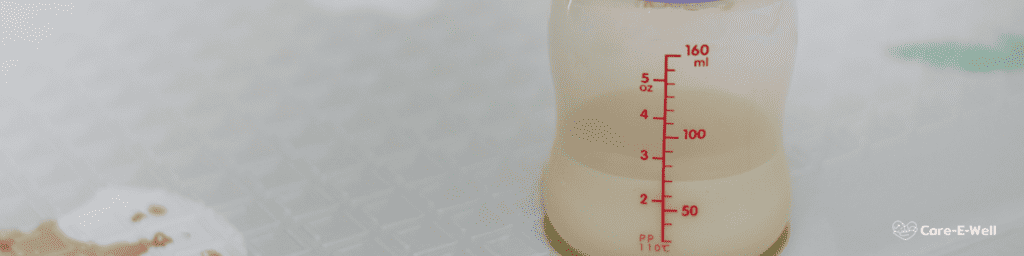
Harmful bacteria do not necessarily make formula smell sour, look curdled or change colour. A bottle can look and smell completely normal while no longer meeting safe time-and-temperature rules.
Use preparation time and storage conditions, not sensory checks, to decide whether a feed is safe.
“It smells fine” is not a food-safety test for prepared infant formula.
Does adding more fresh formula make an old bottle safe?
No. Topping up an old bottle with freshly prepared formula does not reset the contamination risk or storage clock.
Start with a clean bottle and a fresh feed instead. If a baby commonly takes small amounts, prepare smaller portions that match the baby’s usual appetite and make more when needed.
Can you keep a bottle warm in a bottle warmer?
A bottle warmer is designed to warm a feed, not to hold formula safely for extended periods. Keeping formula warm for a long time creates conditions that can favour bacterial growth.
Warm only the feed that is about to be offered. Do not use a warmer as overnight storage or as a substitute for refrigeration.
A simple formula timing checklist
- Prepare powdered formula with careful hygiene and according to current instructions
- Record or remember the preparation time
- Use freshly prepared formula as soon as practical
- Discard room-temperature formula that has not been consumed within two hours of preparation
- Discard leftovers from a bottle the baby has already fed from
- Do not reset the clock by warming, reheating or adding fresh formula
- If advance preparation is necessary, cool promptly and refrigerate at 5°C or below
- When timing or temperature history is uncertain, discard the feed
When are babies at higher risk?
Cronobacter infections are rare, but they can be severe in newborns, especially premature babies and infants with impaired immunity. Clinical teams may recommend sterile ready-to-feed liquid formula rather than powdered formula for some high-risk babies when human milk is unavailable.
If your baby was premature, has a medical condition affecting immunity or is receiving specialised care, follow the neonatal or paediatric team’s formula preparation instructions rather than relying only on general household guidance.
Frequently asked questions
Can prepared formula sit out for three hours if the baby has not touched it?
WHO guidance says prepared formula not consumed within two hours should be discarded. Do not extend the room-temperature limit because the teat has not been used.
Does the two-hour rule start when I add the powder?
Count from preparation of the feed. Do not restart the clock when you warm or first offer the bottle.
Can I put a two-hour-old bottle in the fridge?
That is not the intended advance-preparation method. Formula meant for later use should be cooled promptly after preparation and refrigerated at 5°C or below, not left out for most of the room-temperature window first.
Can I save formula if my baby only drank 10 mL?
No. Once the baby has fed from the bottle, saliva can contaminate the remaining formula. Discard the leftovers rather than storing them for another feed.
What if I cannot remember when the bottle was made?
Discard it and prepare a fresh feed. Formula safety is not a good place to estimate an uncertain timeline.
The key takeaway
How long can prepared formula sit out? For prepared powdered infant formula, WHO guidance sets a maximum of two hours at room temperature from preparation if it has not been consumed. Fresh preparation and prompt use remain the safer default.
Once a baby has fed from the bottle, discard leftovers. Warming does not restart the clock, and a bottle that has sat out should not gain a new storage period simply by being moved into the refrigerator.
Sources and references
- World Health Organization. Safe Preparation, Storage and Handling of Powdered Infant Formula: Guidelines. https://www.who.int/publications/i/item/9789241595414
- UNICEF UK Baby Friendly Initiative. Guide to Bottle Feeding. https://www.unicef.org.uk/babyfriendly/baby-friendly-resources/bottle-feeding-resources/guide-to-bottle-feeding/
- Agostoni C, Axelsson I, Goulet O, et al. Preparation and Handling of Powdered Infant Formula: A Commentary by the ESPGHAN Committee on Nutrition. https://doi.org/10.1002/j.1536-4801.2004.tb00858.x
- Gibson SL, Sahanggamu D, Fatmaningrum D, et al. ‘Unfit for human consumption’: a study of the contamination of formula milk fed to young children in East Java, Indonesia. https://doi.org/10.1111/tmi.12927
- Grant A, Jones S, Ellis R, et al. The safety of at home powdered infant formula preparation: A community science project. https://doi.org/10.1111/mcn.13567
- Losio MN, Pavoni E, Finazzi G, et al. Preparation of Powdered Infant Formula. https://doi.org/10.1097/MPG.0000000000002100
- Kent RM, Fitzgerald GF, Hill C, et al. Novel Approaches to Improve the Intrinsic Microbiological Safety of Powdered Infant Milk Formula. https://doi.org/10.3390/nu7021217
- Redmond EC, Griffith CJ. The importance of hygiene in the domestic kitchen: Implications for preparation and storage of food and infant formula. https://doi.org/10.1177/1757913908101604
- Fein SB, Grummer-Strawn LM, Raju TN. Infant Feeding and Care Practices in the United States: Results From the Infant Feeding Practices Study II. https://doi.org/10.1542/peds.2008-1315b
Did this Insight help?
A little love for something worth reading.


