
Care-E-Well Insights
How Much Formula Does a Baby Need by Age?
How much formula does a baby need by age? See practical age-based context, why intake varies, and when feeding amounts need review.
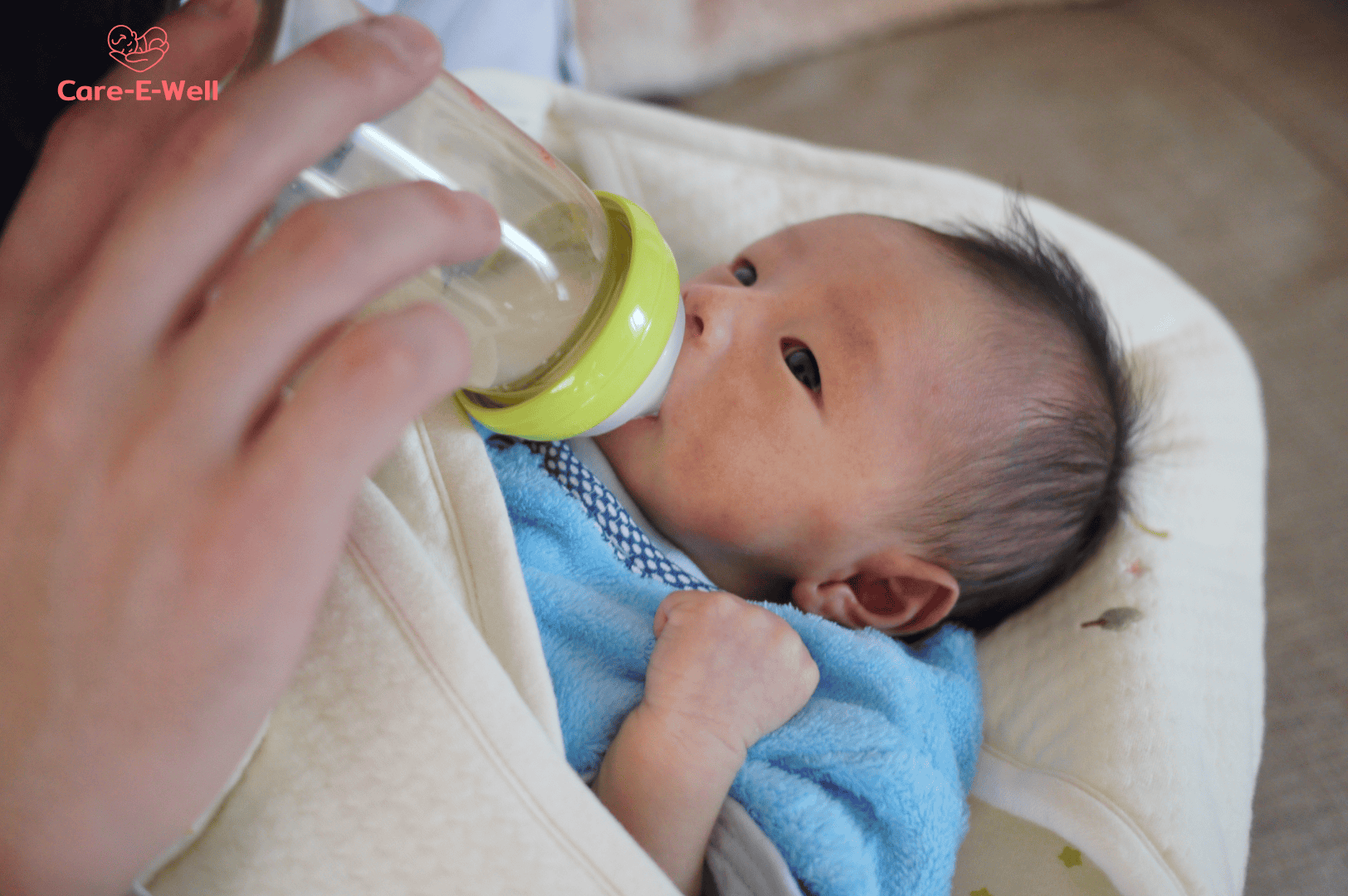
There is no single bottle size that every baby should drink at a particular age. Formula intake changes with body size, growth, feeding frequency, health and—later in infancy—how much complementary food a baby eats. Age is useful context, but it is not a prescription.
In research on healthy term infants, average formula intake around two months has often been in the region of 150 mL per kilogram of body weight per day, while average intake per kilogram tends to fall as babies grow. Those figures describe groups, not a target your baby must reach at every feed.
Use age and body size as context, then let growth, hydration and your baby’s hunger and fullness cues tell you whether the overall pattern is working.
Why formula amounts cannot be reduced to one age chart
Two babies of the same age can have different body weights, growth patterns and appetites. One may prefer smaller, more frequent feeds; another may take larger feeds less often. Both patterns can be normal when the baby is growing appropriately and feeding comfortably.
Formula labels often include feeding tables, but those are starting estimates. They are not evidence that every baby of that age needs exactly the stated amount, and the millilitres left in a bottle should not become a reason to pressure a baby to finish.
What does research show about daily formula intake?
In a randomised trial of healthy term infants, average formula intake at two months was approximately 153–157 mL/kg/day across formula groups. At four months, average intake had fallen to roughly 130–136 mL/kg/day, even though the babies were larger and individual feed sizes had generally increased.
Other cohorts have reported higher real-world intakes. Together, these studies show why a single number should not be treated as a universal requirement: feeding behaviour, caregiver practices, body size and study methods all influence reported amounts.
A research average is not a dose. Do not increase or restrict formula simply to make your baby match a population mean.
How much formula might a newborn need?
In the first days after birth, milk intake rises rapidly as the newborn adapts to feeding. Exact amounts vary considerably with age in hours or days, birth weight, medical status and whether the baby also receives breast milk.
During this period, clinicians look at feeding effectiveness, weight change, urine and stool output, alertness and the baby’s overall condition rather than relying on one universal bottle volume.
If your newborn has been given a specific feeding volume because of prematurity, jaundice, low weight, illness or another clinical reason, follow that plan rather than replacing it with a general online estimate.

Around 1 to 2 months
By this stage, many formula-fed babies have a more recognisable feeding pattern, but variation remains wide. The healthy-term trial above found average intake around 153–157 mL/kg/day at two months and just over five feeds per day on average.
That does not mean a two-month-old should be limited to five feeds or pushed toward a calculated daily total. Some babies naturally feed more frequently, and a smaller baby may need less total volume than a larger baby of the same age.
Around 3 to 4 months
In the same trial, average intake at four months was around 130–136 mL/kg/day, with approximately 4.6–4.7 feeds per day. This illustrates a common pattern: babies may take larger individual feeds while the number of feeds decreases.
It also shows why multiplying an early-infant mL/kg figure indefinitely can overestimate what an older baby needs. If your baby still prefers more frequent smaller bottles at four months, that is not automatically a problem.
Around 5 to 6 months
Milk remains the main source of nutrition in early infancy. Around six months, complementary foods can begin when a baby is developmentally ready, but formula should not suddenly be cut back simply to make room for solids.
UNICEF UK advises that first infant formula can be used throughout the first year and that there is no need to switch to follow-on formula simply because a baby reaches six months.
As solids begin, formula intake becomes more variable. Some babies initially drink similar amounts while learning to eat; others gradually reduce milk as food intake becomes more substantial.
From about 7 to 12 months
As complementary foods become established, the balance between milk and food changes gradually. There is no single month when every baby should reduce to a particular formula volume.
Appetite can vary from day to day with teething, illness, growth, activity and how much food was eaten. Continue to offer age-appropriate formula responsively rather than replacing milk rapidly.
By around one year, family foods supply an increasing share of energy and nutrients. UNICEF UK notes that full-fat cow’s milk can become the main milk drink from one year for children for whom it is suitable.
Should you calculate formula by body weight?
Weight-based figures can help professionals judge whether intake is plausible, especially in early infancy, but they should not become a daily target that overrides the baby’s behaviour.
Research values around 130–160 mL/kg/day at two to four months provide a useful sense of scale for healthy term infants, not a requirement. If intake seems unusually high or low, a feeding diary plus the baby’s growth trend is more useful than forcing the calculated number.
How do you know whether the amount is enough?
Look at the pattern over time: effective feeding, appropriate urine output, alert periods, clinical wellbeing and consistent growth are more informative than one bottle.
Weight should be interpreted as a trend. One isolated measurement tells much less than how the baby has grown from previous measurements.
If intake drops suddenly, consider illness, nasal congestion, oral discomfort, a teat-flow problem or another change rather than assuming the baby has simply “decided to eat less.”
What are signs that a baby wants more?
- Turning toward the bottle or caregiver and opening the mouth
- Bringing hands toward the mouth
- Sucking fingers or making sucking movements
- Becoming more alert or restless
- Continuing to search for the teat after a pause
Crying can be a late hunger cue, but crying is not specific to hunger. A recently fed baby may also need sleep, comfort, burping or a nappy change.
What are signs that a baby has had enough?
- Slowing or stopping sucking
- Turning the head away
- Pushing the teat or bottle away
- Relaxing the hands and body
- Letting milk spill or repeatedly losing interest
UNICEF UK recommends responding to pause and fullness cues rather than forcing a baby to finish. Leftover formula does not mean the feed failed. If hunger cues return later, offer another correctly prepared feed rather than making the formula stronger.
Can a baby drink too much formula?
Overfeeding is possible, particularly when caregivers routinely encourage bottle emptying or use feeding as the default response to every sign of distress. Systematic reviews have linked some bottle-feeding practices—including pressure to finish, larger bottles and higher intake—with rapid weight gain, although these associations do not mean every large feed causes excess weight.
The practical approach is not to restrict a hungry baby. It is to let the baby influence when a feed starts, when pauses happen and when the feed ends.

Can a baby drink too little formula?
A single small feed is usually not meaningful. Concern rises when low intake persists and is accompanied by fewer wet nappies, lethargy, repeated vomiting, feeding difficulty or faltering growth.
Seek prompt medical advice if a young infant is difficult to wake, has markedly fewer wet nappies, repeatedly refuses feeds, vomits green fluid or blood, has persistent forceful vomiting, shows breathing difficulty or appears significantly unwell.
What if your baby always finishes the bottle?
Finishing every bottle does not prove the offered amount is perfect. Some infants keep sucking because milk continues to flow or because the teat is repeatedly reoffered.
Try a responsive approach: hold the bottle more horizontally, allow natural pauses and stop when the baby consistently turns away or relaxes. If clear hunger cues remain, you can offer more.
Should you make a bigger bottle so your baby sleeps longer?
There is no reliable evidence that deliberately overfeeding formula creates healthy longer sleep. Larger feeds can increase spit-up or discomfort in some babies and may encourage caregivers to override fullness cues.
Keep formula concentration correct and respond to actual hunger rather than using milk volume as a sleep treatment.
Frequently asked questions
Should every bottle be the same size?
No. Appetite changes across the day. A responsive pattern can include larger and smaller feeds.
Should I wake my baby to reach a daily formula total?
Do not wake a healthy older infant simply to hit an online calculation without a clinical reason. Newborns, premature babies and infants with jaundice or poor weight gain may need scheduled feeds, so follow their individual plan.
Do solids replace formula immediately at six months?
No. Complementary foods are introduced gradually, and formula remains an important source of nutrition through the first year for formula-fed babies.
The key takeaway
How much formula does a baby need by age? The answer is a range, not a quota. Healthy-term research suggests average daily intake around 150 mL/kg at two months and closer to 130–136 mL/kg at four months, but individual babies vary substantially.
Use those figures as context only. Follow hunger and fullness cues, monitor growth and hydration, keep formula concentration correct and ask for professional review when intake or growth changes in a way that concerns you.
Sources and references
- UNICEF UK Baby Friendly Initiative. Guide to Bottle Feeding. https://www.unicef.org.uk/babyfriendly/wp-content/uploads/sites/2/2022/10/Bottle-feeding-leaflet.pdf
- European Commission. Commission Delegated Regulation (EU) 2016/127 on infant formula and follow-on formula. https://eur-lex.europa.eu/legal-content/EN/ALL/?uri=CELEX%3A32016R0127
- Liotto N, Orsi A, Menis C, et al. Clinical evaluation of two different protein content formulas fed to full-term healthy infants: a randomized controlled trial. https://doi.org/10.1186/s12887-018-1046-6
- Montandon CM, Wills C, Garza C. Formula Intake of 1- and 4-Month-Old Infants. https://doi.org/10.1002/j.1536-4801.1986.tb09100.x
- Mihrshahi S, Battistutta D, Magarey A, Daniels LA. Determinants of rapid weight gain during infancy: baseline results from the NOURISH randomised controlled trial. https://doi.org/10.1186/1471-2431-11-99
- Reynolds L, McCaffery H, Appugliese DP, et al. Capacity for Regulation of Energy Intake in Infancy. https://doi.org/10.1001/jamapediatrics.2023.0688
- Appleton J, Russell CG, Laws R, et al. Infant formula feeding practices associated with rapid weight gain: A systematic review. https://doi.org/10.1111/mcn.12602
- Kotowski J, Fowler C, Hourigan C, Orr F. Bottle-feeding an infant feeding modality: An integrative literature review. https://doi.org/10.1111/mcn.12939
- Graulau RE, Banna J, Campos M, et al. Amount, Preparation and Type of Formula Consumed and Its Association with Weight Gain in Infants Participating in the WIC Program in Hawaii and Puerto Rico. https://doi.org/10.3390/nu11030695
- Ventura AK, Inamdar LB, Mennella JA. Consistency in infants' behavioural signalling of satiation during bottle-feeding. https://doi.org/10.1111/ijpo.250
Did this Insight help?
A little love for something worth reading.


