
Care-E-Well Insights
How Much Solid Food Should a Baby Eat?
How much solid food should a baby eat? See portions by age, hunger and fullness cues, and why babies should not be forced to finish.
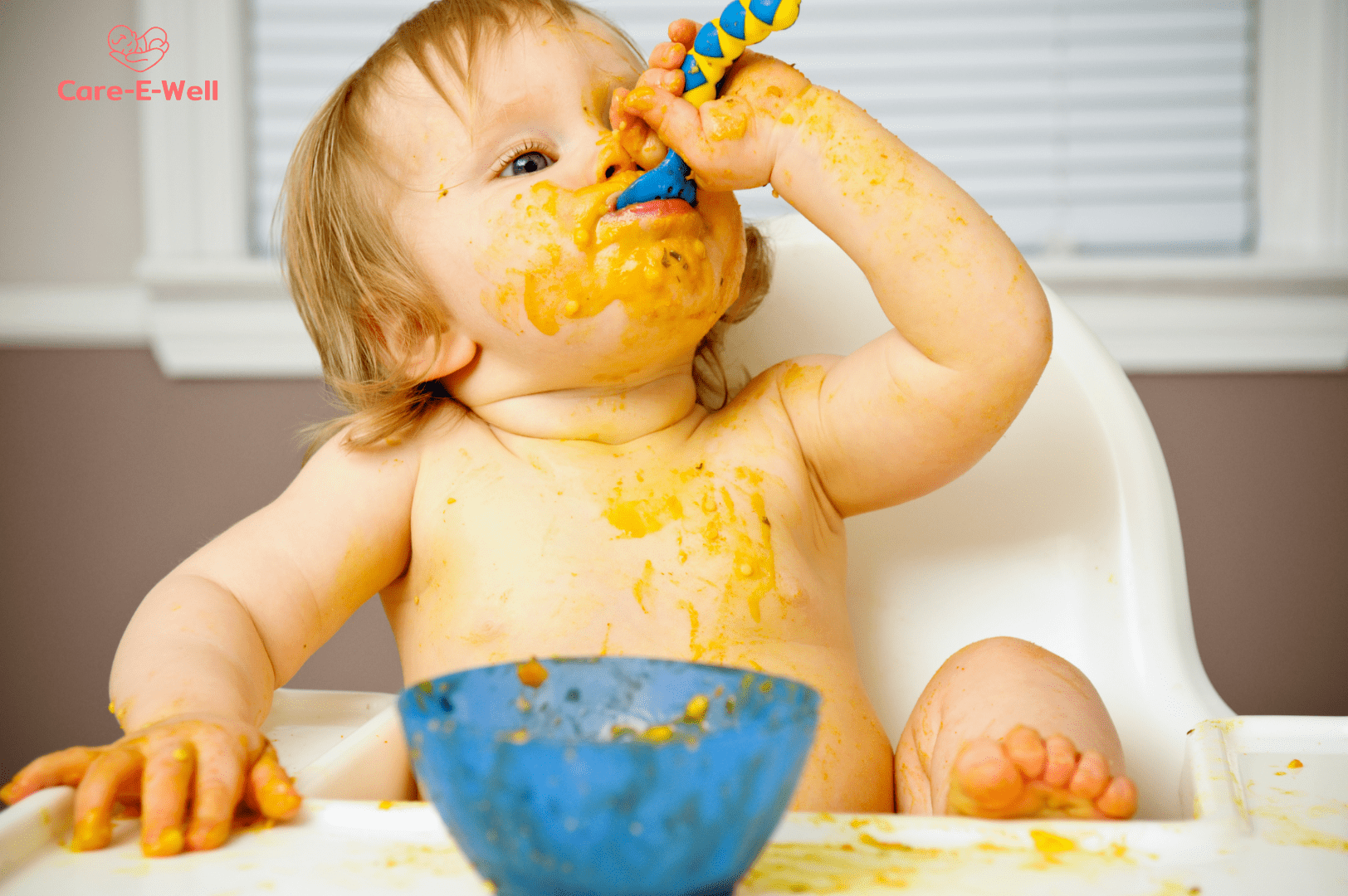
How much solid food should a baby eat? At the beginning, often surprisingly little. Complementary feeding starts as an addition to breast milk or infant formula, not an overnight replacement, and appetite can vary dramatically from one meal to the next.
WHO practical guidance describes starting at around six months with small amounts, such as a few spoonfuls, and increasing gradually. For 6–8 months, guidance progresses toward roughly half of a 250 ml cup at a meal, but this is a planning guide rather than a portion a baby must finish. Responsive feeding means the baby's hunger and fullness cues still decide how much is actually eaten.
Portion guides tell you what you might offer. They do not tell you what your baby must eat.
Why does solid-food intake vary so much?
Babies differ in body size, growth rate, temperament, milk intake, feeding skills and daily appetite. Teething, illness, tiredness and developmental changes can all affect how much a baby eats.
Early complementary feeding also includes learning. A baby may spend part of a meal touching, squashing, licking or dropping food. That exploration is not wasted time; it is part of developing feeding skills.
How much should a baby eat at around six months?
Start with small amounts and increase gradually. Some babies may manage only one or two tastes at first, while others quickly eat several spoonfuls.
WHO's practical table describes beginning with about 2–3 tablespoonfuls per feed for 6–8-month-olds and gradually increasing toward about half of a 250 ml cup. The important word is gradually.
A baby does not need to reach that amount at every meal, and forcing a portion undermines responsive feeding.
What does a "small amount" look like in real life?
It might be a few spoonfuls of thick lentil mash, several soft finger-food pieces, part of an egg, or a small serving of iron-fortified cereal. The exact volume is less useful than watching whether the baby remains interested, opens their mouth or reaches for more.

How much should a 7- or 8-month-old eat?
By 7–8 months, many babies have more experience and can manage a wider range of textures. The offered portion can increase, but appetite remains variable.
Instead of measuring every meal, provide enough food for the baby to continue if hungry, then offer more when needed. Include nutrient-dense foods so small amounts still provide useful iron, energy and protein.
How much should a 9- to 11-month-old eat?
WHO practical guidance uses about half of a 250 ml cup or bowl per meal as a general planning amount for 9–11 months, alongside continued milk feeding. Again, this is not a requirement to finish a bowl.
At this age, many babies eat three or four times a day and may also participate more fully in family meals. Texture should continue progressing toward chopped, mashed and finger foods that match the baby's skills.
Should I measure portions in grams?
Usually not. Gram-level tracking is rarely necessary for a healthy baby growing well. It can create unnecessary pressure and make normal appetite variation look like a problem.
A more useful pattern is to offer a modest portion, allow the baby to eat, and add more if hunger cues continue. If there is persistent poor growth, a medical condition or concern about nutrient intake, a clinician or paediatric dietitian may recommend more structured measurement.
What hunger cues should parents watch for?
- Leaning toward food or opening the mouth when food is offered.
- Reaching for the spoon or food.
- Excited vocalising or increased attention to the meal.
- Continuing to self-feed and actively seeking another bite.
Hunger cues become more individual with age. What matters is the pattern of active interest rather than coaxing the baby to accept one more mouthful.
What fullness cues should parents respect?
- Turning the head away.
- Closing the mouth.
- Pushing the spoon or food away.
- Dropping food repeatedly after previously eating with interest.
- Slowing down and becoming distracted.
- Signalling "all done" through gesture, vocalisation or body movement.
One cue in isolation is not always definitive. A baby may turn away briefly and then re-engage. Give a pause, offer again without pressure and finish the meal when the baby consistently signals they are done.
What if my baby eats less than the portion guide?
Look at the whole pattern rather than one meal. A baby who drinks milk well, is growing appropriately, has normal energy and repeatedly gets opportunities to eat may simply have a smaller appetite that day.
Nutrient density becomes especially helpful for small eaters. Iron-rich foods, egg, pulses, avocado, full-fat unsweetened yoghurt where appropriate, grains and other energy-containing family foods can provide more nutrition than relying mainly on watery fruit or vegetable purée.
What if my baby wants much more?
Some babies have large appetites. Responsive feeding means allowing the baby to continue eating when they show clear hunger cues while still offering a balanced range of foods.
Avoid turning large appetite into a reason to rush the replacement of milk feeds. Complementary foods and milk should develop together over time rather than competing abruptly.
How do milk feeds fit with solids?
Breast milk or infant formula remains nutritionally important through the first year. At the start of solids, milk often supplies most energy and nutrients while the baby learns to eat.
As complementary food intake grows, the balance shifts gradually. There is no need to intentionally withhold milk to make a baby hungrier for solids unless an individual healthcare plan specifically recommends it.

Does baby-led weaning change how much food to offer?
With self-feeding, it is harder to measure actual intake because some food ends up on the tray or floor. That is not a problem in itself.
Offer enough pieces for the baby to choose from, replace food as needed and include calorie- and iron-rich options. The baby's actual intake can still be guided by hunger and fullness rather than by counting pieces.
When is eating too little a concern?
Very small intakes are common early on, but persistent difficulty deserves attention when it is accompanied by other concerns.
Seek professional assessment if your baby repeatedly coughs or chokes during meals, seems unable to swallow safely, has persistent vomiting or pain with feeding, shows poor growth, becomes unusually tired during feeds, or has a very restricted intake that is not improving.
Babies born prematurely or with medical or developmental conditions may need a feeding plan based on corrected age, growth and oral-motor skills.
A simple way to portion food without pressure
- Start with a small amount that does not overwhelm the tray or bowl.
- Include at least one nutrient-dense option, especially an iron-rich food.
- Let the baby eat at their own pace.
- Offer more when hunger cues continue.
- Stop when fullness cues are consistent.
- Consider intake over several days rather than judging one meal.
The goal is not an empty bowl. The goal is a baby who is offered enough nutritious food and is trusted to respond to their own appetite.
Frequently asked questions
Is two tablespoons enough at six months?
It can be. WHO guidance starts with small quantities and increases gradually. Some babies eat less and some more. Growth, milk intake and the overall feeding pattern matter more than a single number.
Should a baby finish everything I serve?
No. Serve an appropriate amount, but let the baby stop. Pressuring a baby to finish food is inconsistent with responsive feeding.
How do I know whether my baby is getting enough overall?
Look at growth, energy, development, milk intake, urine output and the pattern of complementary feeding over time. If any of these raise concern, discuss them with a healthcare professional.
Does a bigger baby need bigger portions?
Not necessarily at every meal. Body size can influence energy needs, but appetite and milk intake also matter. Let growth monitoring and feeding cues guide the overall picture.
Conclusion
How much solid food should a baby eat? Enough to support gradual nutritional expansion while the baby's appetite remains in charge. Start small, increase opportunities and portions with age, prioritise nutrient density and avoid turning suggested serving sizes into compulsory targets.
Sources and References
- World Health Organization. WHO Guideline for complementary feeding of infants and young children 6–23 months of age. https://www.who.int/publications/i/item/9789240081864/
- World Health Organization. Complementary feeding. https://www.who.int/health-topics/complementary-feeding
- World Health Organization. Child health and development: amounts of complementary foods to offer. https://www.who.int/news-room/questions-and-answers/item/child-health-and-development
- World Health Organization. Infant and young child feeding. https://www.who.int/news-room/fact-sheets/detail/infant-and-young-child-feeding
- European Food Safety Authority. Appropriate age range for introduction of complementary feeding into an infant's diet. https://www.efsa.europa.eu/en/news/age-start-complementary-feeding-infants
- Reynolds L, McCaffery H, Appugliese DP, et al. Capacity for Regulation of Energy Intake in Infancy. JAMA Pediatrics. 2023. DOI: https://doi.org/10.1001/jamapediatrics.2023.0688
- Helle C, Hillesund ER, Wills AK, et al. Evaluation of an eHealth intervention aiming to promote healthy food habits from infancy. International Journal of Behavioral Nutrition and Physical Activity. 2019. DOI: https://doi.org/10.1186/s12966-018-0763-4
- Koletzko B, Lehmann Hirsch N, Jewell J, et al. National Recommendations for Infant and Young Child Feeding in the WHO European Region. Journal of Pediatric Gastroenterology and Nutrition. 2020. DOI: https://doi.org/10.1097/MPG.0000000000002912
Did this Insight help?
A little love for something worth reading.


