
Care-E-Well Insights
How Often Should a Formula-Fed Baby Eat?
How often should a formula-fed baby eat? Learn how feeding frequency changes with age, which cues matter and when a pattern needs review.
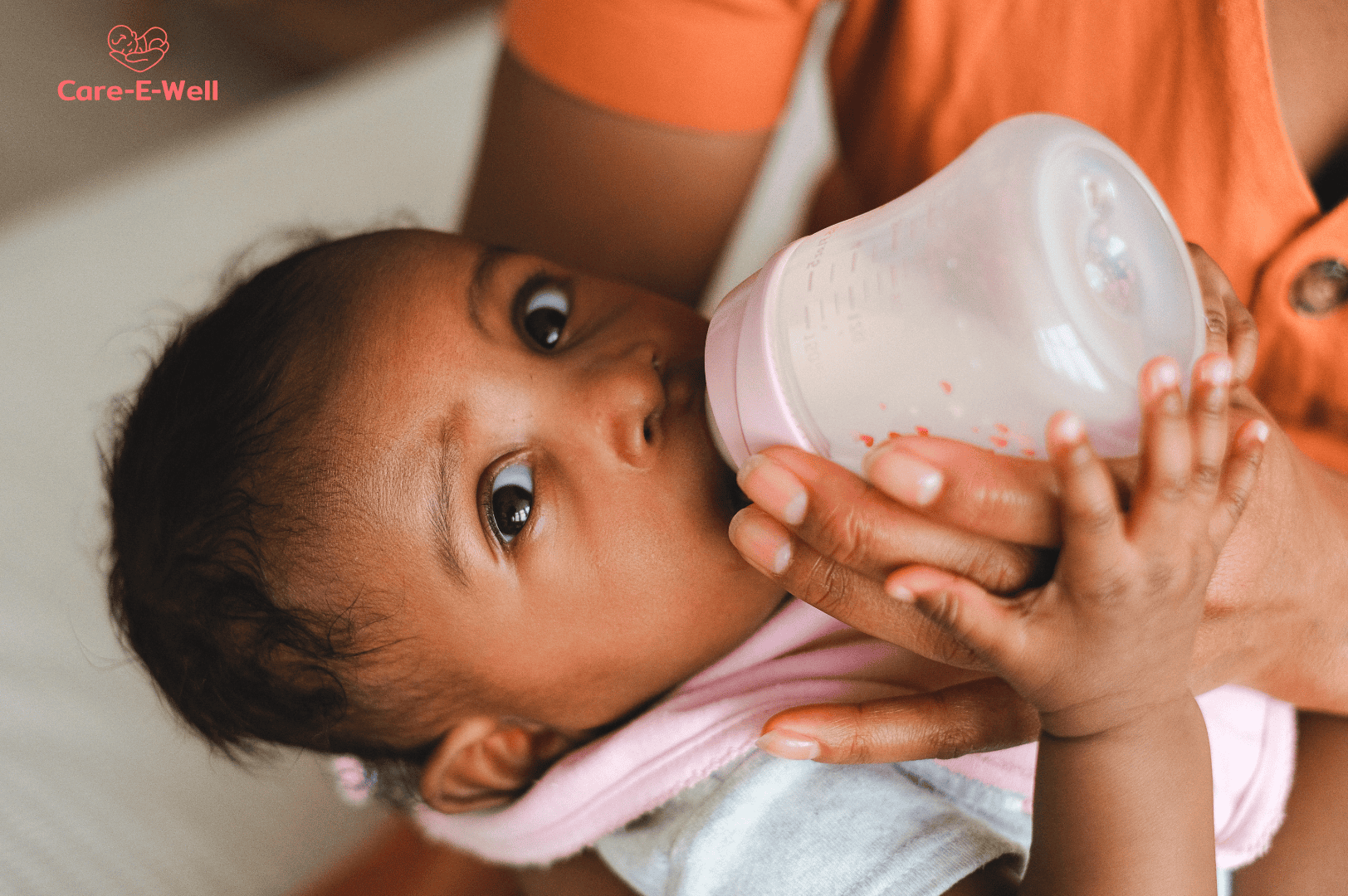
A formula-fed baby should generally eat in response to hunger cues rather than on a rigid clock, unless a clinician has given a specific feeding schedule. Younger babies usually feed more often; as babies grow, they often take larger feeds and the number of feeds gradually falls.
Research does not support one exact interval that every healthy formula-fed baby should follow. Studies show wide variation in feeding frequency even among babies of the same age, which is why growth, hydration, total intake and feeding cues matter more than reaching a three-hour or four-hour rule.
The clock can help you notice a pattern, but your baby’s cues should usually decide when a feed starts and when it ends.
Why there is no universal formula-feeding schedule
Feeding frequency depends on more than age. Body size, appetite, bottle volume, sleep, growth, illness and teat flow all influence how often a baby wants to eat.
A baby who prefers smaller bottles may naturally feed more frequently than a baby who takes larger bottles. Trying to stretch the first baby to match the second can create distress without improving nutrition.
Research on healthy infants has also found substantial variation in how well babies regulate energy intake when feeding opportunities change. Exact timing rules are therefore much less evidence-based than responsive feeding principles.
How often do formula-fed babies feed in research studies?
In one randomised trial of healthy term infants, formula-fed babies averaged just over five feeds per day at two months and about 4.6–4.7 feeds per day at four months. These are group averages, not targets.
Other studies have reported much more frequent feeding. In one cohort, many formula-fed infants between eight and sixteen weeks were reportedly fed seven to twelve times per day. That does not mean such high frequency is ideal for every baby; it shows that real feeding patterns vary widely.
The important question is whether the frequency, volume and baby’s behaviour make sense together.
How often might a newborn need formula?
Newborns have small feeding capacity and usually need frequent opportunities to feed, including overnight. In the first days, feeding frequency can change quickly as intake rises and the baby becomes more efficient.
Do not deliberately stretch a newborn between feeds just to create a schedule. If the baby shows early hunger cues, offer a feed.
Some newborns need planned waking because of prematurity, jaundice, excessive weight loss, poor weight gain, sleepiness or another medical concern. If your maternity or neonatal team has given you a maximum interval or minimum number of feeds, follow that individual plan.
A newborn who is unusually sleepy, repeatedly misses feeds, is difficult to wake or has markedly fewer wet nappies needs prompt professional assessment.
What changes around 1 to 2 months?
Many babies begin to develop a more recognisable rhythm. Some feeds become larger and the intervals may lengthen naturally, but frequent feeding can still be normal.
The healthy-term formula trial that found about five feeds per day at two months should not be used as a five-feed limit. A baby taking smaller feeds may need more feeding opportunities.
If your baby is hungry again sooner than expected, check hunger cues rather than assuming the previous feed “should” have lasted a set number of hours.

What changes around 3 to 4 months?
By three to four months, many babies can take more milk in one feed and may feed fewer times across 24 hours. The trial average of roughly 4.6–4.7 feeds per day at four months illustrates this trend.
But developmental changes, growth, sleep disruptions and individual appetite can temporarily increase feeding frequency. A week of more frequent feeds does not automatically mean the formula is no longer satisfying.
Respond to the baby and look at the full-day pattern rather than making each interval longer by force.
What happens from about 5 to 6 months?
Milk remains central to nutrition. Around six months, complementary foods can start when the baby is developmentally ready, but early tastes and small meals do not immediately replace formula feeds.
Feeding frequency may change gradually as solid-food intake becomes more substantial. Some babies keep a similar milk pattern for a while; others reduce a feed naturally.
Do not remove formula feeds simply because a schedule says a six-month-old should be on fewer bottles.
What about 7 to 12 months?
During the second half of the first year, formula and complementary foods increasingly share the day. Milk feeding frequency becomes more individual because babies differ in meal size, appetite and how quickly solids become established.
First infant formula can remain the formula drink throughout the first year. There is no need to switch to follow-on formula simply to alter feeding frequency.
Offer formula and food within a predictable family routine while continuing to respect hunger and fullness cues.
Which hunger cues mean it is time to offer a bottle?
- Moving the head and mouth as if searching
- Opening the mouth when the teat approaches
- Bringing hands to the mouth
- Sucking fingers or making sucking movements
- Becoming increasingly alert or restless
UNICEF UK describes crying as a late hunger cue. Offering a feed earlier can make it easier for a baby to coordinate sucking, swallowing and breathing calmly.
Does every cry mean the baby should eat?
No. Babies cry because of hunger, but also tiredness, discomfort, overstimulation, temperature, illness, the need for contact and many other reasons.
If a baby has just fed and shows no other hunger cues, first consider whether another need is more likely. Routinely using a bottle for every upset can make it harder to distinguish hunger from soothing needs.
Responsive-feeding research supports matching feeding to hunger and satiety rather than using milk as the default response to distress.
Should you wake a sleeping baby for formula?
That depends on age and clinical context. A healthy older baby who is growing well may not need waking simply to maintain an arbitrary daytime schedule.
Newborns and babies with poor weight gain, jaundice, prematurity or other medical concerns may need scheduled waking. The right interval for those babies is part of their individual care plan.
If you are unsure whether your baby can safely sleep through a usual feed, ask the clinician who is following the baby’s growth.
Is feeding every two hours too often?
Not necessarily. A baby who takes smaller feeds may feed every couple of hours at times, and cluster-like periods can happen even with bottle feeding.
What deserves review is a persistent pattern in which the baby seems unable to settle after feeds, takes very large total volumes, vomits repeatedly, coughs or chokes, or shows poor growth.
Before increasing bottle size, check whether the teat flow is too fast or too slow and whether fullness cues are being respected.
Is feeding every four hours enough?
It may be for some older babies taking adequate feeds and growing well, but four hours should not be imposed as a minimum interval on a hungry baby.
Deliberately delaying feeds can lead to intense crying and rushed feeding. It can also encourage a baby to take a larger bottle than is comfortable simply because the baby is extremely hungry.
A predictable routine can be helpful, but it should have enough flexibility to respond to appetite.

Should you stretch feeds so a baby takes more at once?
There is no need to train a healthy infant to tolerate longer intervals simply to create larger bottle volumes. Feeding frequency and feed size naturally interact: more frequent opportunities often mean smaller meals, while less frequent feeding can mean larger meals.
Research on infant energy regulation suggests babies have some capacity to adjust intake, but caregiver pressure and bottle-based cues can interfere with that process.
Let the baby’s pattern develop rather than pursuing a target bottle size.
How do you know a feeding pattern is working?
Look beyond the interval. A reassuring pattern includes comfortable feeds, appropriate urine output, periods of alertness, a baby who can show both hunger and fullness, and steady growth over time.
A feeding diary can help if you are worried. Record the approximate time, amount offered, amount taken and any symptoms for a few days without turning the diary into a target the baby must satisfy.
The pattern is especially useful when a clinician needs to distinguish low intake, frequent small feeds, vomiting or feeding-skill difficulties.
When should feeding frequency be reviewed?
Seek medical advice if feeding frequency changes suddenly alongside fever, lethargy, breathing difficulty, repeated forceful vomiting, green vomit, blood in stool or vomit, signs of dehydration, poor growth, repeated choking or a baby who is difficult to wake.
Also ask for support when feeding is persistently stressful even if the baby is growing. A teat-flow issue, oral-motor difficulty, reflux symptoms or another feeding problem may be easier to solve once the actual pattern is observed.
Frequently asked questions
Do formula-fed babies have to eat every three hours?
No. Three hours is a common practical interval, not a physiological rule. Some babies feed sooner and some later.
Can a formula-fed baby feed on demand?
For a healthy term infant without a prescribed schedule, responsive or cue-led feeding is appropriate. Offer milk when hunger cues appear and stop when fullness cues are clear.
Why is my baby suddenly feeding more often?
Growth, developmental changes, illness recovery, smaller feeds, changes in sleep or simply day-to-day appetite can all alter frequency. A short change is often less important than growth and overall wellbeing.
Should I make each bottle bigger if feeds are frequent?
Not automatically. Offer enough for the baby to continue if still hungry, but do not use a larger bottle as a way to force longer gaps.
The key takeaway
How often should a formula-fed baby eat? Usually, as often as hunger cues require within a feeding pattern that supports adequate intake and growth. Younger babies tend to feed more frequently; intervals often lengthen naturally with age.
Use the clock to observe, not control. Respect hunger, allow pauses, stop at fullness and follow any individual schedule given for a newborn or baby with a medical or growth concern.
Sources and references
- UNICEF UK Baby Friendly Initiative. Infant Formula and Responsive Bottle Feeding: A Guide for Parents. https://www.unicef.org.uk/babyfriendly/wp-content/uploads/sites/2/2019/04/Infant-formula-and-responsive-bottle-feeding.pdf
- Liotto N, Orsi A, Menis C, et al. Clinical evaluation of two different protein content formulas fed to full-term healthy infants: a randomized controlled trial. https://doi.org/10.1186/s12887-018-1046-6
- Berger PK, Lavner JA, Smith JJ, et al. Differences in early risk factors for obesity between African American formula-fed infants and White breastfed controls. https://doi.org/10.1186/s40814-017-0198-8
- Reynolds L, McCaffery H, Appugliese DP, et al. Capacity for Regulation of Energy Intake in Infancy. https://doi.org/10.1001/jamapediatrics.2023.0688
- Mihrshahi S, Battistutta D, Magarey A, Daniels LA. Determinants of rapid weight gain during infancy: baseline results from the NOURISH randomised controlled trial. https://doi.org/10.1186/1471-2431-11-99
- Appleton J, Russell CG, Laws R, et al. Infant formula feeding practices associated with rapid weight gain: A systematic review. https://doi.org/10.1111/mcn.12602
- Kotowski J, Fowler C, Hourigan C, Orr F. Bottle-feeding an infant feeding modality: An integrative literature review. https://doi.org/10.1111/mcn.12939
- Savage JS, Hohman EE, Marini ME, et al. INSIGHT responsive parenting intervention and infant feeding practices: randomized clinical trial. https://doi.org/10.1186/s12966-018-0700-6
- Ventura AK, Silva García K, Meza M, et al. Promoting Responsive Bottle-Feeding Within WIC: Evaluation of a Policy, Systems, and Environmental Change Approach. https://doi.org/10.1016/j.jand.2021.05.003
- Ventura AK. Associations between Breastfeeding and Maternal Responsiveness: A Systematic Review of the Literature. https://doi.org/10.3945/an.116.014753
Did this Insight help?
A little love for something worth reading.


