
Care-E-Well Insights
How to Dress a Newborn With Less Pulling and Twisting
Dress your newborn more gently with simple ways to reduce pulling, twisting and awkward handling during everyday clothing changes.
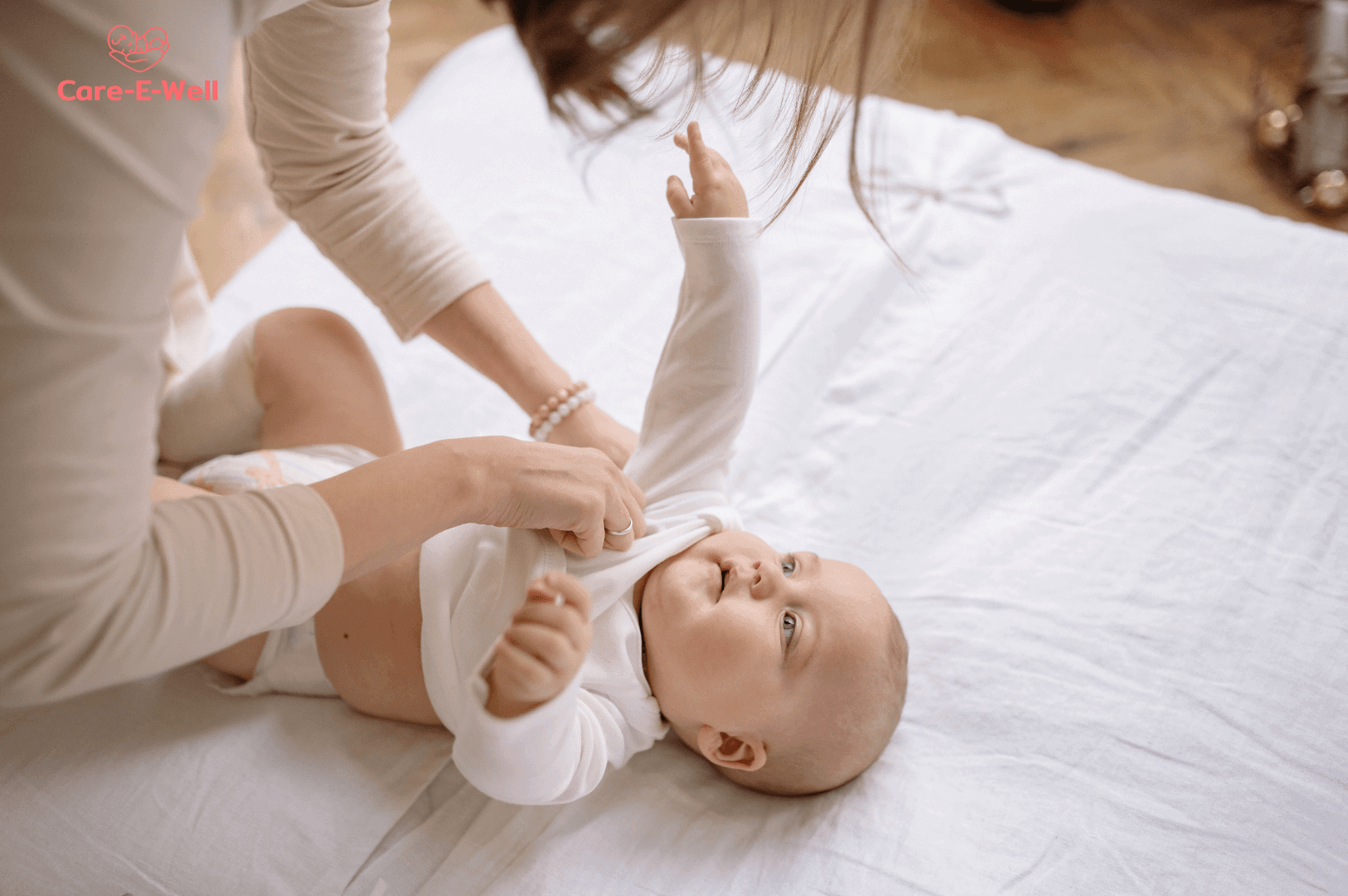
Dressing a newborn can feel surprisingly awkward. Their arms are tiny, their head still needs support, and a simple sleeve can seem to require three hands. The goal is not to keep your baby perfectly still. It is to make each clothing change slower, more supported and less dependent on pulling an arm, twisting the trunk or lifting by a limb.
A useful rule is to move the clothing around the baby rather than moving the baby forcefully through the clothing. Bring fabric toward the hand or foot, support the body close to the surface, and use small side-to-side shifts when you need access underneath. This makes dressing easier for you and gives your baby time to respond to each change in position.
Newborn dressing does not need a special therapeutic technique. Gentle support, small movements and moving the clothes around the baby are usually enough.
Why newborn dressing can feel so difficult
Newborns have limited head control and immature movement coordination. Their arms and legs often rest in flexed positions, and movements can be sudden or uneven. Developmental-care literature also emphasises that young infants respond to handling, sensory input and changes in position, so calm pacing and support can make routine care easier to tolerate.
Some babies stay relaxed through dressing. Others startle, cry, stiffen briefly or draw their limbs tightly toward the body. These responses do not necessarily mean that you are hurting them. They often mean that the movement, temperature change or loss of support was noticeable and your baby needs a slower transition.
How to dress a newborn with less pulling and twisting
Start with a stable surface
Dress your baby on a firm, secure surface at a comfortable height whenever possible. Keep everything you need within reach before you begin. A stable surface lets you use both hands for the baby instead of trying to balance clothing, nappies and a moving newborn at the same time.
Never leave a baby unattended on a changing table, bed, sofa or other raised surface, even for a moment. If you need to step away, take the baby with you or place them in a safe sleep space.
Bring the sleeve to the hand
Instead of pushing the baby's arm through a long sleeve, gather or bunch the sleeve in your hand until you can reach the cuff. Gently guide the cuff over the baby's hand, then ease the fabric up the arm. This reduces the amount of traction on the wrist, elbow and shoulder.
If the baby keeps the elbow bent, work with that position rather than trying to straighten the arm first. Newborn movement is naturally variable, and there is usually no reason to force a limb into a straight line just to get clothing on.

Support the shoulder instead of pulling the arm
When you need to adjust fabric around the shoulder, support the upper arm and shoulder area with your hand. Avoid lifting the baby by the hands, wrists or forearms. The same principle applies to legs: guide fabric over the foot and up the leg rather than pulling the leg outward to make room.
Use a small side roll for clothing underneath the back
For bodysuits, tops or sleepwear that need to be smoothed behind the back, a gentle partial roll can be easier than lifting the whole trunk. Keep one hand supporting the shoulder and upper body while you roll the baby slightly to one side, adjust the fabric, then return to the middle. Repeat on the other side if needed.
This is a practical handling strategy rather than a treatment technique. The movement should remain small, controlled and comfortable. There is no need to roll a newborn forcefully or hold them in a side position if they resist strongly.
Think "roll a little, adjust a little" rather than lifting the baby high off the surface to pull clothing flat underneath.
What about clothes that go over the head?
Wide-neck bodysuits, envelope-neck tops, wrap-style clothing and front-opening sleepers can reduce how much you need to manipulate the head and arms. If clothing must pass over the head, stretch the neckline open with both hands, bring it over the back of the head first, then forward over the face without dragging fabric across the nose or mouth.
Support the head and upper back as needed. Do not pull the baby upward by the clothing or use the garment to move the head. If your newborn strongly dislikes overhead clothing, front-opening designs may simply be the easier option for the first weeks.
Should you alternate sides during dressing?
It is reasonable to vary the side from which you approach routine care. For example, you might sometimes guide the right arm into a sleeve first and sometimes the left. You can also position interesting visual stimuli, your face or your voice on different sides during calm awake care.
This does not mean you must keep a strict left-right schedule. Healthy infants naturally show temporary preferences and asymmetries. The purpose of varied handling is to offer movement opportunities, not to force perfect symmetry at every change.
Dressing a baby who stiffens or cries
If your baby becomes tense, pause before continuing. Bring the arms closer to the body, place a steady hand on the chest or trunk, speak softly and wait for the baby to settle. Caregiver education in developmental care often emphasises responding to infant cues and adjusting handling to the baby's state rather than finishing a task as quickly as possible.
You can also break dressing into smaller steps. Put on the nappy, pause. Add the bodysuit, pause. Then add the outer layer. A hungry, overtired or very cold baby may tolerate the same movements less well than a calm, alert baby.
What not to do when dressing a newborn
- Do not pull a baby up by the hands, wrists, forearms or clothing.
- Do not force an arm or leg straight against strong resistance.
- Do not twist the trunk sharply to reach fabric underneath.
- Do not press the head into a fixed position while dressing.
- Do not use forceful stretches because one side feels slightly tighter during a single clothing change.
- Do not leave the baby unattended on a raised changing surface.
These cautions are about avoiding unnecessary force. Routine newborn dressing should feel like supported repositioning, not like an exercise session.
If your baby always resists movement on one side
A repeated pattern is more useful than one difficult dressing session. Notice whether your baby consistently turns the head to one side, seems unable to rotate comfortably the other way, keeps one arm or leg in a noticeably different position, or becomes upset whenever the neck is moved in one direction.
Persistent positional preference can occur with congenital muscular torticollis and may also accompany positional skull asymmetry. Evidence-based guidance supports early assessment when a persistent neck asymmetry or restricted range of motion is noticed. Early professional input can identify whether the issue is simply a preference, a musculoskeletal restriction or something else that requires evaluation.
Seek professional assessment if your baby consistently cannot turn the head both ways, develops a persistent head tilt, shows a growing flat area on one side of the skull, moves one arm or leg much less than the other, or appears to be in pain during ordinary handling.
Clothing choices that make handling easier
Practical clothing can reduce unnecessary manipulation. During the newborn period, many families find wrap bodysuits, stretchy envelope necklines, two-way zips, wide trouser waists and sleepers with generous openings easier than tight garments with narrow cuffs.
Choose the size that fits your baby rather than trying to squeeze into an item that has become too small. If you repeatedly need to pull hard at sleeves, shoulders or trouser legs, the clothing itself may be creating the problem.

A simple dressing sequence
- Prepare the clothing and nappy before placing the baby on the changing surface.
- Keep the baby supported and close to the surface.
- Gather each sleeve or trouser leg before guiding the hand or foot through.
- Support the upper arm or thigh rather than pulling the hand or foot.
- Use small side rolls to adjust fabric behind the body.
- Pause if the baby becomes tense or upset.
- Finish by checking that clothing is not bunched tightly around the neck, shoulders, hips or toes.
With repetition, this becomes much faster. The aim is not to perform every movement perfectly, but to avoid the combination of pulling, twisting and rushing that makes dressing harder for both of you.
Frequently asked questions
Can I lift my baby's bottom by the ankles while dressing?
It is better to support the pelvis or thighs and use a small side roll when possible rather than suspending the lower body by the ankles. Briefly holding both lower legs during a nappy change is common, but avoid high lifting or forceful traction through the legs.
Do I need to keep my baby's spine perfectly straight?
No. Babies naturally flex, curl and rotate during care. The goal is controlled, comfortable movement without forceful twisting, not rigid alignment.
Is it harmful if my baby bends one arm while I dress the other?
No. Newborn movements are often asymmetrical from moment to moment. What matters more is a persistent pattern in which one side consistently moves less or the baby cannot comfortably turn or move in both directions.
Should I stretch my baby's neck during dressing if they prefer one side?
Do not improvise forceful neck stretches. Change your approach, offer interesting stimuli from both sides and mention a persistent preference to your baby's healthcare professional. If torticollis is present, a paediatric physiotherapist can show you an individualised plan.
The key takeaway
How to dress a newborn with less pulling and twisting comes down to a few simple habits: move clothing toward the baby, support the body close to the surface, use small controlled rolls and pause when your baby needs a moment. Routine care should feel gentle and adaptable, not like something you need to force.
If dressing repeatedly reveals a consistent neck restriction, head tilt, skull asymmetry or marked difference in movement between sides, bring that pattern to a healthcare professional early rather than trying to correct it yourself.
Sources and references
- Sargent B, Coulter C, Cannoy J et al. — Physical Therapy Management of Congenital Muscular Torticollis: A 2024 Evidence-Based Clinical Practice Guideline
- Sargent B, Kaplan SL, Coulter C et al. — Congenital Muscular Torticollis: Bridging the Gap Between Research and Clinical Practice
- Krishnan S, Chokshi TR, Alaparthi GK et al. — Practice patterns of physiotherapists in neonatal intensive care units: A national survey
- Byrne EM, Campbell SK — Physical Therapy Observation and Assessment in the Neonatal Intensive Care Unit
- Lee HN, Park JH, Cho H — Analysis of research on developmentally supportive care for prematurity in neonatal intensive care unit: a scoping review
- Leung A, Mandrusiak A, Watter P — Impact of Parent Practices of Infant Positioning on Head Orientation Profile and Development of Positional Plagiocephaly in Healthy Term Infants
- Öhman A, Nilsson S, Lagerkvist AL — Are infants with torticollis at risk of a delay in early motor milestones compared with a control group of healthy infants?
- Blanco-Díaz M, Marcos-Alvarez M, Escobio-Prieto I et al. — Effectiveness of Conservative Treatments in Positional Plagiocephaly in Infants: A Systematic Review
- Hewitt L, Kerr E, Stanley RM et al. — Tummy Time and Infant Health Outcomes: A Systematic Review
Did this Insight help?
A little love for something worth reading.


