
Care-E-Well Insights
Infant Choking First Aid: What to Do Step by Step
Infant choking first aid step by step: recognise severe choking, use back blows and chest thrusts, and know when to start CPR.
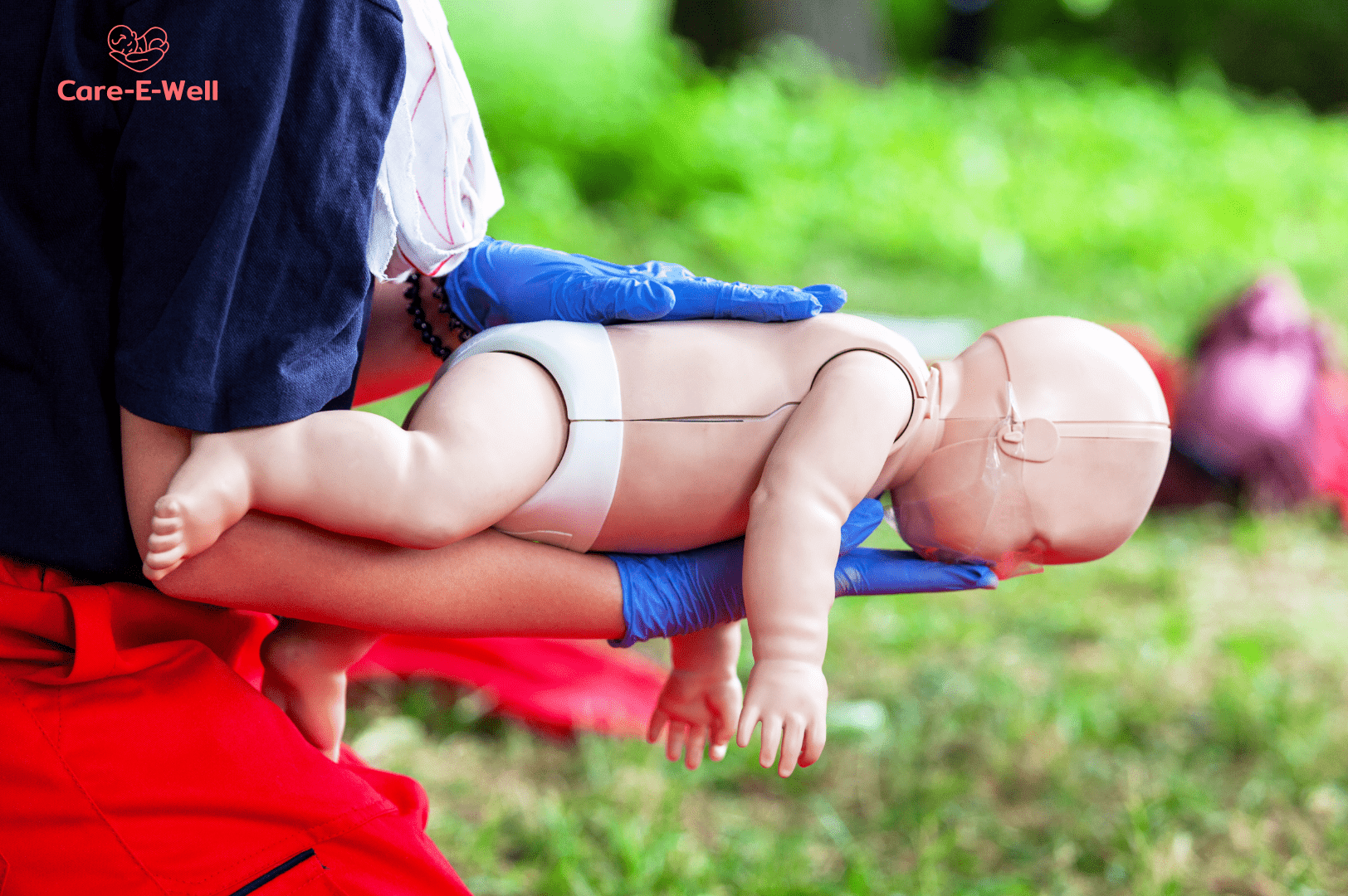
Infant choking first aid starts with one decision: is the baby still moving air effectively? If an infant can cough strongly, cry or make sound, stay close and let the cough work. If the cough becomes weak or silent, the baby cannot breathe or cry effectively, or colour and responsiveness worsen, treat this as severe choking and act immediately.
For a conscious infant under one year with an ineffective cough, current paediatric resuscitation guidance uses back blows followed by chest thrusts. Abdominal thrusts are not used for infants. If the baby becomes unresponsive, the response changes to emergency activation and infant CPR.
A strong cough is useful. A silent or weak cough with poor air movement is dangerous. The aim is to recognise that change quickly and move from observation to active choking first aid.
How can you tell gagging from choking?
Gagging and coughing can look dramatic, especially when babies are learning to eat, but they still involve air moving through the airway. A baby who is coughing forcefully, making noise, crying or breathing is not managed the same way as a baby with severe airway obstruction.
Severe choking may be quieter than parents expect. The infant may be unable to cry normally, produce only a weak or silent cough, struggle without effective air movement, become blue or grey, or lose responsiveness.
If the baby is unable to breathe effectively, cannot cry or cough effectively, becomes blue or grey, or becomes unresponsive, activate emergency medical help and begin age-appropriate first aid immediately.
What should you do if the infant is coughing effectively?
Encourage the baby to keep coughing and watch closely. Do not start back blows or chest thrusts while the infant has an effective cough, because unnecessary interventions can worsen a partial obstruction.
Stay ready to act if the cough weakens, breathing becomes ineffective or the baby becomes less responsive. If another adult is present, they can prepare to call the local emergency number while you remain with the infant.

What should you do if the infant has an ineffective cough?
If the infant is conscious but has severe airway obstruction, use the choking sequence taught in current paediatric first-aid training. European guidance uses five back blows followed, if needed, by five chest thrusts, repeating the sequence while the infant remains conscious and the obstruction persists.
- Sit or kneel so you can support the baby securely.
- Position the infant face-down along your forearm or thigh, with the head lower than the chest and the head and jaw supported.
- Give up to five firm back blows between the shoulder blades with the heel of your hand.
- Check after each blow whether the object has been expelled and breathing has improved.
- If the obstruction remains, carefully turn the infant face-up while supporting the head and neck.
- Give up to five chest thrusts on the breastbone using the infant choking technique taught in a current paediatric first-aid course.
- Continue alternating up to five back blows and five chest thrusts until the obstruction clears or the baby becomes unresponsive.
The exact hand position and force are practical skills that are much easier to learn on an infant manikin than from text. Parents and regular caregivers benefit from practising them in an accredited paediatric first-aid course.
Do not use abdominal thrusts on a baby under one year. Infant anatomy and the recommended rescue technique differ from those for an older child.
Should you call emergency services immediately?
Severe choking can progress rapidly. If the infant cannot breathe effectively, emergency services should be activated as soon as possible. If another person is present, have them call while you begin choking first aid. If you are alone, use a speakerphone if practical and follow the dispatcher's instructions without delaying care.
Emergency dispatchers can guide the sequence while help is travelling. This is particularly valuable when a parent is frightened or uncertain about the next step.
What if you can see the object in the baby's mouth?
If the object is clearly visible and can be removed easily without pushing it deeper, remove it carefully. Do not repeatedly probe the mouth.
Never perform a blind finger sweep. Putting a finger into the mouth when you cannot see the object can push it farther into the airway or injure delicate tissues.
What if the baby becomes unresponsive?
If the infant becomes unresponsive, place them on a firm, flat surface and activate emergency medical services if that has not already happened. Begin infant basic life support according to your current training and the dispatcher's instructions.
During CPR for choking, each time the airway is opened for rescue breaths, look for a clearly visible object. Remove it only if you can see it and can take it out safely. Do not spend time searching blindly in the mouth.
An unresponsive infant who is not breathing normally needs immediate resuscitation. Start infant CPR according to current paediatric guidance or dispatcher instructions and continue until the baby shows signs of life or trained help takes over.
Why does CPR become necessary after choking?
Complete airway obstruction prevents oxygen from reaching the lungs. If it is not relieved, the infant can lose consciousness and progress to cardiac arrest. Paediatric cardiac arrest is often related to respiratory failure or lack of oxygen, which is why rescue breaths remain an important part of infant and child CPR.
Chest compressions during CPR may also generate pressure that helps move a foreign body, but CPR is not a substitute for the conscious-infant choking sequence. The approach changes because an unresponsive infant can no longer maintain posture or cough.
Should you use an anti-choking suction device?
Commercial suction devices are marketed for airway obstruction, but the clinical evidence is still limited and includes experimental studies, case reports and observational data. They should not replace established choking first aid or delay emergency activation.
If a family chooses to keep such a device, everyone should still learn standard infant choking first aid and infant CPR. The device should never become a reason to postpone back blows, chest thrusts or calling for professional help.
Does the baby need medical assessment if the object comes out?
Often, yes—especially after a severe choking episode, chest thrusts, ongoing cough, wheeze, noisy breathing, difficulty swallowing or any uncertainty that the object was completely expelled. A foreign body can sometimes remain deeper in the airway even after the dramatic choking settles.
Persistent cough, one-sided wheeze, breathing difficulty, recurrent respiratory symptoms or a convincing history of aspiration warrant medical assessment. Some aspirated objects are not visible on a standard chest X-ray, so the history and clinical picture matter.
Seek urgent medical help if breathing remains abnormal, the infant becomes unusually sleepy, develops blue or grey colour, has persistent noisy breathing, or symptoms return after an apparent recovery.
What foods and objects commonly cause choking?
Choking prevention matters because infants explore with their mouths and have immature chewing skills. Foods that are hard, round, smooth, sticky or difficult to break down can obstruct the airway, as can small toy parts and household objects.
- whole nuts and hard pieces of food
- whole grapes or similarly shaped foods unless prepared appropriately
- hard sweets
- chunks of raw hard vegetables or fruit
- pieces of sausage or other round foods that are not cut safely
- coins and small toy parts
- button batteries
- pen caps, beads and small household items
Food preparation must match the baby's developmental abilities. Supervise eating, keep the child upright and avoid feeding while the baby is crawling, walking, playing or riding in a moving vehicle.
Can babies choke on milk?
Babies can cough, splutter or briefly struggle with a fast milk flow without having a solid foreign body obstruction. If the baby is coughing and recovering, allow them to clear the airway and reassess feeding.
Persistent breathing difficulty, blue colour, limpness or inability to breathe normally is an emergency regardless of whether milk, food or another cause is suspected. Recurrent coughing or choking during feeds also deserves clinical assessment because feeding and swallowing difficulties can have several causes.

What should parents practise before an emergency happens?
The most valuable preparation is hands-on training. Choking is a high-stress event, and correct positioning, support of the infant and placement of chest thrusts are motor skills rather than facts to memorise.
- practise recognising effective versus ineffective cough
- practise five back blows and five chest thrusts on a manikin
- learn how the sequence changes when the infant becomes unresponsive
- practise infant CPR, including rescue breaths
- know your local emergency number
- teach grandparents, babysitters and other regular caregivers
Reading the sequence helps you understand it. Practising on a manikin helps your hands know what to do when seconds matter.
Frequently asked questions
Can I hold a choking baby upside down by the feet?
No. Use a supported face-down position with the baby's head lower than the chest for back blows. Holding a baby by the feet risks dropping or injuring them and is not the recommended technique.
Should I give water to wash the object down?
No. Do not give food or drink during an active choking episode. The priority is restoring the airway.
Should I pull food out with my finger?
Only remove an object that you can clearly see and reach safely. Do not sweep a finger blindly through the mouth.
Can I use abdominal thrusts on an infant?
No. For infants under one year, current guidance uses back blows and chest thrusts. Abdominal thrusts are used in older children according to the applicable paediatric choking algorithm.
Should a caregiver learn infant CPR as well as choking first aid?
Yes. Severe choking can lead to unconsciousness and cardiac arrest, so choking training and infant CPR belong together.
The key takeaway
Infant choking first aid depends on recognising whether the baby still has an effective cough. Let an effective cough work. For a conscious infant with severe obstruction, use up to five back blows followed by up to five chest thrusts and repeat as needed; do not use abdominal thrusts. If the infant becomes unresponsive, activate emergency services and begin infant CPR. Hands-on paediatric first-aid training is the best way to turn this knowledge into a skill you can use safely.
Sources and References
- Djakow J, Turner NM, Skellett S, et al. — European Resuscitation Council Guidelines 2025 Paediatric Life Support
- Joyner BL, Dewan M, Bavare A, et al. — Part 6: Pediatric Basic Life Support: 2025 AHA and AAP Guidelines for CPR and Emergency Cardiovascular Care
- Bieliński JR, Huntley R, Timler D, et al. — Medical Students’ Knowledge and Adherence to Paediatric Choking Rescue Manoeuvre Guidelines
- Montana A, Salerno M, Feola A, et al. — Risk Management and Recommendations for the Prevention of Fatal Foreign Body Aspiration
- Markov S, Markova P, Karavelikova I, et al. — Foreign Bodies in Lower Airway in Children: Brief Review and Clinical Experience
- Hristonof MLS, Lazzaretti FJ, Bernardes MM, et al. — Comparative efficacy of LifeVac and Heimlich maneuver in simulated airway obstruction
- Goto Y, Funada A, Maeda T, et al. — Dispatcher-assisted conventional cardiopulmonary resuscitation and outcomes for paediatric out-of-hospital cardiac arrests
- Murasaka K, Yamashita A, Owada H, et al. — Association between the types of bystander cardiopulmonary resuscitation and survival with good neurologic outcome of preschool pediatric out-of-hospital cardiac arrest
- Kuru M, Altınok T, Yılmaz R, et al. — Evaluation of Preoperative Capnographic Parameters in Children with Suspected Foreign Body Aspiration
Did this Insight help?
A little love for something worth reading.


