
Care-E-Well Insights
Infant CPR: What Parents Need to Know
Infant CPR basics for parents: when to start, why rescue breaths matter, how compressions work, AED use and when to call emergency help.
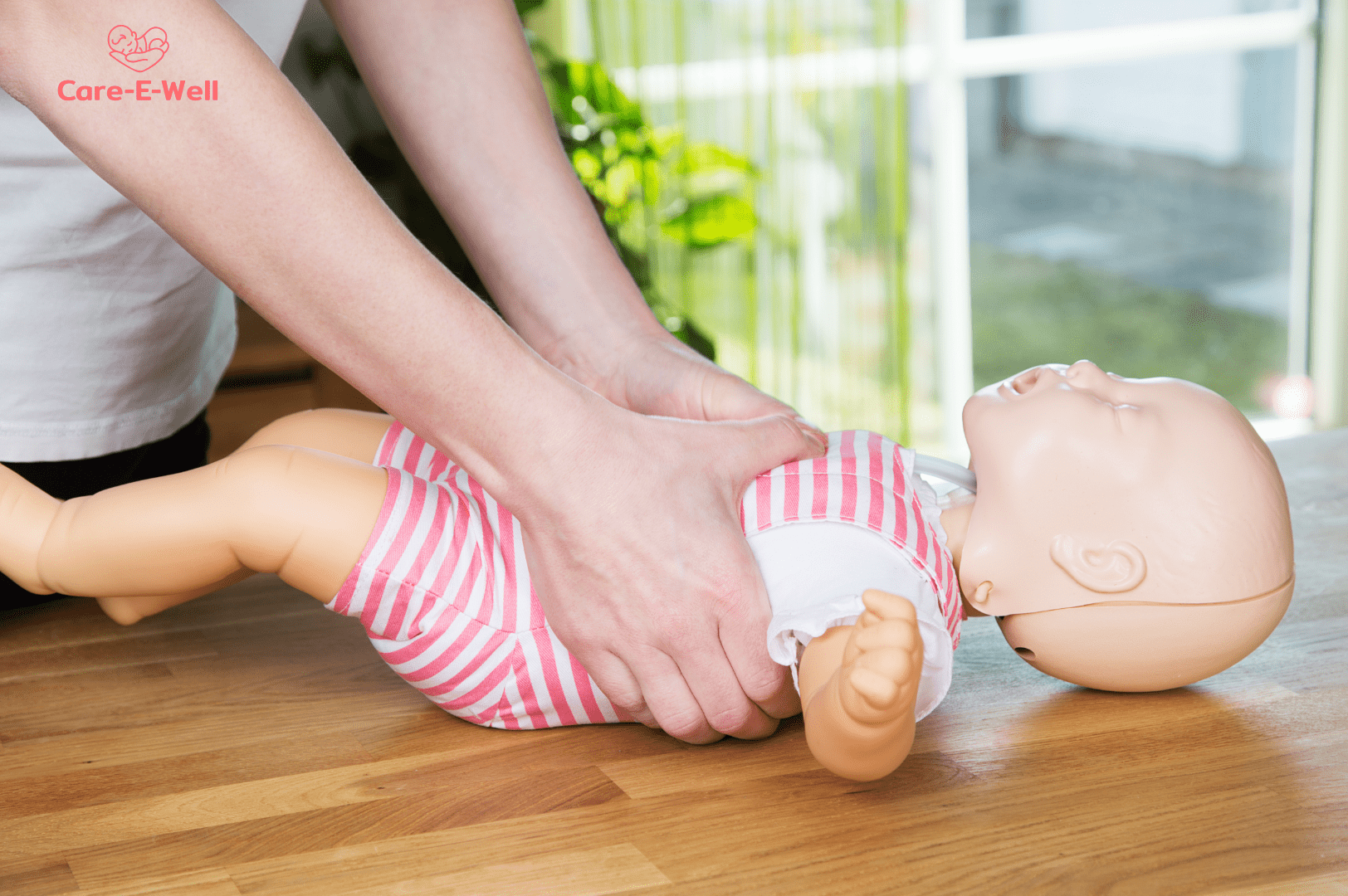
Infant CPR is needed when a baby is unresponsive and not breathing normally. In that situation, call the local emergency number, put the phone on speaker if possible, and start resuscitation rather than waiting to understand why the baby collapsed. Emergency dispatchers can guide you while help is on the way.
Infant CPR is different from adult CPR because cardiac arrest in babies is often preceded by breathing failure or lack of oxygen. Rescue breaths therefore remain an important part of paediatric resuscitation. The safest preparation is a current hands-on infant CPR course, but knowing the core sequence can make the first moments less confusing.
If an infant is unresponsive and not breathing normally, treat it as an emergency. Call, start CPR and follow the dispatcher's instructions.
When should you start infant CPR?
Start CPR when an infant is unresponsive and is not breathing normally. Occasional gasps are not normal breathing. Do not spend a long time checking for subtle signs or trying to diagnose the cause.
Current paediatric basic-life-support guidance emphasises rapid recognition, effective ventilation, high-quality chest compressions and early emergency activation. If you are unsure whether the breathing you see is normal, describe it to the dispatcher and follow their instructions.
An unresponsive infant who is not breathing normally needs immediate emergency care. Activate emergency medical services and begin infant CPR according to current training or dispatcher guidance.
What should you do first?
Make sure the scene is safe before approaching. Fire, electricity, traffic, water, smoke or other hazards can create a second casualty.
- Check whether the infant responds to your voice and gentle stimulation.
- Open the airway using the infant technique taught in paediatric first-aid training.
- Check for normal breathing briefly, for no more than about 10 seconds.
- Activate emergency services or have another person call and bring an AED if one is available.
- Begin the paediatric basic-life-support sequence you have been trained to use.
European paediatric BLS teaching includes initial rescue breaths because lack of oxygen is a common pathway to cardiac arrest in babies. Exact sequencing can vary slightly between training systems, so in a real emergency follow your accredited training and the emergency dispatcher's instructions.
Why are rescue breaths important for infants?
Adult sudden cardiac arrest is often caused by a primary heart rhythm problem. In infants, arrest more commonly follows respiratory failure, airway obstruction, drowning or another process that reduces oxygen. That difference makes ventilation especially relevant.
Observational research in paediatric out-of-hospital cardiac arrest supports bystander CPR, and several studies have found better neurological outcomes with conventional CPR that includes rescue breaths than with no CPR. Compression-only CPR is still better than doing nothing when a rescuer cannot provide breaths.
If you are trained and able, infant CPR should include rescue breaths. If you cannot give breaths, start chest compressions rather than giving no CPR at all.
How do you give rescue breaths to an infant?
Position the infant on a firm, flat surface. Open the airway gently without overextending the neck. In standard infant rescue breathing, a rescuer typically seals their mouth over the baby's mouth and nose and gives a small breath sufficient to make the chest visibly rise.
An infant needs much less air than an adult. Forceful or excessive ventilation can inflate the stomach and interrupt chest compressions. Give only enough air to produce visible chest movement.
If the chest does not rise, reposition the head and check the mouth for a clearly visible obstruction before trying again. Do not perform blind finger sweeps.

How are chest compressions performed on an infant?
Chest compressions are delivered over the lower half of the breastbone, avoiding the very bottom tip of the sternum. Current paediatric resuscitation guidelines prioritise adequate depth, a rate of about 100–120 compressions per minute, full recoil and minimal interruptions.
The target depth is approximately one-third of the front-to-back depth of the infant's chest, roughly 4 cm for most infants. The exact hand or finger technique can depend on the number of rescuers and the training system; modern guidelines increasingly emphasise whichever recommended technique allows reliable depth and recoil.
This is one of the reasons a manikin course is valuable. A written description cannot tell you whether your compressions are deep enough or whether you are leaning on the chest between compressions.
CPR is intended for an infant who is unresponsive and not breathing normally. Do not practise compressions on a healthy baby.
How many compressions and breaths should you give?
Compression-to-ventilation ratios vary according to rescuer training and the number of rescuers. Current paediatric systems commonly use 30 compressions to 2 breaths for a single lay rescuer in some protocols and 15 to 2 in paediatric-trained or two-rescuer situations.
Because Care-E-Well readers may live in different European countries or have been trained under different recognised systems, follow the ratio taught by your current accredited course or the emergency dispatcher. The priorities are to start promptly, ventilate effectively, compress at the correct rate and depth, and minimise pauses.
Do not stop CPR to search online for a ratio. Once an emergency call is active, speakerphone guidance is more useful than trying to compare guidelines in real time.
What if you are alone with the baby?
The ideal sequence depends on how the collapse happened, whether you have a phone immediately available and your local paediatric BLS training. If a mobile phone is within reach, activate emergency services on speaker without leaving the infant and begin CPR.
If you cannot call without leaving the baby, paediatric training may instruct a lone rescuer to provide a period of CPR before going for help in certain unwitnessed/asphyxial situations. This detail is best learned through local training because emergency systems and algorithms differ.
In a real emergency, the dispatcher can adapt instructions to your situation. The goal is not to remember every branch of an algorithm perfectly; it is to start effective care quickly.
When should you use an AED on an infant?
An automated external defibrillator can analyse the heart rhythm and advise a shock when appropriate. Cardiac arrest in infants is less often caused by a shockable rhythm than adult arrest, but early AED access still matters when a shockable rhythm is present.
Use paediatric pads or a paediatric mode when available and appropriate for the device. If only a standard AED is available, follow the device instructions and emergency dispatcher or current local training rather than delaying resuscitation while searching for different equipment.
Make sure pads do not touch each other. On a very small chest, one pad may need to be placed on the chest and the other on the back, depending on the device instructions.
What if the baby starts breathing again?
Stop chest compressions if the infant shows clear signs of life and begins breathing normally, but continue close observation until professional help arrives. A baby who has required CPR needs urgent medical assessment even if they appear to recover.
If the infant remains unresponsive but is breathing normally, maintain an open airway and position them safely according to your training while monitoring breathing continuously.
Do not cancel emergency care after apparent recovery from a cardiac arrest or significant breathing event unless the emergency medical service specifically advises you to do so.
What if choking caused the collapse?
If a choking infant becomes unresponsive, the response changes from back blows and chest thrusts to infant CPR. Each time you open the airway for breaths, look for a clearly visible object and remove it only if you can do so safely.
Do not continue the conscious-infant choking sequence once the infant is unresponsive, and do not perform blind finger sweeps.
What if drowning caused the collapse?
Drowning is primarily an oxygen-deprivation emergency, so ventilation is particularly important. Remove the infant from the water only when it is safe for you to do so, activate emergency services and start paediatric resuscitation if the infant is unresponsive and not breathing normally.
Do not waste time trying to drain water from the lungs. Follow current paediatric CPR and dispatcher instructions.
Can CPR hurt an infant?
Effective compressions are forceful enough to move the chest and can cause injury, but the alternative in true cardiac arrest is no circulation to the brain and other organs. Fear of causing a rib or chest injury should not prevent CPR when an infant is unresponsive and not breathing normally.
Technique matters, however. Correct hand position, depth and recoil reduce avoidable errors, which is another reason practical instruction is worthwhile.

How does dispatcher-assisted CPR help?
Cardiac arrest is stressful, and even trained adults can forget sequences. Dispatcher-assisted CPR provides immediate coaching, confirms when to start, helps with rhythm and counting, and keeps the emergency response moving.
Studies of paediatric out-of-hospital cardiac arrest have found that dispatcher assistance increases bystander CPR and is associated with better outcomes in some populations. Put the phone on speaker so both hands remain available.
What are common mistakes parents should avoid?
- waiting too long because breathing looks like occasional gasps
- spending excessive time checking for a pulse
- delaying CPR while searching for online instructions
- giving large or forceful rescue breaths
- compressing too slowly, too shallowly or with long pauses
- leaning on the chest instead of allowing full recoil
- stopping CPR for repeated checks without a clear sign of life
- withholding all CPR because rescue breaths feel difficult
Parents are not expected to perform like a resuscitation team. Early, reasonably good CPR is far more useful than perfect CPR that never starts.
How can parents prepare before they ever need infant CPR?
Take an accredited paediatric first-aid course that includes manikin practice. Ask grandparents, babysitters and other regular caregivers to learn too.
- practise recognising unresponsiveness and abnormal breathing
- practise airway opening and infant rescue breaths
- practise compression position, depth and rate
- learn the compression-to-ventilation ratio used in your local course
- practise using an AED trainer
- know the local emergency number
- refresh skills periodically
CPR skill fades when it is never used. Short periodic refreshers and manikin practice are more useful than reading the algorithm once and assuming it will stay automatic.
Frequently asked questions
Do I need to check an infant's pulse before starting CPR?
Lay rescuers should not delay CPR with a prolonged pulse check. If the infant is unresponsive and not breathing normally, activate emergency help and follow current paediatric BLS or dispatcher instructions.
Is gasping normal breathing?
No. Occasional abnormal gasps can occur in cardiac arrest and should not be mistaken for normal breathing.
Can I do compression-only CPR on a baby?
If you cannot or will not give rescue breaths, chest compressions are better than no CPR. However, because many infant arrests are related to lack of oxygen, CPR with rescue breaths is preferred when the rescuer is trained and able.
How fast should infant chest compressions be?
Major paediatric resuscitation guidelines target about 100–120 compressions per minute, with full recoil and as few interruptions as possible.
Should I take an infant CPR course before birth?
It is a useful time to learn because parents can practise without the pressure of caring for a newborn. A refresher after the baby arrives can reinforce the skill.
The key takeaway
Infant CPR is for a baby who is unresponsive and not breathing normally. Call emergency services, begin paediatric resuscitation promptly, include rescue breaths if you are trained and able, compress the chest at about 100–120 per minute to roughly one-third of its depth, and minimise interruptions. Ratios and detailed hand techniques should follow your current accredited course and local dispatcher guidance. The strongest preparation is hands-on practice before an emergency happens.
Sources and References
- Djakow J, Turner NM, Skellett S, et al. — European Resuscitation Council Guidelines 2025 Paediatric Life Support
- Joyner BL, Dewan M, Bavare A, et al. — Part 6: Pediatric Basic Life Support: 2025 AHA and AAP Guidelines for CPR and Emergency Cardiovascular Care
- Lee J, Kim DK, Kim J-T, et al. — 2025 Korean Guidelines for Cardiopulmonary Resuscitation: Part 7. Pediatric basic life support
- Lee JE, Kim M, Choi EK, et al. — Updated pediatric cardiopulmonary resuscitation: a comprehensive review of the 2025 guidelines
- Goto Y, Funada A, Maeda T, et al. — Dispatcher-assisted conventional cardiopulmonary resuscitation and outcomes for paediatric out-of-hospital cardiac arrests
- Murasaka K, Yamashita A, Owada H, et al. — Association between the types of bystander cardiopulmonary resuscitation and survival with good neurologic outcome of preschool pediatric out-of-hospital cardiac arrest
- Naim MY, Burke RV, McNally B, et al. — Association of Bystander Cardiopulmonary Resuscitation With Overall and Neurologically Favorable Survival After Pediatric Out-of-Hospital Cardiac Arrest
- Morimoto M, Kiyohara K, Kitamura T, et al. — Impact of Dispatcher-Assisted Bystander Cardiopulmonary Resuscitation on Neurological Outcomes in Children With Out-of-Hospital Cardiac Arrests
- Hsu CH, Neumar RW — To Breathe or Not to Breathe
- Peters MA, Stipulante S, Cloes V, et al. — Can Video Assistance Improve the Quality of Pediatric Dispatcher-Assisted Cardiopulmonary Resuscitation?
Did this Insight help?
A little love for something worth reading.


