
Care-E-Well Insights
What Is the M-Position in Babywearing?
Learn what the M-position in babywearing means, how hips and knees are supported, and why it is a guide rather than a rigid shape.
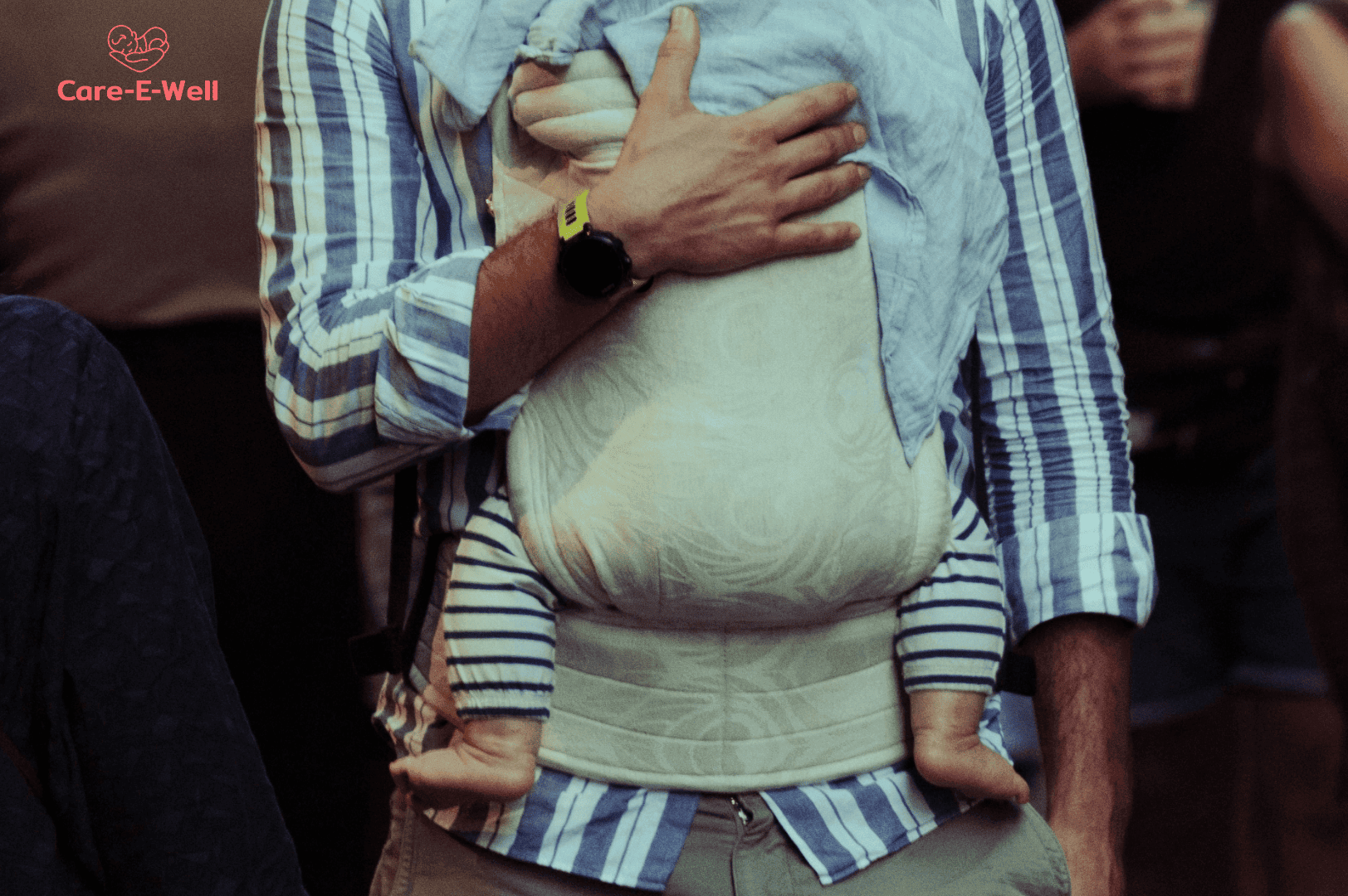
What is the M-position in babywearing? It is a practical way to describe a carried baby with the hips and knees flexed, the thighs supported and the legs allowed to open comfortably around the caregiver. From the front, the bottom sits between the two knees, creating a shape that can resemble the letter M.
The idea is useful, but it is not a rigid pose that every baby must copy. A safe carrier fit should respect the baby’s size, natural range of movement and developmental stage. Most importantly, the M-position never comes before airway safety: the face must remain visible, the nose and mouth clear and the chin away from the chest.
Think “supported flexion and comfortable hip opening,” not “force the legs into a perfect letter M.”
What does the M-position actually look like?
In an inward-facing carrier, the baby’s pelvis rests against the adult and the thighs are supported by the carrier seat. The hips are bent rather than hanging straight down, and the knees are also flexed.
The thighs usually angle upward from the bottom, which is why parents often hear that the knees should be level with or higher than the bottom. That visual description can be helpful, but exact knee height varies with the baby’s age, body proportions, carrier design and how deeply the pelvis sits in the seat.
The important feature is not the letter itself. It is that the baby is supported through the pelvis and thighs without the legs being held straight together or forced into an uncomfortable wide split.
Why is the M-position called hip-friendly?
Developmental dysplasia of the hip involves abnormal development or instability of the relationship between the femoral head and the hip socket. Postnatal positioning is only one part of a multifactorial condition, but prolonged positions that tightly restrict the hips and knees in extension have been associated with concern for hip development.
In contrast, flexion and abduction—the hips bent and comfortably opened—are also used in orthopaedic devices that treat some infants with developmental dysplasia. This similarity is one reason flexed, supported babywearing positions are described as hip-friendly.
Experimental studies have found that some inward-facing commercial carriers hold healthy infants in hip positions comparable in certain measurements with a Pavlik harness. Ultrasound research has also shown reassuring immediate hip parameters in healthy infants carried in tested inward-facing carriers.
These studies examine positioning and biomechanics. They do not prove that babywearing prevents developmental dysplasia or that a carrier can replace screening, diagnosis or treatment.

Does the M-position prevent hip dysplasia?
No. Current evidence does not support promising parents that an M-position carrier will prevent developmental dysplasia of the hip.
Hip dysplasia has several recognised risk factors, including family history, breech presentation and other biological or developmental influences. A favourable carrying position may avoid unnecessarily restrictive lower-limb positioning, but it is not a medical prevention programme.
If your baby has diagnosed or suspected hip dysplasia, follow the orthopaedic plan. Do not change brace use, carrying position or treatment based only on generic babywearing advice.
Do the knees have to be higher than the bottom?
Not by a fixed number of centimetres. “Knees higher than bottom” is a useful shorthand that helps many parents recognise flexed hips, but it should not become a visual test that overrides comfort and fit.
A small newborn may sit with a compact, deeply flexed posture. An older baby with longer legs may show a broader, less curled shape. Different carriers also support the thighs at different points.
Look for a pelvis that is well supported, bent knees, comfortable hip opening and thighs supported rather than dangling. If achieving a dramatic M requires pushing the knees upward or spreading the legs farther than they naturally go, the fit needs reconsidering.
How wide should the legs be?
The hips should be able to open within the baby’s comfortable range. More abduction is not automatically better.
A carrier panel that is too wide for a small baby can push against the lower legs or force the knees farther apart than comfortable. A panel that is too narrow may support little of the thighs and leave the legs hanging more vertically.
The goal is size-matched support. In many adjustable structured carriers, this means narrowing the seat for a newborn and gradually widening it as the baby grows. In wraps and slings, the fabric can be spread to support the thighs without pulling the legs apart.
“Wide base” is not a quality score by itself. The correct width is the width that fits this baby now.
Where should the carrier support the thighs?
Support usually extends under the thighs toward the knee area, but it should not create hard pressure directly in the knee crease or push the lower legs outward.
The exact endpoint varies with carrier design. What matters is that the baby’s weight is not concentrated only on a narrow crotch area and that the legs remain free to move.
Check both sides. If one leg is much lower, one knee is being pushed up, or the pelvis consistently rotates to one side, loosen and reset the baby before retightening the carrier.
What should the pelvis and back look like?
A newborn often has a naturally rounded trunk and flexed posture. The carrier should support that posture without allowing the baby to collapse into a deep slump.
The pelvis should feel supported rather than hanging away from the adult. A snug carrier keeps the baby close enough that the trunk moves with the wearer. Excess slack can let the baby sink lower, which can change both hip position and airway alignment.
Do not chase a particular spinal curve from photographs. The practical checks are stability, age-appropriate head and trunk support, free breathing and comfortable lower-limb positioning.
Is the M-position different for a newborn?
Newborns are smaller, more flexed and less able to control the head and trunk. Their knees may naturally sit relatively high and close to the body, but the carrier must not force the legs into a predetermined width.
Some newborns initially keep the legs more tucked; others open the hips more readily. Use a carrier mode approved for the baby’s size and follow its newborn instructions rather than improvising with rolled towels, cushions or unapproved inserts.
Airway protection is more urgent than obtaining a textbook M. The face should remain uncovered and visible, the nose and mouth clear, and the chin should not be pressed toward the chest.
Can the M-position be too deep?
Yes. A baby can be folded too deeply even if the hips look flexed. If the pelvis sinks so low that the trunk curls sharply and the chin approaches the chest, the position is unsafe.
Tighten and support the carrier so the baby remains upright against the adult rather than hanging in a fabric pocket. Young babies should not disappear below carrier panels or inside deep sling fabric.
A good hip position never compensates for a compromised airway. Reposition immediately if the baby’s face is hidden, the chin is on the chest or breathing appears restricted.
Are narrow-base carriers always unsafe?
The evidence is not strong enough to classify every carrier by seat width alone as safe or unsafe. Carrier design, infant size, duration, movement and the actual position achieved all matter.
Research comparing carrier designs has found measurable differences in hip position, but long-term clinical outcomes are less certain. The most defensible approach is to avoid prolonged forced extension and adduction and choose a carrier that provides comfortable, size-appropriate thigh support.
Marketing labels such as “ergonomic” or “hip healthy” should not replace checking the baby in the actual carrier.

Can you create the M-position in a wrap or ring sling?
Yes. The M-position is a description of the baby’s body position, not a feature exclusive to structured carriers.
In a woven or stretchy wrap, fabric can be spread under the thighs while the pelvis settles against the wearer. In a ring sling, the fabric seat can support from one side of the knee area to the other while the baby remains upright and close.
These carriers require technique. Uneven tension, excessive slack or a deep pouch can undo an otherwise good lower-body position, so check airway and trunk stability as carefully as the legs.
What common mistakes happen when parents aim for the M-position?
- Spreading the legs wider than the baby comfortably allows
- Pulling the knees upward simply to match a photograph
- Choosing a seat wider than the baby because “wider must be healthier”
- Ignoring a rotated pelvis or uneven legs
- Letting the baby slump deeply to create a lower bottom
- Focusing on the hips while the face or airway is poorly positioned
- Assuming the M-position treats or prevents hip dysplasia
A useful M-position should emerge from good overall fit rather than from manipulating individual body parts into place.
How can you check the M-position quickly?
- Confirm the baby’s face is visible and the airway is clear.
- Check that the carrier is snug enough to prevent slumping.
- Look at the pelvis: it should be supported against the wearer.
- Check that both hips and knees are comfortably flexed.
- Make sure the thighs have useful support on both sides.
- Confirm that neither leg is forced unusually high, low or wide.
- Recheck after the baby falls asleep or after you have been walking for a while.
If the position changes quickly after you start moving, the carrier may need more even tightening or a different adjustment for the baby’s current size.
Frequently asked questions
Is the M-position mandatory for every baby carrier?
The principle of comfortable flexion and thigh support is useful, but no single visual M is mandatory. Fit should adapt to the baby and carrier.
Should newborn knees touch the adult’s body?
They often rest naturally around the wearer, but there is no need to force them against the torso. Comfortable alignment matters more than a specific contact point.
Is a deeper M always healthier for the hips?
No. More flexion or abduction is not automatically better. Excessive positioning can be uncomfortable and may compromise overall fit.
What if one leg never sits like the other?
Reset the carrier and baby first. If persistent asymmetry, limited hip movement or a known hip concern remains, ask the baby’s clinician for assessment.
The key takeaway
What is the M-position in babywearing? It is a shorthand for supported, flexed hips and knees with the thighs comfortably opened around the wearer. It helps parents think about lower-body support, but it is not a rigid target or a treatment for hip dysplasia.
Judge the whole position: clear airway, stable trunk, supported pelvis, comfortable thighs and freedom from forced spreading. A good M-position should look natural because the carrier fits—not because the baby has been pushed into shape.
Sources and references
- World Health Organization. Kangaroo mother care: a clinical practice guide. https://www.who.int/publications/i/item/9789240115910
- Lovell-Kennedy SR, Strong RLJ, Grieve LM, et al. Safety and benefits of adult-worn slings and baby carriers: a narrative systematic review to inform guidance for parents. https://doi.org/10.1136/bmjpo-2026-004693
- Sidharthan S, Kehoe C, Dodwell ER, et al. Post-Natal Positioning through Babywearing: What the Orthopaedic Surgeon Needs to Know. https://doi.org/10.55275/jposna-2020-131
- Siddicky SF, Wang J, Rabenhorst BM, et al. Exploring infant hip position and muscle activity in common baby gear and orthopedic devices. https://doi.org/10.1002/jor.24818
- Siddicky SF, Eckels J, Rabenhorst BM, et al. Ultrasonographic evaluation of infant hips in the Pavlik harness compared to body-worn commercial baby carriers. https://doi.org/10.1002/jor.25571
- Bracken J, Tran T, Ditchfield M. Developmental dysplasia of the hip: Controversies and current concepts. https://doi.org/10.1111/j.1440-1754.2012.02601.x
- Studer K, Williams N, Antoniou G, et al. Increase in late diagnosed developmental dysplasia of the hip in South Australia: risk factors, proposed solutions. https://doi.org/10.5694/mja15.01082
- Storz D, Dame C, Wendt A, et al. Sudden Unexpected Death of Two Infants in Baby Carriers. https://doi.org/10.1055/a-1545-4590
- Bigelow AE, Williams LR. To have and to hold: Effects of physical contact on infants and their caregivers. https://doi.org/10.1016/j.infbeh.2020.101494
Did this Insight help?
A little love for something worth reading.


