
Care-E-Well Insights
What to Do If a Newborn’s Head Slumps Forward in the Car Seat
If your newborn's head slumps forward in the car seat, check recline, fit and harness first. Learn safe fixes and when to seek help.
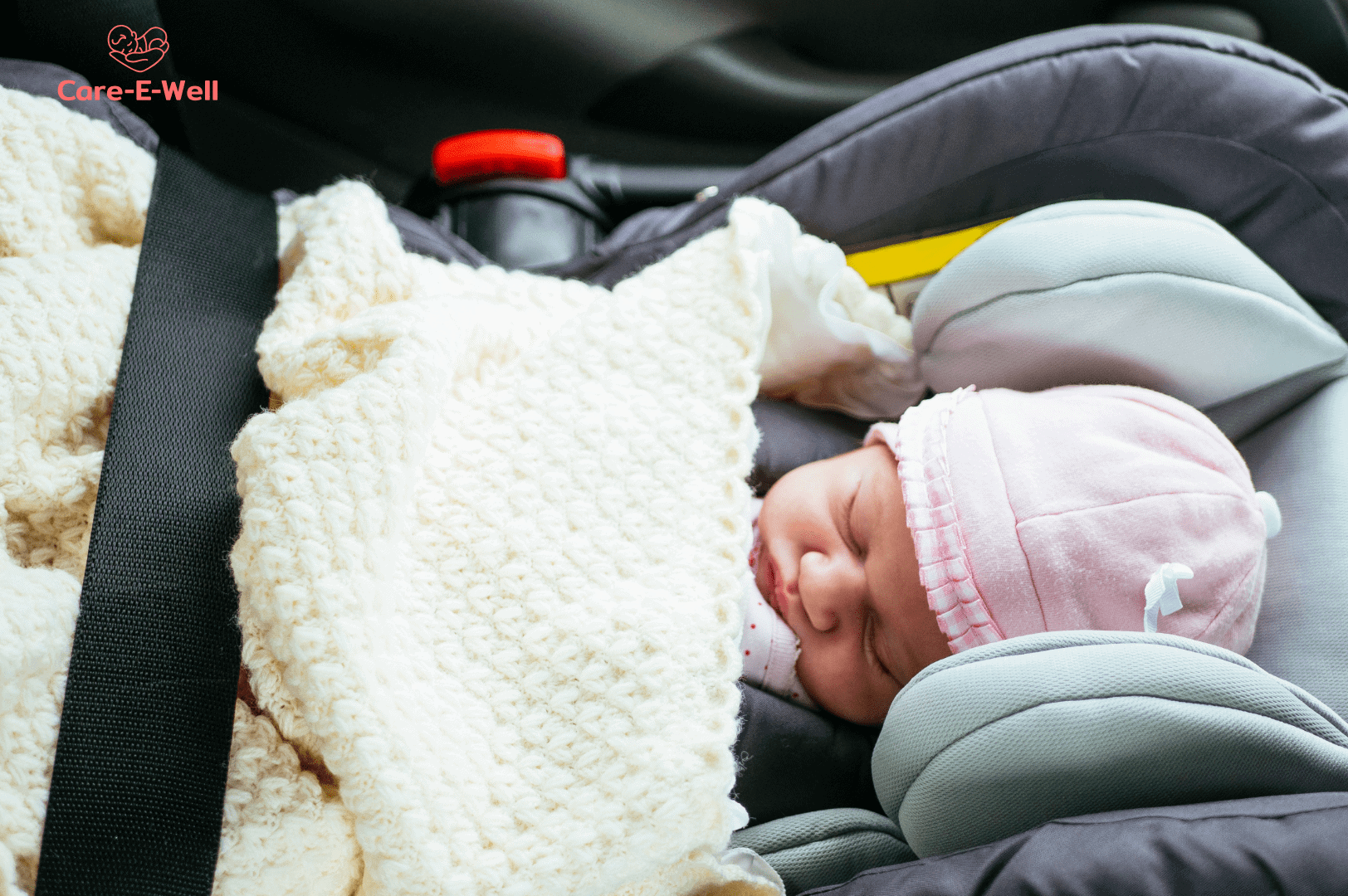
If a newborn's head slumps forward in the car seat, first stop and check the basics: the seat's recline angle, installation, approved newborn insert, the baby's position and harness fit. A young baby's chin should not be forced down tightly onto the chest, because marked neck flexion can narrow the airway.
Do not fix the problem by adding a pillow, generic head support or extra padding. Those products can alter the baby's position and harness geometry. If the head continues to fall forward despite correct use of the restraint, get the fit checked and seek medical advice when the baby is premature, unusually small, has low muscle tone or has breathing concerns.
A newborn does not need the head held rigidly straight, but the baby should not remain deeply slumped with the chin pressed toward the chest.
Why can a newborn's head fall forward?
Newborns have a relatively large head and limited neck control. In a semi-upright seat, gravity can pull the head forward when the restraint is too upright, the baby slides down, the pelvis is not positioned correctly or the approved insert configuration is wrong.
Vehicle seat shape also matters. A steep rear bench can change the effective angle of the child restraint, which is why manufacturers provide recline indicators and vehicle-specific installation instructions.
Some babies are more vulnerable than others. Premature infants, babies with low muscle tone and babies with cardiorespiratory or neurological conditions may have more difficulty maintaining stable positioning.
Is head slumping dangerous?
A slight turn of the head to one side is different from marked forward slumping. The concern with forward flexion is that the chin approaches the chest and the upper airway may narrow.
In a pilot study, Tonkin and colleagues found evidence that head flexion contributed to upper-airway narrowing in preterm infants positioned in car seats. Other studies have recorded oxygen desaturation in some term and preterm babies while restrained in semi-upright car seats.
These studies do not mean that every sleepy newborn in a car seat is in immediate danger. They show why correct positioning deserves attention, especially in the first weeks and in medically vulnerable babies.

Step 1: check the recline indicator
The first practical check is the seat's approved recline angle. Do not assume that a universal 45-degree number applies to every seat.
Park on level ground, check the built-in indicator and compare it with the manual. If the seat is too upright, reinstall it using only the adjustment method the manufacturer allows.
Never put loose objects under the restraint unless the manufacturer specifically permits a levelling method such as a rolled towel in a defined location.
Step 2: make sure the baby's bottom is fully back
A baby who has slid forward can round through the back and neck, making head slumping more likely. Before tightening the harness, place the baby's bottom and back against the restraint as the manual shows.
Do not pull the baby down by the legs or push forcefully on the head. Reposition the pelvis and torso gently, then secure the harness.
If the restraint includes a crotch buckle position or infant insert setting for newborns, confirm that it matches the manual.
Step 3: check the newborn insert
Use the insert supplied with or approved for the exact restraint if the manual requires it for your baby's current size. An insert that is missing too early can leave a small baby poorly supported.
However, an insert that has already been outgrown can also push the baby forward and change harness alignment. Follow the stated fit limit rather than keeping it because it looks comfortable.
Do not combine the approved insert with a generic head pillow, neck roll or body support.
Step 4: check harness height and tightness
The harness should lie flat and be routed through the position approved for a rear-facing child of your baby's size. It should be snug enough to remove excess slack without compressing the baby unnaturally.
Loose harnesses allow more movement before the restraint begins controlling the body in a crash. Research on child-restraint misuse has identified loose harnesses and incorrect harness routing as important errors.
Harness adjustment can also affect everyday posture. If the straps are badly positioned or loose, the baby may slide or rotate more easily.
Step 5: remove bulky clothing
Thick coats, padded snowsuits and other compressible layers can interfere with close harness fit. In cold weather, dress the newborn in thin warm layers, secure the harness, then add warmth over the harness if needed.
This does not directly fix an incorrect recline angle, but it removes one source of fit uncertainty and makes the baby's actual body position easier to assess.
What should you not do?
- Do not place a pillow behind the baby's head.
- Do not add aftermarket head supports unless the seat manufacturer approves them.
- Do not stuff blankets behind or under the baby's torso to change posture unless explicitly instructed.
- Do not loosen the harness so the baby can “sit more naturally.”
- Do not rotate a young newborn forward-facing to solve head slumping.
- Do not prop the head with an object that could move during travel.
Some special inserts have been studied clinically, but those findings cannot be generalized to unapproved accessories. McIntosh and colleagues tested a defined insert designed to keep the head more neutral; that is very different from adding a retail cushion to a restraint that was not tested with it.
What if the head falls to the side instead?
A newborn may naturally rest with the head turned to one side. Side turning is generally less concerning than deep forward flexion as long as the baby's nose and mouth remain unobstructed and the head is supported by the restraint's approved design.
Do not wedge the head straight between two cushions. If the baby always turns strongly to one side outside the car seat too, has limited neck movement or develops visible head-shape asymmetry, mention it to a healthcare professional because persistent positional preference can have causes unrelated to the car seat.
What if the baby falls asleep?
Babies commonly fall asleep during car travel. Continue to use the restraint correctly for the journey and observe the baby's position when practical and safe for the driver.
The car seat is designed as a travel restraint, not a routine sleep space outside the vehicle. Research on sitting devices and infant deaths supports caution about leaving young babies unattended or continuing sleep in a semi-upright car seat after travel.
When the journey ends, move the baby to the intended flat sleep surface rather than using the car seat as a portable cot.

When should you stop the journey?
Stop safely if the baby's head is deeply flexed and cannot be corrected while the vehicle is stationary, or if you notice breathing difficulty, unusual colour, repeated choking, marked limpness or reduced responsiveness.
Blue or grey colour, severe breathing difficulty, repeated pauses in breathing, unresponsiveness or sudden marked limpness require urgent medical assessment.
Why premature babies need extra attention
Preterm infants have been the focus of much of the research on car-seat positioning because some experience oxygen desaturation, apnoea or bradycardia in semi-upright positions even when otherwise ready for discharge.
Pilley and McGuire reviewed this problem, and Ojadi and colleagues found cardiorespiratory abnormalities in some preterm infants during car-seat testing. Arya and colleagues later showed that simulated vehicle motion could affect physiological responses.
If your baby was born early or has a relevant medical condition, use the transport plan given by the neonatal or medical team rather than relying only on general car-seat advice.
The key takeaway
If a newborn's head slumps forward in the car seat, correct the cause rather than propping the head. Check approved recline, installation, pelvis position, insert configuration and harness fit. Persistent forward slumping despite correct setup deserves a professional fit check, and vulnerable babies may need medical assessment.
Frequently asked questions
Can I use a neck pillow to stop my newborn's head falling forward?
Not unless the manufacturer explicitly approves that product for your exact restraint. Generic pillows can change positioning and harness fit.
Is it okay if my newborn's head turns to one side?
A gentle side turn can be normal if the airway is clear. Marked forward flexion with the chin pushed toward the chest is more concerning.
Does head slumping mean the car seat is unsafe?
Not necessarily. It often signals an installation, recline or fit problem that needs correction. The exact restraint may still be appropriate when used as designed.
Should I wake a sleeping baby to check head position?
You should ensure the baby's position remains acceptable during travel. The driver should never become distracted; if a check is needed, stop the vehicle safely.
Sources/References
- UNECE — UN Regulation No. 129 – Rev.4
- World Health Organization — Occupant Restraints: A Road Safety Manual for Decision-Makers and Practitioners
- Tonkin S et al. — Simple Car Seat Insert to Prevent Upper Airway Narrowing in Preterm Infants: A Pilot Study
- McIntosh CG et al. — Randomized Controlled Trial of a Car Safety Seat Insert to Reduce Hypoxia in Term Infants
- Merchant JR et al. — Respiratory Instability of Term and Near-Term Healthy Newborn Infants in Car Safety Seats
- Pilley E, McGuire W — The car seat: a challenge too far for preterm infants?
- Ojadi VC et al. — Risk of cardio-respiratory abnormalities in preterm infants placed in car seats: a cross-sectional study
- Arya R et al. — Is the infant car seat challenge useful? A pilot study in a simulated moving vehicle
- Côté A et al. — Sudden infant deaths in sitting devices
- Whyte T et al. — Restraint Factors and Child Passenger Deaths in New South Wales, Australia
Did this Insight help?
A little love for something worth reading.


