
Care-E-Well Insights
Pacifiers and Sleep: Safety, Benefits and Common Questions
Pacifiers and sleep: learn about SIDS evidence, breastfeeding, feeding cues, safety, ear concerns and common questions.
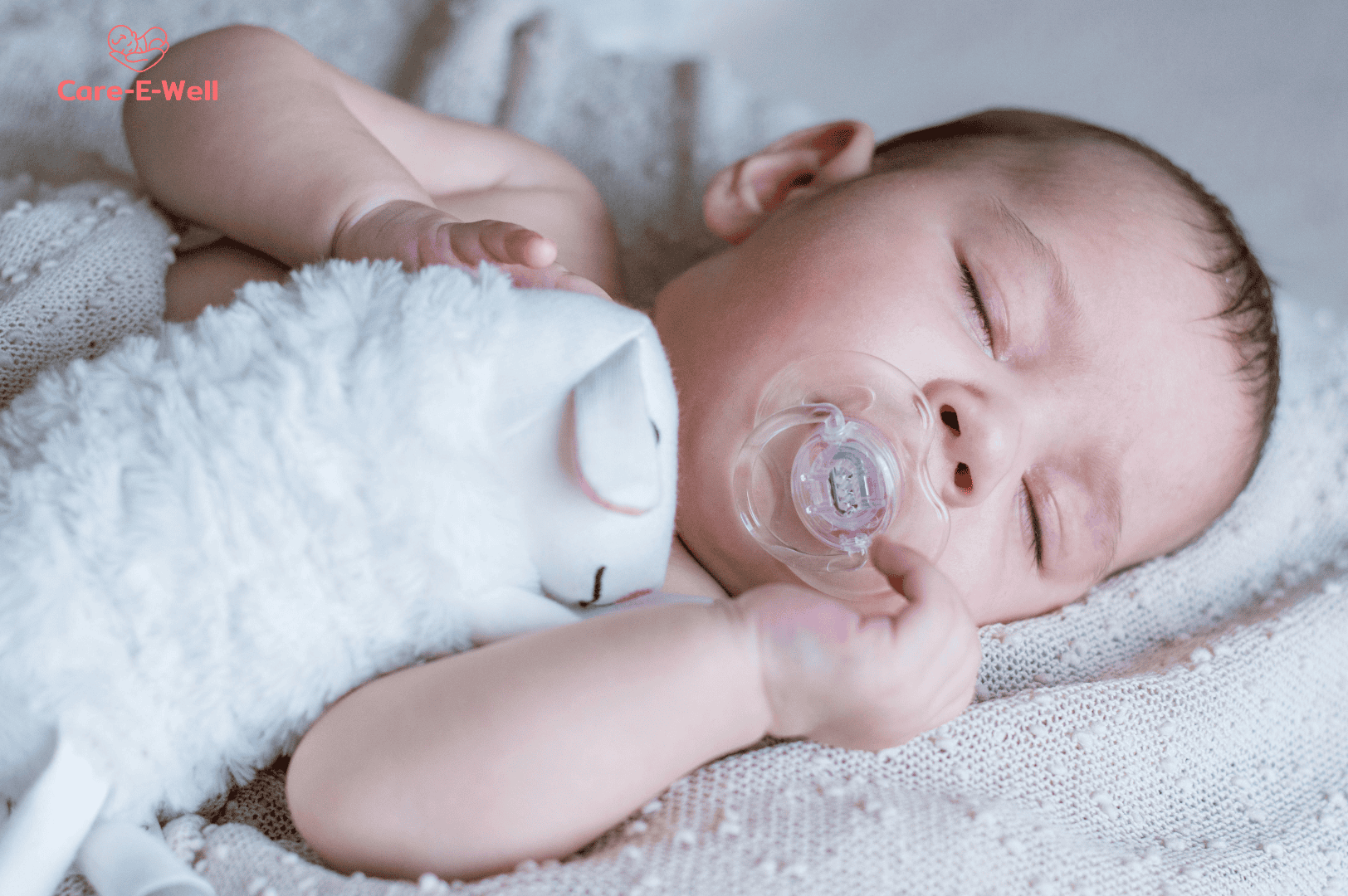
Pacifiers can be a useful soothing tool for sleep, and observational research has consistently found an association between pacifier use during sleep and a lower risk of sudden infant death syndrome (SIDS). That association is important, but it does not mean pacifiers are essential for every baby or that they replace the rest of safe-sleep guidance.
Pacifier decisions also intersect with breastfeeding, feeding cues, ear health and later dental development. The evidence is more nuanced than either “pacifiers are bad” or “every baby should use one.” If your baby accepts a pacifier, it can be one option; if your baby refuses it, there is no need to force it.
A pacifier can be offered as a soothing cue, but it should never replace a feed, safe sleep positioning or attention to a baby's breathing and health.
Why do pacifiers help some babies settle?
Babies have a strong sucking reflex, and sucking is not only about taking milk. Non-nutritive sucking can be calming, which is why some babies relax quickly with a pacifier even when they are not hungry.
For sleep, the pacifier may become one predictable cue that helps the baby move from alertness toward settling. Some babies use it briefly and let it fall out; others continue sucking for longer.
Not every baby likes a pacifier. A baby who repeatedly pushes it out, gags or becomes more upset does not need to be trained to accept one.
Do pacifiers reduce the risk of SIDS?
Multiple case-control studies and a meta-analysis have found that pacifier use during the last sleep is associated with a lower risk of SIDS. Reviews have reached the same broad conclusion.
The mechanism is not fully understood, and this evidence is observational rather than proof from randomised trials. Researchers have proposed several possible mechanisms involving airway position, arousal or sleep state, but none should be presented as established fact.
The practical message is that pacifier use may be protective during sleep, while the foundations of safe sleep remain more important: place the baby on the back, keep breathing unobstructed and use an appropriate clear sleep surface.
Does a baby need a pacifier to sleep safely?
No. Pacifier use is one possible risk-reduction practice, not a requirement for safe sleep.
If your baby does not use a pacifier, continue following the rest of safe-sleep guidance. Do not repeatedly force a pacifier into a baby's mouth or hold it in place.
Breastfeeding itself is also associated with lower SIDS risk in observational and meta-analytic research, which is another reason to avoid framing pacifier use as the single decisive sleep-safety factor.
What if the pacifier falls out after my baby falls asleep?
Many babies stop sucking and the pacifier falls out once sleep deepens. That does not mean something has gone wrong.
You do not need to spend the night repeatedly checking whether a sleeping baby still has the pacifier in the mouth. If the baby wakes and clearly wants it, you can offer it again.
Keep the sleep surface otherwise clear and do not add pillows, positioners or soft objects simply to keep the pacifier near the baby's face.

Can a pacifier interfere with breastfeeding?
This is one of the most debated questions. Observational studies often find that pacifier use is associated with shorter breastfeeding duration, but families who introduce pacifiers may differ in many other ways, including early feeding difficulty. Association does not prove that the pacifier caused breastfeeding to end.
A Cochrane review of randomised trials in healthy term breastfeeding infants found that restricting pacifier use did not significantly improve exclusive or partial breastfeeding rates through four months. WHO's evidence summary reaches the same conclusion for the included motivated breastfeeding participants, while noting limits in the evidence and generalisability.
At the same time, WHO breastfeeding guidance emphasises protecting responsive breastfeeding and cautions about bottles, teats and pacifiers in the context of establishing exclusive breastfeeding. These positions are not necessarily contradictory: population-level breastfeeding support and trial evidence about breastfeeding duration answer somewhat different questions.
If breastfeeding is painful, milk transfer is uncertain or weight gain is a concern, solve the feeding problem first. A pacifier should not be used to stretch time between feeds or quiet persistent hunger cues.
When can a breastfeeding baby start using a pacifier?
There is no single evidence-based day that fits every breastfeeding family. The important question is whether feeding is going well.
In the early weeks, frequent feeding helps establish milk production and allows parents to learn feeding cues. If a newborn is not transferring milk effectively, is very sleepy at feeds or has weight concerns, using a pacifier to delay feeding would be inappropriate.
If breastfeeding is comfortable and effective and the baby is growing appropriately, parents can weigh the soothing and sleep benefits against their own feeding goals. If uncertain, a breastfeeding professional can assess milk transfer rather than relying on a calendar alone.
Can a pacifier hide hunger cues?
Yes, if it is offered automatically whenever a baby fusses. Sucking can calm a hungry baby temporarily, so the pacifier should not replace checking whether feeding is due.
Early hunger cues can include stirring, bringing hands toward the mouth, rooting and increasing alertness. Crying is a later cue.
For a young infant, especially in the newborn period, respond to likely hunger with feeding rather than repeatedly resettling with a pacifier.
Does using a pacifier create a sleep association?
It can. A baby may learn that sucking helps with settling and then signal for the pacifier after night arousals.
This is not automatically a problem. Compared with rocking or holding, a pacifier requires little physical effort from the caregiver, and older babies may eventually find and replace it themselves.
It becomes inconvenient if the pacifier falls out repeatedly and the baby wakes every time until a caregiver replaces it. If that pattern is exhausting, you can decide whether to keep replacing it, introduce other settling cues or gradually reduce reliance on it.
How can you reduce pacifier dependence at night?
You do not need to remove the pacifier because of one difficult week. First check whether waking is actually caused by losing it.
If repeated replacement is clearly the issue, start with one sleep period. Pair the pacifier with another predictable cue, such as a bedtime phrase, song or gentle touch. Then experiment with using the other cue for some resettling attempts.
There is no evidence-based number of nights for this transition. Avoid replacing one rigid dependency with a stressful programme that leaves the family more exhausted.
Are pacifiers linked with ear infections?
Research has reported an association between pacifier use and otitis media, particularly with more frequent or prolonged use. The size of the effect varies across studies, and a pacifier is only one of several factors that can influence middle-ear infections.
This is more relevant when pacifier use continues frequently beyond early infancy than when a young baby uses one mainly for settling. If a child has recurrent ear infections, discuss pacifier use as part of the overall picture with a healthcare professional.
Do not diagnose an ear infection from poor sleep alone. Ear pain, fever, discharge or persistent distress needs clinical assessment.
What about teeth and the bite?
Prolonged sucking habits can influence dental and jaw development as children grow, and concern generally increases with persistent use into later toddlerhood and childhood.
Infant sleep use and long-term daytime sucking are not the same exposure. For a young infant, dental concerns should not be exaggerated into a reason to panic about occasional sleep-time pacifier use.
As the child gets older, especially when teeth and speech are developing, review how often and how long the pacifier is used and discuss persistent use with an appropriate health or dental professional.
What type of pacifier is safest?
Use an intact pacifier designed for infants and follow the manufacturer's instructions. Inspect it regularly and stop using it if the material is damaged, cracked or deteriorating.
Do not modify a pacifier, dip it in sweet substances or use it as a way to deliver medicine unless a clinician has specifically instructed you to do so.
During sleep, keep the cot clear. Avoid turning the pacifier into a soft sleep object by attaching bulky toys or other loose items around the baby's face.
Can I use a pacifier clip during sleep?
Clips can be convenient while the baby is awake, but sleep introduces different hazards because cords, straps and attached objects can end up near the neck or face.
For sleep, the safer approach is to keep the pacifier unattached and the infant sleep space clear. Do not put a necklace, cord or strap around the baby's neck.
If a particular product has its own age or usage restrictions, follow the manufacturer's safety instructions.

Can a pacifier be used for every cry?
It is better to respond to the reason for the cry. A pacifier may help when a baby needs non-nutritive sucking, but hunger, pain, temperature, illness, nappy needs and desire for contact still require attention.
If a previously settled baby suddenly needs constant sucking to remain calm, look for what has changed rather than assuming the baby has developed a pacifier habit.
Persistent crying, poor feeding or unusual lethargy deserves assessment.
Pacifiers and safe sleep
A pacifier does not make an unsafe sleep environment safe. WHO advises placing babies on their back to sleep during the first year and ensuring that breathing remains unobstructed.
Use a firm, flat, clear infant sleep surface and keep soft objects away from the baby's face. Avoid overheating and smoke exposure.
Never use a pacifier as a reason to relax the rest of safe-sleep precautions. A protective association with pacifier use does not cancel risks from an unsafe sleep surface or obstructed breathing.
When should pacifier use be discussed with a professional?
Most pacifier use does not require medical input. Professional advice is useful when the pacifier seems to be replacing feeds, breastfeeding is painful or ineffective, weight gain is uncertain, ear infections recur or prolonged use becomes difficult to reduce as the child gets older.
Seek medical advice if sleep or feeding is accompanied by breathing difficulty, repeated pauses in breathing, blue or grey colour, persistent loud snoring, repeated choking, poor feeding, significant vomiting, fever, unusual lethargy, poor growth, significant pain or a marked change in responsiveness.
Frequently asked questions
Should I give my newborn a pacifier for sleep?
It depends on feeding. A pacifier may soothe, but a newborn who is showing hunger cues needs feeding. If breastfeeding is still painful, ineffective or weight gain is uncertain, prioritise feeding assessment before using a pacifier to stretch intervals.
Is it okay if my baby refuses a pacifier?
Yes. Pacifiers are optional. Do not force one into the mouth or treat refusal as a sleep problem.
Can a baby sleep with a pacifier all night?
A baby may keep or lose the pacifier during sleep. The more important safety questions are the overall sleep environment and avoiding attached cords, soft objects or other hazards.
Does a pacifier cause nipple confusion?
The concept is debated. Observational studies show associations between pacifier use and breastfeeding outcomes, while randomised trial evidence in healthy term infants did not show that restricting pacifiers improved breastfeeding duration through four months.
When should I stop using a pacifier?
There is no single sleep-specific deadline for every child. Reassess use as the child grows, particularly if it becomes frequent during the day, contributes to recurrent ear problems or persists into later childhood when dental effects become more relevant.
The key takeaway
Pacifiers and sleep can fit together safely for many families. Pacifier use during sleep is associated with lower SIDS risk, but the evidence is observational and the pacifier remains only one part of a safe-sleep approach.
Use it as an optional soothing tool, never as a substitute for feeding or health assessment. Protect breastfeeding when it is being established, keep the sleep space clear and revisit frequent or prolonged use as your child grows.
Sources and references
- World Health Organization. Breastfeeding. https://www.who.int/health-topics/breastfeeding
- World Health Organization. Effect of restricted pacifier use in breastfeeding term infants for increasing duration of breastfeeding. https://www.who.int/tools/elena/review-summaries/breastfeeding-inability–effect-of-restricted-pacifier-use-in-breastfeeding-term-infants-for-increasing-duration-of-breastfeeding
- World Health Organization. Making sure newborns and children under 5 years sleep safely. https://www.who.int/tools/your-life-your-health/life-phase/newborns-and-children-under-5-years/making-sure-newborns-and-children-under-5-years-sleep-safely
- UNICEF UK Baby Friendly Initiative. Sleep and night-time resources. https://www.unicef.org.uk/babyfriendly/baby-friendly-resources/sleep-and-night-time-resources/
- Hauck FR, Omojokun OO, Siadaty MS. Do Pacifiers Reduce the Risk of Sudden Infant Death Syndrome? A Meta-analysis. https://doi.org/10.1542/peds.2004-2631
- Horne RSC, Hauck FR, Moon RY, et al. Dummy (pacifier) use and sudden infant death syndrome: Potential advantages and disadvantages. https://doi.org/10.1111/jpc.12402
- Jaafar SH, Ho JJ, Jahanfar S, Angolkar M. Effect of restricted pacifier use in breastfeeding term infants for increasing duration of breastfeeding. https://doi.org/10.1002/14651858.CD007202.pub4
- Pineda R, Luong A, Ryckman J, et al. Pacifier use in newborns: related to socioeconomic status but not to early feeding performance. https://doi.org/10.1111/apa.14253
- Thompson JMD, Tanabe K, Moon RY, et al. Duration of Breastfeeding and Risk of SIDS: An Individual Participant Data Meta-analysis. https://doi.org/10.1542/peds.2017-1324
- Perrone S, Lembo C, Moretti S, et al. Sudden Infant Death Syndrome: Beyond Risk Factors. https://doi.org/10.3390/life11030184
Did this Insight help?
A little love for something worth reading.


