
Care-E-Well Insights
How to Position Car Seat Harness Straps Correctly
Learn how to position car seat harness straps correctly, avoid twists and uneven routing, and adjust shoulder height as your child grows.
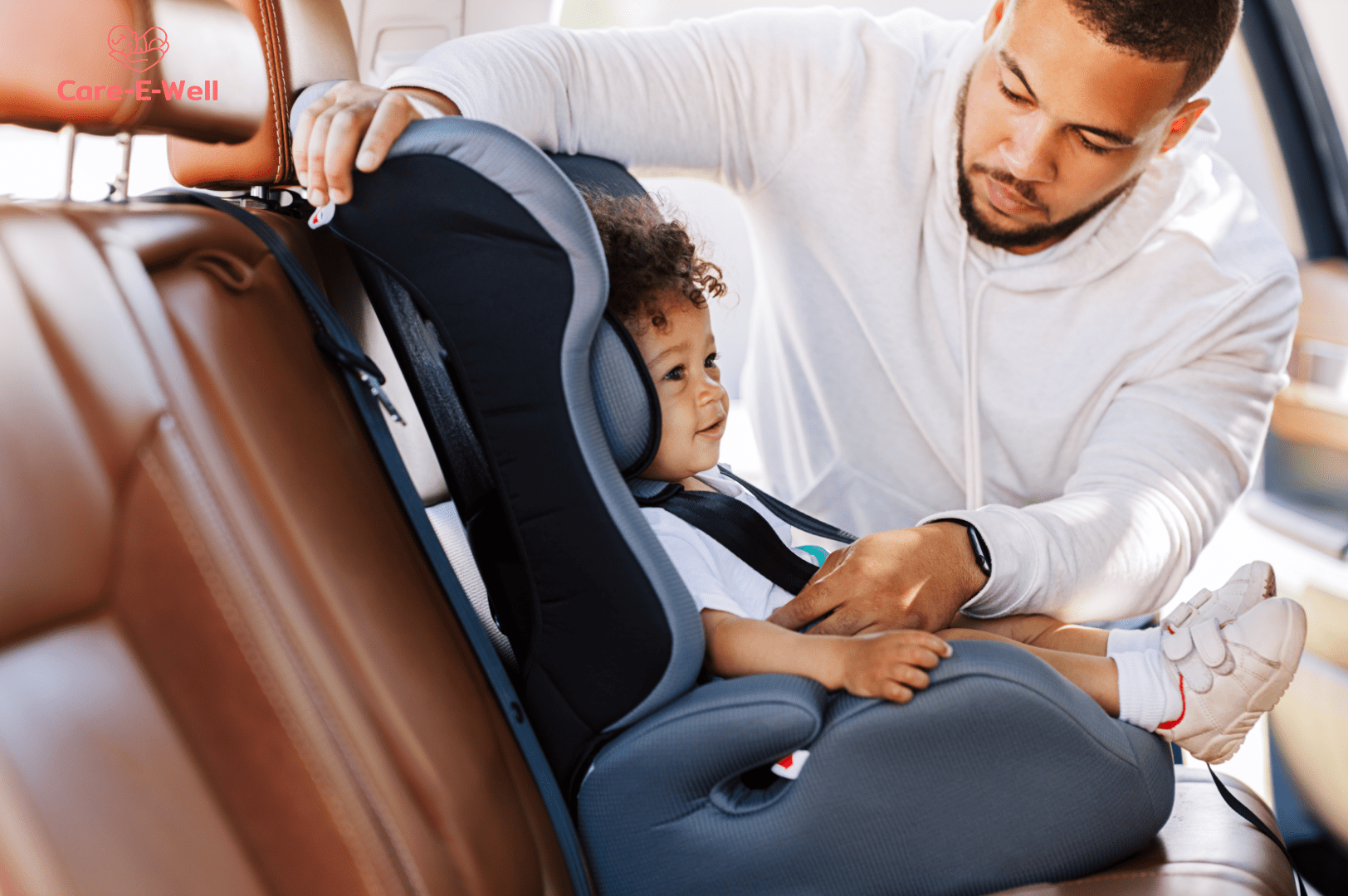
Car seat harness straps should sit in the exact shoulder position specified for your restraint, lie flat without twists and stay centred over the child’s shoulders rather than slipping toward the neck or off the outer shoulder. The correct height can change as the child grows and may also change when a convertible seat switches from rear-facing to forward-facing.
There is no universal strap-slot rule that safely overrides every European R129 restraint. Many traditional harnesses use different shoulder relationships in rear-facing and forward-facing modes, but modern seats can have sliding headrests, integrated guides or routing systems that work differently. Always follow the manual for the exact model.
Harness position and harness tightness are separate checks. The straps can feel tight while still running through the wrong height.
Why does harness position matter?
The internal harness keeps the child aligned with the protective structure of the seat and manages movement during a crash. If you route straps too high, too low, unevenly or outside their intended guides, the child can move differently from the restraint’s tested setup.
Research on child-restraint misuse has identified incorrect harness height and routing as recurring errors. Fatal-crash analyses have also linked loose harnesses and incorrect routing with greater head excursion or acceleration in some cases.
Correct positioning therefore helps the harness begin restraining the child from the intended place on the body.
Where should rear-facing shoulder straps sit?
Many rear-facing harness systems position the shoulder straps at or slightly below the child’s shoulders, because this helps limit upward movement along the rear-facing shell during a frontal crash. This is a common design principle, not a substitute for the manual.
Some R129 restraints use an integrated headrest-and-harness adjustment rather than separate visible slots. In those seats, the manufacturer may give a specific relationship between the shoulder, headrest and harness guide.
If the manual gives a diagram or measurement, use that. Do not deliberately choose a lower slot simply because you remember an old rule from another seat.
Where should forward-facing shoulder straps sit?
Traditional forward-facing harness designs often use straps at or above shoulder level to help restrain the torso appropriately as the child moves forward. Again, the exact requirement depends on the restraint.
A multi-stage seat may therefore require you to move the harness when you change direction. Some seats automate that movement through the headrest; others require manual rerouting.
Never continue using a harness position that the manual identifies as rear-facing-only after turning the seat forward.

How do you know when to raise the harness?
Check the child’s shoulder level whenever the child has a growth spurt, clothing fit changes noticeably or the headrest begins to look low. In an adjustable system, move the headrest or harness to the next approved position before the child grows beyond the manufacturer’s stated fit.
The straps should not emerge dramatically below or above the shoulders unless the product instructions specifically call for that geometry. A visibly awkward angle is a reason to stop and check the instructions.
Take the child out of the seat before making a complicated rerouting adjustment. This gives you room to verify that both straps pass through matching, approved positions.
Can the left and right straps be at different heights?
No, not in a conventional symmetrical harness unless the manufacturer explicitly designed the system otherwise. Uneven routing can produce unequal loading and usually means one strap runs through the wrong slot or guide.
After removing the cover for cleaning, double-check both sides before the next journey. Harnesses are sometimes accidentally reassembled unevenly.
If the webbing disappears behind the shell, trace both sides from the buckle or splitter plate to the shoulder so you can see whether the routing matches.
What about twists in the harness?
Harness webbing should lie flat. A twist narrows the area that carries force and makes harness tension harder to judge.
Run your fingers along the strap from the shoulder toward the buckle to find hidden half-turns. Correct the twist according to the manual rather than forcing buckles or adjusters through openings they were not designed to pass.
If a strap repeatedly twists after you reassemble a buckle tongue or pad, contact the manufacturer rather than modifying the hardware.
How close should straps be to the neck?
The straps should follow the restraint’s intended shoulder path. They should not be deliberately pushed far outward to avoid touching clothing, nor pulled inward so that they rub the side of the neck.
Approved shoulder pads or harness covers supplied with the seat may help manage comfort while keeping the webbing in the intended place.
Do not add aftermarket pads that change the path or thickness of the harness unless the manufacturer approves them for that restraint.
How does the headrest affect harness position?
In many modern child restraints, the headrest adjustment also moves the harness height. Raising or lowering the headrest moves the shoulder guides at the same time.
The correct headrest position may depend on the child’s shoulders, the space above the head, the side-impact wings and the harness guide. Follow the seat’s diagram rather than positioning the headrest solely by where it looks comfortable.
If you cannot raise the headrest enough while keeping the harness in the required position, the child may be approaching the limit of that configuration.
What is the role of a chest clip?
Many European R129 harnesses do not use the separate chest clip commonly seen on North American seats. Do not add one unless the manufacturer supplies it or specifically permits it for the restraint.
Research has examined chest clips because they can alter pre-crash strap position and introduce other contact considerations. The important point is to use the harness exactly as the manufacturer and approval instructions specify.
If your restraint does include a chest clip, place it only where the manufacturer instructs. Do not copy the position from another brand.

Harness position after winter clothing changes
Thick outerwear can push shoulder straps outward or make them appear to fit differently. It can also create compressible space beneath the harness.
Use thin layers under the harness when possible and recheck shoulder routing after changing seasonal clothing. The strap should still emerge through the correct guide and lie flat against the child.
Do not raise the harness solely to make room for a thick coat if the child’s shoulder position does not require the change.
Recheck when converting the car seat
Any major configuration change deserves a full harness reset. This includes moving from an infant insert to the standard seat, changing recline stages, switching rear-facing to forward-facing, or converting a seat from an integrated harness to booster mode.
- Read the configuration-specific section of the manual.
- Move the headrest and harness to the specified position.
- Confirm that both shoulder straps run symmetrically.
- Check that the webbing is flat and untwisted.
- Seat the child fully back.
- Buckle and remove slack according to the manufacturer’s instructions.
Treat the conversion as a new setup rather than assuming the previous harness arrangement remains correct.
Signs the harness position needs attention
- One shoulder strap is higher than the other.
- A strap repeatedly slides off the shoulder.
- The strap emerges from a guide far from the child’s shoulder when the manual says it should align closely.
- The harness rubs the neck despite otherwise correct adjustment.
- The headrest cannot reach the required position.
- Webbing twists or catches behind the shell.
- The child has reached a stated harness-height or stature limit.
When a correct adjustment is no longer possible within the approved range, the child may have outgrown that configuration.
The key takeaway
Position car seat harness straps according to the exact restraint design, not a universal rule remembered from another seat. Keep both sides symmetrical, flat and correctly guided at the shoulders, and recheck the position as the child grows or whenever the seat changes configuration.
Frequently asked questions
Should rear-facing straps always be below the shoulders?
Many rear-facing harnesses use straps at or below shoulder level, but the specific restraint manual is the authority. Integrated headrest systems may use different guidance.
Should forward-facing straps always be above the shoulders?
Many traditional forward-facing designs use at-or-above shoulder positioning, but again, follow the exact approved seat instructions.
Can I add a chest clip to keep the straps together?
No, unless the restraint manufacturer supplies or specifically approves that clip for the model.
How often should I check harness height?
Recheck after growth spurts, seasonal clothing changes, seat conversions and whenever the headrest or shoulder relationship starts to look different.
Sources/References
- UNECE — UN Regulation No. 129 – Rev.4
- World Health Organization — Occupant Restraints: A Road Safety Manual for Decision-Makers and Practitioners
- Whyte T et al. — Restraint Factors and Child Passenger Deaths in New South Wales, Australia
- Brown J et al. — The Characteristics of Incorrect Restraint Use Among Children Traveling in Cars in New South Wales, Australia
- Kopańska M et al. — Determinants of child restraint system selection and installation practices: implications for injury prevention and public health implementation
- Bilston LE et al. — Cross-chest clips in child restraints: A crash testing study
- Akinyemi Y, Komolafe M — Child Restraint use and Seating Position in Motor Vehicles: An Observational Survey in Ibadan Metropolis, Nigeria
- Giannakakos AR et al. — Teaching installation and use of child passenger safety restraints
- Wei Z — Analysis of the Effect of Infant Carrier’s Webbing Tension on 18-month-old Child Occupant’s Chest Accelerations in Frontal Crash Accidents Based on Experimental Validations
Did this Insight help?
A little love for something worth reading.


