
Care-E-Well Insights
How to Prepare Formula Safely When You Are Out
Learn how to prepare formula safely when you are out, including hot water, travel storage, ready-to-feed options and bottle hygiene.
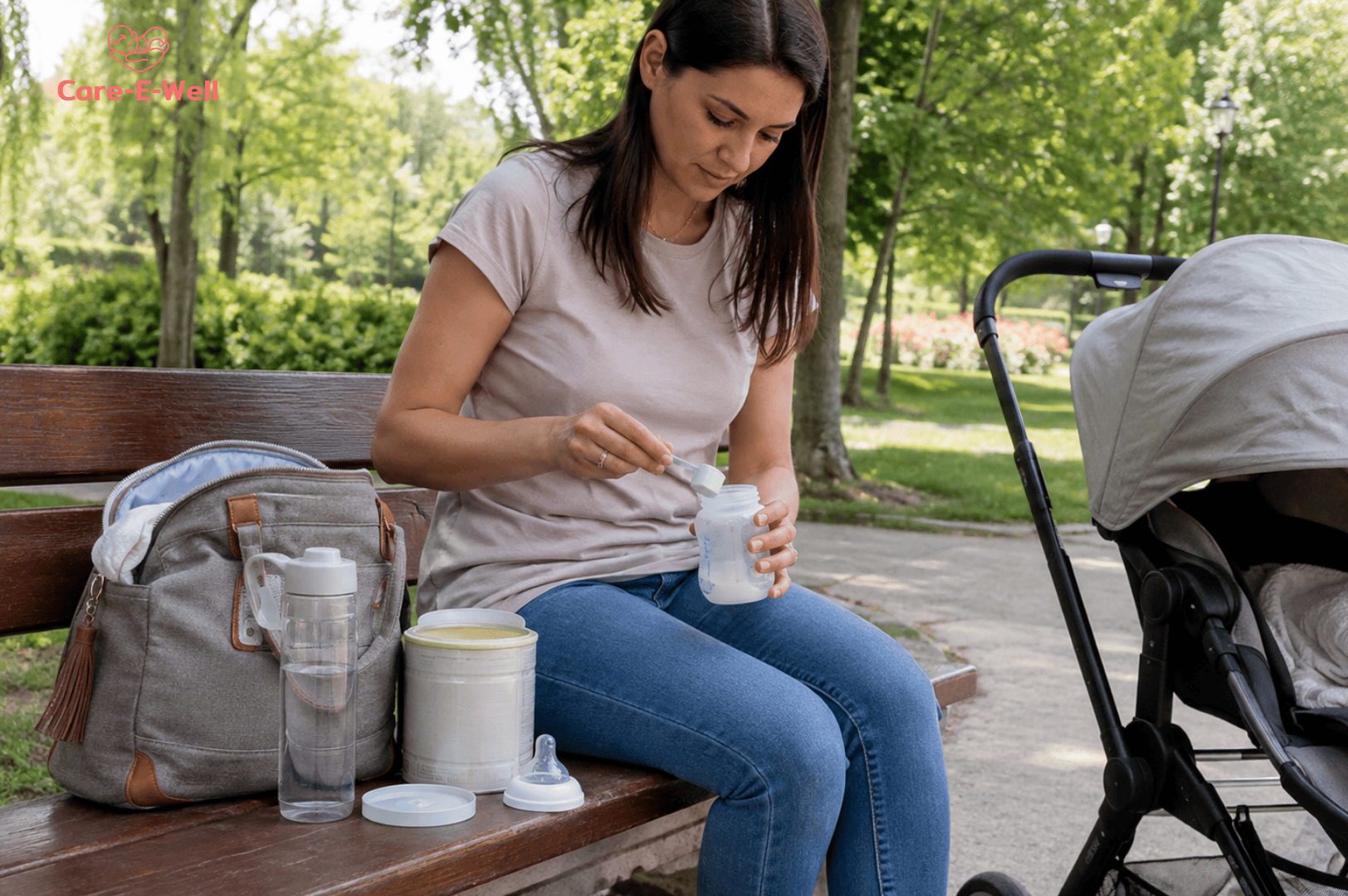
How to prepare formula safely when you are out comes down to planning the whole feeding process before you leave: safe water, clean equipment, correct measuring, enough heat for powdered formula, and a clear plan for storage and leftovers. The safest option is usually to make each powdered feed as close as possible to feeding time.
If reliable preparation is difficult during a journey, sealed ready-to-feed formula can remove the reconstitution step. If you take prepared formula with you, it must remain reliably cold rather than simply “cool,” and storage times still apply.
Travel safety is not about carrying more gadgets. It is about controlling water, hygiene, time and temperature from preparation to feeding.
Why is formula preparation away from home different?
At home, you usually know where the clean bottles are, how hot the water is and how long a feed has been sitting. Outside the home, those controls can become less predictable.
Powdered infant formula is not sterile. Rarely, it can contain harmful bacteria such as Cronobacter or Salmonella, and contamination can also come from hands, surfaces, scoops or feeding equipment. WHO guidance therefore recommends careful hygiene and water no cooler than 70°C when it contacts the powder.
The challenge when travelling is preserving those protections without improvising shortcuts.
What is the simplest safe option for short trips?
If the baby uses an appropriate ready-to-feed formula, unopened single-feed containers can be the simplest option for many outings. They need no water or scooping and begin as commercially sterile liquid.
You still need clean feeding equipment unless the product is designed to connect directly to a sterile teat. Once a container is opened or formula is poured into a bottle, the manufacturer’s storage instructions apply.
Ready-to-feed formula is not automatically necessary for every healthy baby, but it can be useful when safe hot-water preparation is difficult.
How should you prepare powdered formula while you are out?
The principle is the same as at home: prepare the feed when it is needed rather than mixing powder hours earlier and carrying it warm.
- Wash your hands thoroughly or use the best available handwashing facility before preparation.
- Use a clean preparation area and properly cleaned feeding equipment.
- Measure the exact amount of safe water needed for the feed.
- Make sure the water is still at least 70°C when it contacts the powder, unless a medically specialised formula has different product-specific instructions from the baby’s clinical team.
- Add the exact amount of powder specified by the manufacturer.
- Mix according to the product instructions.
- Cool the closed bottle quickly to a safe feeding temperature.
- Offer it promptly and discard leftovers after the baby has fed.
Do not change the powder-to-water ratio because you are travelling or trying to make bottles easier to carry.
Never add extra powder to make a “concentrate” for later dilution, and never add extra water to stretch a feed.
Can you carry hot water in a vacuum flask?
A clean vacuum flask can be useful for carrying freshly boiled water so it remains hot enough for safe powdered-formula preparation. The key issue is the water temperature at the moment it contacts the powder.
A flask that merely keeps water warm may not maintain the temperature needed. Performance varies by flask, fill volume and how long it has been closed.
If you routinely rely on a flask, use one capable of maintaining very hot water and minimise the time between boiling and preparation. The safest practical approach is to fill it with freshly boiled water shortly before leaving.
Take care with hot-water burns. Keep the flask closed, upright and out of children’s reach, and prepare feeds on a stable surface.
Should you put powder into bottles before leaving?
Powder should remain dry until the feed is prepared. A clean, dry, dedicated formula dispenser can make measuring easier, provided you have measured the correct amount for each planned bottle and keep the powder protected from moisture and contamination.
Do not put powder into a bottle that contains water long before feeding. Once water and powder are combined, the prepared-feed safety clock starts.
If your formula manufacturer gives specific instructions for travel or powder storage, follow those instructions.

Can you take pre-measured water in bottles?
Carrying the exact volume of water in clean bottles may seem convenient, but the water still needs to be at the appropriate temperature when it contacts powdered formula. Room-temperature bottled water does not provide the same microbiological risk reduction as water at least 70°C.
For powdered formula, carrying hot water separately and mixing when needed is generally more aligned with WHO’s risk-reduction approach.
For a medically specialised formula with a different preparation temperature, follow the product and clinical instructions rather than applying generic travel rules.
Is bottled water safer than tap water for formula?
Bottled water is not automatically sterile and is not automatically safer than safe tap water. The key questions are whether the water is suitable for drinking, whether local water quality is reliable and whether it can be boiled or otherwise prepared according to current guidance.
In a location where drinking-water safety is uncertain, use a source recommended by local public-health authorities or your baby’s healthcare team. Do not assume the most expensive bottled brand is the safest option.
Avoid mineral waters with unusually high mineral content unless they are specifically suitable for infant feeding.
What if there is nowhere clean to make a bottle?
If you cannot wash hands, find a stable clean surface or safely handle hot water, powdered-formula preparation becomes more difficult to control.
In that situation, an appropriate sealed ready-to-feed formula may be the safer practical option. Another option is to delay preparation until you reach a place with adequate facilities, provided the baby’s feeding needs allow it.
A car seat, public toilet changing table or unstable lap is not an ideal place for handling very hot water and open feeding equipment.
Can you make formula in the car?
Preparing formula in a moving vehicle is unsafe because hot water can spill and measuring can become inaccurate. Stop somewhere safe before preparing the feed.
Use a stable surface, keep the baby away from the hot-water preparation area and complete the feed before returning to the road if possible.
Never handle boiling or near-boiling water while the vehicle is moving or while holding the baby.
What if you need to carry prepared formula?
Fresh preparation is preferred, but there are situations where a feed must be prepared before leaving. WHO guidance allows advance preparation when necessary if the feed is cooled rapidly after preparation, refrigerated at 5°C or below and kept within the 24-hour storage limit.
During transport, the cold chain must continue. Use a properly insulated cool bag with sufficient ice packs and keep the formula reliably cold. A bottle that feels slightly cool is not proof that it stayed at 5°C or below.
Once a prepared refrigerated feed is removed from cold storage and warmed, offer it promptly. Do not repeatedly warm and cool the same bottle.
Prepared formula can travel cold only if you can genuinely maintain refrigeration conditions.
How long can a prepared bottle stay in a cool bag?
There is no universal safe number of hours for every cool bag because performance depends on the bag, ice packs, outside temperature, opening frequency and starting temperature.
The goal is not to count hours in an ordinary insulated bag but to maintain the required cold temperature. If you cannot be confident the feed remained safely cold, discard it.
For longer trips, sealed ready-to-feed formula or preparation close to feeding time can reduce uncertainty.
What about airport security and flying?
Travel rules for carrying infant feeds vary by country and airport. Formula safety does not change because of security procedures: powder must stay dry, ready-to-feed containers need appropriate after-opening storage, and prepared formula must remain safely cold if carried in advance.
For a flight, plan more feeds than the minimum in case of delays. Bring enough clean bottles or a safe method to clean feeding equipment between uses.
Do not rely on cabin crew or airport cafés to provide water at a specific temperature unless you can verify that it is appropriate for formula preparation.
Can you use a formula preparation machine while travelling?
Portable formula machines and dispensers vary greatly. Automation does not guarantee correct powder concentration, hygienic handling or a water temperature high enough to reduce bacterial risk.
If you use a device, confirm how it measures powder, how it controls water temperature and how it is cleaned. Do not assume that a machine marketed for convenience replaces WHO preparation principles.
A simple flask, measured powder and clean bottle can be easier to audit than a complex device.
How should you manage feeding equipment on a day out?
Bring enough clean bottles and teats for the expected feeds if cleaning facilities will be limited. Store clean equipment covered so the inside surfaces stay protected.
Used bottles should be kept separate from clean equipment. Rinsing a bottle with cold water does not make it ready for safe reuse.
If you must clean equipment away from home, use safe water, detergent and a clean area, and follow your usual sterilisation approach where recommended for your baby’s age and local guidance.

Can you save a bottle the baby did not finish?
No. Once the baby has sucked from the teat, saliva can contaminate the remaining formula. Discard leftovers rather than placing the bottle back in the cool bag for later.
If waste is a recurring problem during outings, prepare smaller initial volumes and offer more if the baby remains hungry.
How can you make travel feeds easier without cutting safety corners?
- Pack bottles and teats already clean and protected
- Pre-measure dry powder into clean dry containers if appropriate
- Carry freshly boiled water in a suitable vacuum flask
- Use a stable preparation surface
- Prepare only the feed you need
- Cool the bottle safely before feeding
- Keep hot water away from children
- Discard used-bottle leftovers
- Carry a backup sealed ready-to-feed feed if appropriate for your baby
- Pack more supplies than the minimum for delays
Good travel systems reduce decisions when you are tired, rushed or somewhere unfamiliar.
What if your baby is premature or medically vulnerable?
Premature newborns and babies with impaired immunity are more vulnerable to severe Cronobacter infection. Their clinical team may advise sterile ready-to-feed liquid formula rather than powdered formula or may give stricter preparation instructions.
For these babies, plan travel with the neonatal or paediatric team rather than adapting general household advice.
Frequently asked questions
Can I mix formula with room-temperature bottled water while out?
For powdered infant formula, WHO recommends water no cooler than 70°C when it contacts the powder. Room-temperature bottled water does not provide that heat step.
Can I prepare bottles before leaving home?
Fresh preparation is preferred. If advance preparation is necessary, cool the feeds promptly, refrigerate at 5°C or below and maintain the cold chain during transport.
Is ready-to-feed formula best for travel?
It is often the simplest option because it needs no reconstitution, but it must be appropriate for your baby and handled according to its after-opening instructions.
Can I keep prepared formula warm in a thermos?
No. A thermos can carry hot water for later preparation, but prepared formula should not be held warm for extended periods.
What if I run out of formula while away?
Buy the same appropriate formula if available and prepare it according to its instructions. Do not dilute feeds or substitute ordinary milk or plant drinks for infant formula in a young infant.
The key takeaway
How to prepare formula safely when you are out is mainly a planning problem. For powdered formula, carry the components separately, keep the powder dry, use sufficiently hot water and prepare the feed close to feeding time. If you carry prepared formula, maintain reliable refrigeration.
Ready-to-feed formula can simplify travel when it is appropriate for your baby. Whichever option you choose, protect clean equipment, measure accurately, avoid prolonged warm holding and discard leftovers from a used bottle.
Sources and references
- World Health Organization. Safe Preparation, Storage and Handling of Powdered Infant Formula: Guidelines. https://www.who.int/publications/i/item/9789241595414
- UNICEF UK Baby Friendly Initiative. Guide to Bottle Feeding. https://www.unicef.org.uk/babyfriendly/baby-friendly-resources/bottle-feeding-resources/guide-to-bottle-feeding/
- Losio MN, Pavoni E, Finazzi G, et al. Preparation of Powdered Infant Formula. https://doi.org/10.1097/MPG.0000000000002100
- Grant A, Jones S, Ellis R, et al. The safety of at home powdered infant formula preparation: A community science project. https://doi.org/10.1111/mcn.13567
- Kent RM, Fitzgerald GF, Hill C, et al. Novel Approaches to Improve the Intrinsic Microbiological Safety of Powdered Infant Milk Formula. https://doi.org/10.3390/nu7021217
- Turck D. Safety Aspects in Preparation and Handling of Infant Food. https://doi.org/10.1159/000338215
- Sani NA, Hartantyo SHP, Forsythe S. Microbiological assessment and evaluation of rehydration instructions on powdered infant formulas, follow-up formulas, and infant foods in Malaysia. https://doi.org/10.3168/jds.2012-5409
- Chiang KV, Anstey EH, Abrams SA, et al. Infant burn injuries related to water heating for powdered infant formula preparation. https://doi.org/10.3389/fped.2023.1125112
- Chen PC, Zahoor T, Oh SW, et al. Effect of heat treatment on Cronobacter spp. in reconstituted, dried infant formula. https://doi.org/10.1111/j.1472-765X.2009.02733.x
Did this Insight help?
A little love for something worth reading.


