
Care-E-Well Insights
How to Prepare Powdered Infant Formula Safely
Prepare powdered infant formula safely with correct water temperature, exact scoops, clean equipment, rapid cooling and safe leftovers.
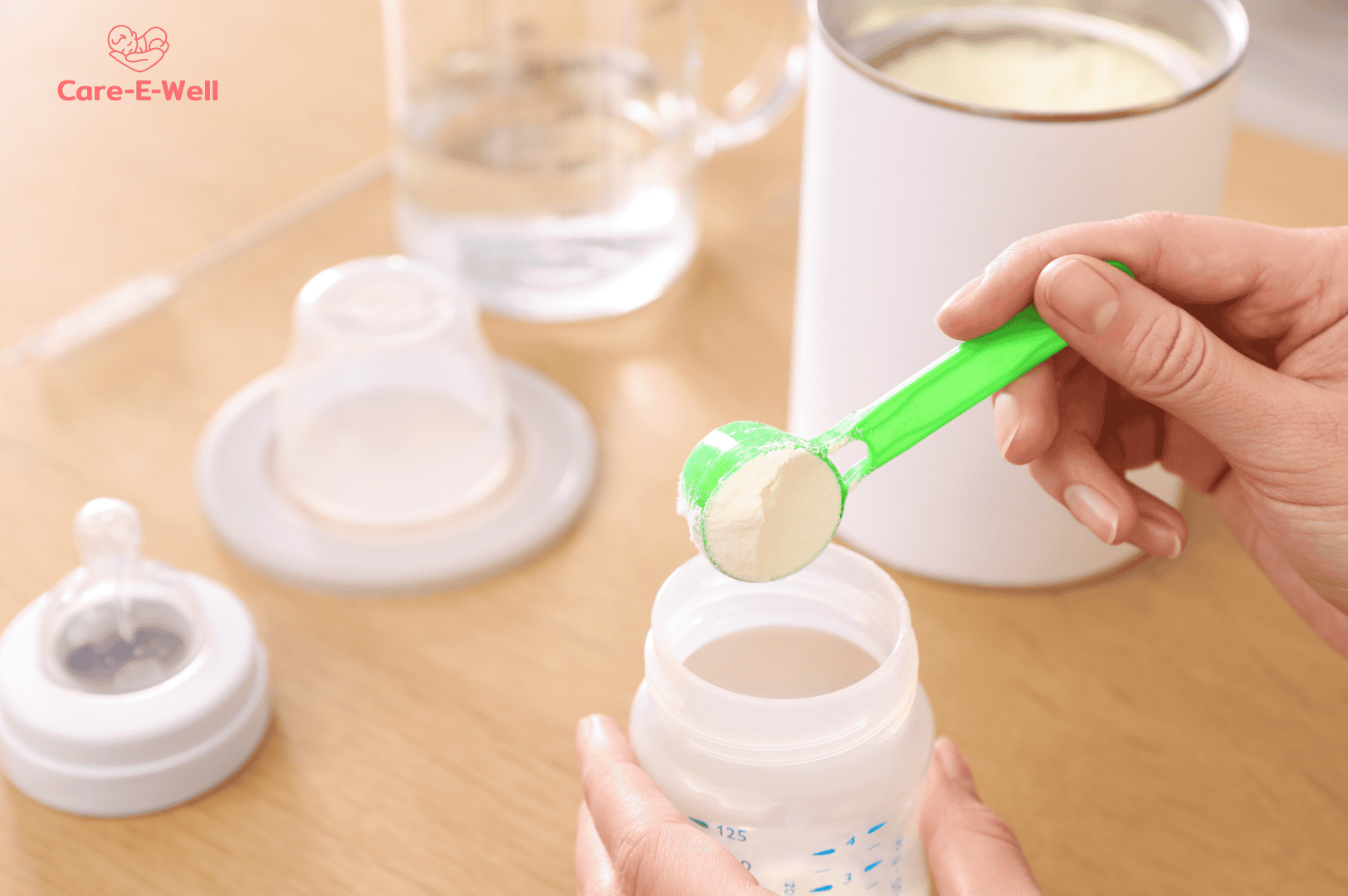
Safe formula preparation is mostly about controlling three things: contamination, concentration and time. Powdered infant formula is not sterile, so the goal is to reduce the chance that harmful bacteria survive or multiply while also making sure the feed contains exactly the amount of powder and water the manufacturer intended.
The most important habits are consistent hand and equipment hygiene, using sufficiently hot water when powder is mixed, adding water before powder, measuring accurately, cooling the finished bottle safely and discarding leftovers after feeding.
Powdered infant formula can be used safely. The routine matters because the powder itself is not sterile and because small preparation errors can change the feed’s concentration.
Why is powdered infant formula not sterile?
Powder is a low-moisture food, but manufacturing cannot guarantee that every scoop is completely free of microorganisms. Cronobacter species and Salmonella are the two pathogens most often discussed because they can cause severe illness in infants, especially newborns, premature babies and infants with weakened immunity.
Contamination can also happen after the tin is opened. Hands, scoops, preparation surfaces, bottles, teats and water can introduce microorganisms, which is why preparation hygiene remains important even when the formula itself left the factory within microbiological standards.
The risk is small, but the potential consequences in a vulnerable infant can be serious. Safety guidance therefore aims to reduce risk at several points rather than relying on one step alone.
Why does WHO recommend water at 70°C or above?
WHO guidance recommends that water should be no cooler than 70°C when it contacts powdered infant formula. This temperature is not the temperature at which the baby should drink the feed. It is a microbial-risk-reduction step during preparation.
Experimental studies show that hot-water reconstitution reduces viable Cronobacter and Salmonella compared with mixing powder into lukewarm water. Research also shows that temperature can fall quickly during preparation, so starting with water that is only around 70°C may result in a lower temperature by the time powder is fully mixed.
The prepared bottle must be cooled to a comfortable feeding temperature before it reaches the baby.
Think “hot to mix, cool to feed.” The ≥70°C step is about the powder; the baby should never be given formula at that temperature.
A safe step-by-step preparation routine
- Clean the preparation area before you start.
- Wash your hands thoroughly with soap and water and dry them.
- Use feeding equipment that has been cleaned and sterilised appropriately for infancy.
- Boil fresh safe drinking water.
- Allow it to cool only enough that it is still at least 70°C when it contacts the powder.
- Pour the exact amount of water needed into the bottle first.
- Add the exact number of level scoops stated on the product.
- Close the bottle and mix as instructed until the powder is dissolved.
- Cool the bottle quickly using a safe external method such as cool running water, keeping cooling water away from the teat and bottle opening.
- Check the milk temperature before feeding.
- Feed promptly.
- Discard formula left after the baby has fed.
This sequence is deliberately repetitive. A routine that works the same way every time reduces the chance of forgotten steps when you are tired or preparing a night feed.

Why should water go into the bottle before powder?
Formula scoops are calibrated for a particular volume of water. If you add powder first and then fill the bottle to a target line, the final amount of water can be too small because the powder itself takes up volume.
Too much powder makes the feed more concentrated. Too much water makes it too dilute. Both can be harmful, particularly in young infants who have limited ability to compensate for fluid and electrolyte disturbances.
Never use extra powder to make a bottle “more filling” and never add extra water to stretch formula. Follow the exact scoop-to-water ratio for that specific product.
Can you prepare formula with warm tap water?
Not if you are relying on the WHO hot-water step for powdered formula. Warm or lukewarm tap water may be comfortable for feeding, but it does not provide the same microbial reduction when it contacts the powder.
Hot tap water also is not the same as freshly boiled safe drinking water. Use the preparation method recommended by public-health guidance and the product’s instructions, and do not treat a comfortable drinking temperature as a preparation temperature.
What if the formula label says to use cooler water?
Some products, particularly those containing heat-sensitive added microorganisms or specialised ingredients, may give lower mixing temperatures. That creates a genuine practical conflict: cooler water may preserve a heat-sensitive ingredient, while it does not provide the same pathogen-reduction step as water at 70°C or above.
For an ordinary powdered infant formula, WHO’s microbiological safety guidance supports the ≥70°C approach. If a medically indicated specialised formula has different preparation instructions, ask the baby’s clinician, pharmacist or the manufacturer for a product-specific plan rather than improvising.
Do not quietly split the difference by choosing an arbitrary temperature. The reason for the product and the vulnerability of the baby matter.
How should you cool the bottle after mixing?
Cool the closed bottle from the outside. Running cool water over the outside of the bottle or standing it in a container of cold water can lower the temperature quickly.
Keep tap or cooling water away from the teat and bottle opening. Before feeding, mix the bottle again if needed and check that the formula is comfortably warm rather than hot.
Cooling is important not only for comfort but also because a very hot feed can burn the baby.
Why should you avoid a microwave?
Microwave heating can create uneven hot spots. A bottle can feel acceptable on the outside while parts of the milk are hot enough to burn the mouth.
If prepared formula needs warming, warm the closed container indirectly and test the temperature before feeding. Formula does not need to be warmed at all if the baby accepts it at a safe temperature.
Should you make bottles in advance?
Fresh preparation is the lower-risk default because it minimises the time bacteria have to multiply after water is added to powder.
WHO guidance includes procedures for situations in which feeds must be prepared in advance, including rapid cooling and cold storage, but this requires reliable refrigeration and careful handling. At home, preparing one feed at a time is generally simpler and reduces opportunities for temperature-control errors.
Never prepare several bottles and leave them standing at room temperature for later use.
Can you keep formula the baby did not finish?
No. Once a baby feeds from the bottle, saliva enters the teat and milk. The remaining formula should be discarded rather than refrigerated for another feed.
This can feel wasteful, so it is reasonable to prepare a smaller feed and make more if the baby remains hungry. What you should not do is save a partly used bottle for later.
Do bottles and teats need sterilising?
Feeding equipment should be thoroughly cleaned after use, and sterilisation remains an important risk-reduction step during infancy. Follow the method appropriate for the equipment, such as steam or boiling when the product is designed for it.
Cleaning comes before sterilising. Dried milk residue can protect microorganisms and make later disinfection less reliable.
Let equipment dry and keep it protected from contamination rather than wiping the inside with a kitchen towel.
What about automatic formula preparation machines?
Convenience machines vary. Research examining home preparation has found that some machines can dispense water that is too cool to achieve the ≥70°C step when powder is mixed.
Do not assume a machine is microbiologically safer because it is automated. Check exactly how it works, what temperature reaches the powder, how the internal water system is cleaned and whether the device’s process aligns with the safety guidance you are following.
A “hot shot” is only protective if the powder actually contacts sufficiently hot water in a way that achieves the intended microbial reduction.

Is ready-to-feed formula safer from Cronobacter?
Commercially sterile ready-to-feed liquid formula does not carry the same risk of intrinsic bacterial contamination from dry powder before opening. For that reason, sterile liquid formula may be preferred in some very high-risk infants.
Once opened or transferred into feeding equipment, however, normal hygiene and storage rules still matter. Ready-to-feed does not make a dirty bottle safe.
What if you accidentally used cooler water once?
Do not panic. A single lower-temperature preparation does not mean the formula was contaminated. The recommendation is a risk-reduction strategy because contamination is possible, not because every scoop contains harmful bacteria.
Return to the safer preparation routine for future feeds. If the baby is very young, premature, immunocompromised or becomes unwell, seek medical advice promptly.
When should illness after formula feeding be medically assessed?
Seek urgent medical advice if a young infant develops fever, marked lethargy, poor feeding, repeated vomiting, abnormal movements, breathing difficulty, a bulging fontanelle, unusual irritability, signs of dehydration or a major sudden change in responsiveness.
These symptoms can have many causes and do not prove formula contamination. They matter because severe infections in young infants can progress quickly.
Frequently asked questions
Can I use previously boiled water that has gone cold?
Cold previously boiled water does not provide the ≥70°C microbial-reduction step when mixed with powdered formula. If using powdered formula under WHO guidance, prepare with sufficiently hot safe water.
Can I make formula stronger for a hungry baby?
No. Formula concentration should never be changed to manage hunger. Offer an additional correctly prepared feed if hunger cues persist and discuss unusually high or low intake with a health professional.
Is powdered formula dangerous?
Powdered formula is widely used and can be prepared safely. The important fact is that it is not sterile, so careful preparation reduces avoidable risk.
The key takeaway
How to prepare powdered infant formula safely comes down to a repeatable sequence: clean hands and equipment, safe water, at least 70°C when water contacts powder, water before powder, exact scoops, prompt cooling, responsive feeding and discarding leftovers.
The process may look detailed on paper, but it quickly becomes routine. The aim is not perfection; it is consistent reduction of contamination and concentration errors every time you make a feed.
Sources and references
- World Health Organization. Guidelines for the safe preparation, storage and handling of powdered infant formula. https://www.who.int/publications/i/item/9789241595414
- Losio MN, Pavoni E, Finazzi G, et al. Preparation of Powdered Infant Formula. https://doi.org/10.1097/MPG.0000000000002100
- Grant A, Jones S, Ellis R, et al. The safety of at home powdered infant formula preparation: A community science project. https://doi.org/10.1111/mcn.13567
- Kent RM, Fitzgerald GF, Hill C, Stanton C, Ross RP. Novel Approaches to Improve the Intrinsic Microbiological Safety of Powdered Infant Milk Formula. https://doi.org/10.3390/nu7021217
- Silano M, Paganin P, Davanzo R. Time for the 70 °C water precautionary option in the home dilution of powdered infant formula. https://doi.org/10.1186/s13052-016-0228-9
- Osaili TM, Al-Haddaq MS, Al-Nabulsi AA, et al. Heat resistance of Cronobacter species in milk and special feeding formula. https://doi.org/10.1111/j.1365-2672.2009.04271.x
- Chen PC, Zahoor T, Oh SW, et al. Effect of heat treatment on Cronobacter spp. in reconstituted, dried infant formula: preparation guidelines for manufacturers. https://doi.org/10.1111/j.1472-765x.2009.02733.x
- Parra-Flores J, Holý O, Acuña S, et al. Genomic Characterization of Cronobacter spp. and Salmonella spp. Strains Isolated From Powdered Infant Formula in Chile. https://doi.org/10.3389/fmicb.2022.884721
- Chiang KV, Anstey EH, Abrams SA, et al. Infant burn injuries related to water heating for powdered infant formula preparation. https://doi.org/10.3389/fped.2023.1125112
- Osaili TM, Ayyash M, Al-Nabulsi AA, et al. Survival and growth of Cronobacter species in wheat-based infant follow-on formulas. https://doi.org/10.1111/j.1472-765x.2008.02541.x
Did this Insight help?
A little love for something worth reading.


