
Care-E-Well Insights
Ready-to-Feed vs Powder Formula: Pros, Cons and Safety
Ready-to-feed vs powder formula: compare safety, preparation, convenience, storage and cost so you can choose confidently for your baby.
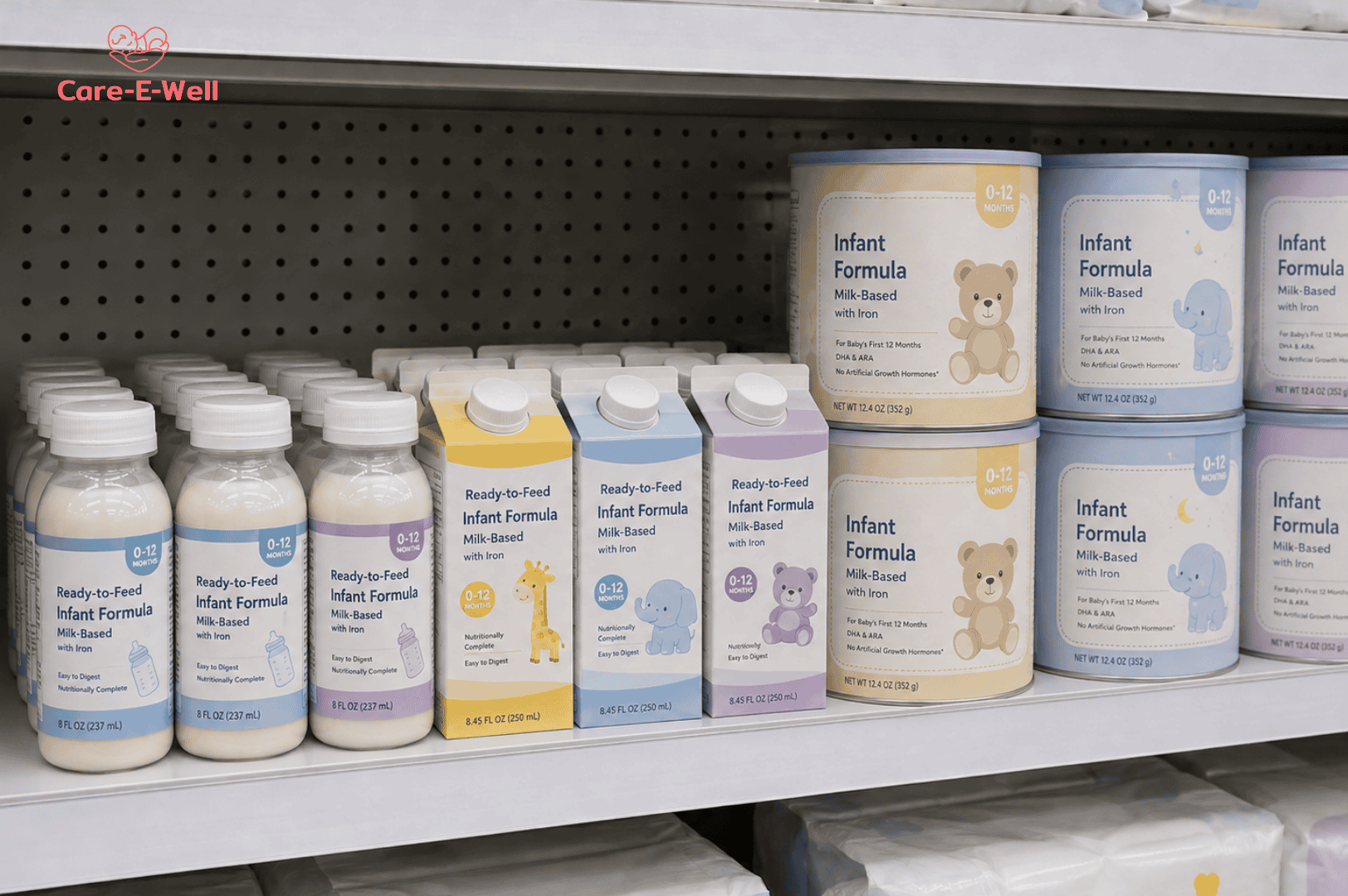
Ready-to-feed vs powder formula is less about which one is nutritionally “better” and more about preparation, microbiological risk, convenience, storage and cost. Regulated infant formulas are designed to meet infant nutritional requirements, but the two formats reach the bottle in different ways.
Powdered infant formula is not sterile and must be mixed accurately with safe water using careful hygiene. Unopened ready-to-feed formula is a commercially sterile liquid product that needs no water or measuring, which removes the reconstitution step. Once a liquid container is opened or formula is poured into feeding equipment, however, contamination and storage rules still matter.
Powder formula can be used safely when prepared correctly, but it is not sterile. Ready-to-feed formula reduces preparation steps; it does not remove the need for clean hands, clean equipment and safe storage after opening.
What is ready-to-feed formula?
Ready-to-feed, often shortened to RTF, is liquid infant formula manufactured at the correct concentration. It is designed to be fed without adding water or powder.
The unopened product is commercially sterile. This is particularly relevant for babies at higher risk from infections associated with powdered formula, because there is no powder reconstitution step.
Ready-to-feed formula may come in single-feed containers or larger bottles. Once opened, the product is no longer protected by the sealed manufacturing environment, so the label’s refrigeration and discard instructions become important.
What is powdered infant formula?
Powdered infant formula is a dry product that must be reconstituted with the exact amount of water specified by the manufacturer. The powder itself is not sterile, even when it has been manufactured under strict hygiene standards.
Rarely, harmful bacteria such as Cronobacter or Salmonella can be present in powdered formula. Contamination can also occur from hands, work surfaces, scoops, bottles or teats during preparation.
WHO guidance therefore emphasises careful hygiene, correct water temperature, accurate mixing and minimising the time prepared feeds are held before use.
Are ready-to-feed and powder formula nutritionally equivalent?
Both forms can be nutritionally complete when they are regulated infant formulas intended for the baby’s age and medical needs. European legislation sets compositional requirements for infant formula and follow-on formula whether marketed ready for use or prepared according to the manufacturer’s instructions.
Individual products can still differ in protein source, carbohydrate composition, fat blend or specialised purpose. A standard ready-to-feed formula should therefore be compared with the corresponding type of powder rather than assuming every liquid formula is identical to every powdered one.
For a baby who needs a specialised formula—for example an extensively hydrolysed or amino-acid formula—availability in ready-to-feed form may be limited.
Which format has the lower preparation risk?
Ready-to-feed has fewer preparation steps. Parents do not need to measure water, count scoops or achieve a particular reconstitution temperature. That removes several opportunities for concentration errors or contamination during mixing.
Powder requires more handling. The caregiver must prepare the feeding area, wash hands, use clean feeding equipment, measure the correct water volume, add the exact amount of powder and cool the feed safely before offering it.
These differences do not mean powder is inherently unsafe. They mean safe use depends more heavily on preparation technique.

Why does it matter that powdered formula is not sterile?
A dry product does not support rapid bacterial growth in the same way as a prepared liquid feed, but bacteria can survive in powder. Once water is added, formula becomes a nutrient-rich liquid in which bacteria can multiply if conditions allow.
WHO’s powdered infant formula guidance was developed specifically to reduce risks from organisms including Cronobacter sakazakii and Salmonella. Using sufficiently hot water during reconstitution and limiting holding time can reduce risk.
Never assume a sealed tin of powder is sterile. Follow current preparation instructions every time, especially for newborns and babies at higher risk from infection.
Is ready-to-feed formula sterile after opening?
No. Commercial sterility applies to the unopened product. Once the seal is broken, the liquid can be contaminated from hands, the bottle neck, feeding equipment or the environment.
Follow the exact storage time and refrigeration instructions on the container after opening. Different ready-to-feed formats and manufacturers may specify different limits, so there is no single safe after-opening duration that should replace the label.
Formula that has been in a bottle from which the baby has already fed should not be returned to the original container or saved for another feed.
Which is better for newborns?
For healthy term newborns, either an appropriate ready-to-feed formula or correctly prepared powdered formula may be used according to local guidance and family circumstances.
The distinction becomes more important for premature babies, infants with impaired immunity or babies receiving specialised hospital care. In higher-risk settings, sterile liquid formula is often preferred when human milk is unavailable because it avoids the intrinsic non-sterility of powder.
A neonatal or paediatric team may have specific feeding instructions. Those instructions should take priority over general home guidance.
Which is easier for night feeds?
Ready-to-feed can be simpler because there is no measuring or mixing. A clean bottle can be filled when needed, or a single-feed container can be used according to its instructions.
Powder can also be managed safely at night, but it should not be made safer by preparing bottles and leaving them at room temperature for hours. If feeds are prepared in advance, WHO refrigeration limits and careful cooling must be followed.
Convenience should never depend on extending room-temperature storage beyond safe limits.
Which is better for travel?
Ready-to-feed can be practical for short journeys because it does not require access to water for reconstitution. Sealed single-feed containers can reduce preparation steps away from home.
The trade-off is weight and bulk, and opened containers may need refrigeration. Powder is lighter and compact, but safe water, clean equipment and a method that follows preparation guidance are still needed.
Think through the full journey: preparation, hand hygiene, clean bottles, temperature control, storage after opening and what will happen to leftovers.
Is powder always cheaper?
Powder is often less expensive per prepared feed than ready-to-feed liquid, but this is not universal. Prices vary by country, retailer, brand, package size and whether the baby needs a specialised formula.
Ready-to-feed may cost more because the manufacturer supplies a sterile liquid in heavier packaging, but it can reduce waste in some situations if single-feed containers closely match what a baby takes.
Compare actual cost per usable feed rather than only the shelf price. Do not compromise safety by keeping opened formula longer than directed to reduce waste.
Does ready-to-feed create more packaging?
Ready-to-feed usually involves transporting and packaging water as part of the product, so it is heavier and often uses more packaging per feed. Powder is concentrated and generally more compact.
Environmental impact depends on packaging type, manufacturing, transport, household preparation and local recycling systems. There is no simple evidence-based rule that one option is environmentally superior in every setting.
For families, nutrition and safe feeding should remain the priority.
Can you switch between ready-to-feed and powder?
If both products are the same age-appropriate formula type and the baby has no medical reason to avoid one form, many families use both. Taste, texture and stool pattern may differ slightly, and a baby may notice the change.
Check that the products really are equivalent variants. A ready-to-feed standard formula should not be assumed equivalent to a powdered anti-reflux, lactose-free or hypoallergenic formula simply because the brand name looks similar.
If the formula is prescribed for allergy, prematurity or another medical condition, confirm substitutions with the baby’s clinical team.
Can ready-to-feed formula be diluted?
No. Ready-to-feed formula is already at the intended concentration. Adding water changes the nutrient and electrolyte concentration.
Do not dilute ready-to-feed formula and do not add extra powder to it. Feed it exactly as supplied unless a specialist has given a medically specific instruction.
Can powder be made stronger for a hungry baby?
No. Adding extra scoops makes the feed too concentrated and can alter fluid and nutrient intake. Adding extra water dilutes energy and nutrients and can also be dangerous.
If a baby regularly seems hungry after feeds, respond to hunger cues and discuss feeding volumes and growth if needed rather than changing the recipe.
Always use the exact powder-to-water ratio stated on the formula label.
What about bacterial contamination from bottles?
The formula format is only one part of safety. Ready-to-feed liquid can become contaminated if poured into dirty equipment, and safely reconstituted powder can become contaminated from hands, work surfaces, bottles or teats.
Clean preparation surfaces, hand hygiene and properly cleaned feeding equipment therefore matter for both formats.
Do not touch the inside of bottles, teats or container openings unnecessarily during preparation.

Does ready-to-feed need warming?
No. Infant formula does not have to be warm if the baby accepts it at a safe temperature. Some babies prefer milk warmed gently; others take it at room temperature.
If warming is desired, warm the bottle safely and test the temperature before feeding. Microwaving can create dangerous hot spots and is not recommended.
Warming does not extend a formula’s safe storage time.
What should parents choose?
The best format is the one that meets the baby’s nutritional and medical needs and that caregivers can use safely and consistently.
- Choose ready-to-feed when minimising preparation steps is especially valuable
- Consider ready-to-feed if the clinical team recommends sterile liquid formula for a high-risk infant
- Choose powder when cost, storage space or routine home use makes it more practical and safe preparation is manageable
- Keep some ready-to-feed as a practical backup if that fits your family and the product is appropriate for your baby
- Follow product-specific storage rules after opening
- Never change concentration to stretch either format
Families do not need to prove commitment to one format. Some use powder at home and ready-to-feed during travel or emergencies while keeping the underlying formula type consistent.
Frequently asked questions
Is ready-to-feed formula safer than powder?
It has a lower intrinsic microbiological risk before opening because it is commercially sterile and needs no reconstitution. Safe handling still matters after opening and during feeding.
Is powdered formula sterile?
No. Powdered infant formula is not sterile. Correct preparation reduces risk but does not change the fact that the dry product can occasionally contain harmful bacteria.
Does ready-to-feed have more nutrients?
Not simply because it is liquid. Both regulated formats can meet infant nutritional requirements. Compare the actual product type and label rather than assuming liquid is nutritionally superior.
Can I pour ready-to-feed formula into several bottles in advance?
Only if the product instructions allow the storage method and you can keep the formula safely refrigerated. Once a baby has fed from a bottle, do not save that leftover feed.
Is ready-to-feed useful during a power cut or emergency?
Sealed ready-to-feed formula can be useful when safe water or normal preparation is difficult, provided the product is appropriate for the baby and any opened formula can be handled according to its storage instructions.
The key takeaway
In the ready-to-feed vs powder formula decision, both can provide appropriate infant nutrition. Ready-to-feed removes the reconstitution step and begins as a commercially sterile liquid, while powder is not sterile and relies more heavily on exact preparation technique.
Choose based on the baby’s medical needs, safe preparation capacity, storage, convenience and cost. Whichever format you use, follow the label, keep feeding equipment clean and discard formula according to safe storage rules.
Sources and references
- World Health Organization. Safe Preparation, Storage and Handling of Powdered Infant Formula: Guidelines. https://www.who.int/publications/i/item/9789241595414
- UNICEF UK Baby Friendly Initiative. Guide to Bottle Feeding. https://www.unicef.org.uk/babyfriendly/baby-friendly-resources/bottle-feeding-resources/guide-to-bottle-feeding/
- European Commission. Commission Delegated Regulation (EU) 2016/127 on infant formula and follow-on formula. https://eur-lex.europa.eu/eli/reg_del/2016/127/oj
- Losio MN, Pavoni E, Finazzi G, et al. Preparation of Powdered Infant Formula. https://doi.org/10.1097/MPG.0000000000002100
- Grant A, Jones S, Ellis R, et al. The safety of at home powdered infant formula preparation: A community science project. https://doi.org/10.1111/mcn.13567
- Kent RM, Fitzgerald GF, Hill C, et al. Novel Approaches to Improve the Intrinsic Microbiological Safety of Powdered Infant Milk Formula. https://doi.org/10.3390/nu7021217
- Fein SB, Grummer-Strawn LM, Raju TN. Infant Feeding and Care Practices in the United States: Results From the Infant Feeding Practices Study II. https://doi.org/10.1542/peds.2008-1315b
- Chiang KV, Anstey EH, Abrams SA, et al. Infant burn injuries related to water heating for powdered infant formula preparation. https://doi.org/10.3389/fped.2023.1125112
- Norberg S, Stanton C, Ross RP, et al. Cronobacter spp. in Powdered Infant Formula. https://doi.org/10.4315/0362-028X.JFP-11-285
Did this Insight help?
A little love for something worth reading.


