
Care-E-Well Insights
Starting Solid Foods: Complete Guide for the First Months
Starting solid foods around 6 months? Learn readiness, first foods, textures, allergens, milk feeds, choking safety and responsive feeding.
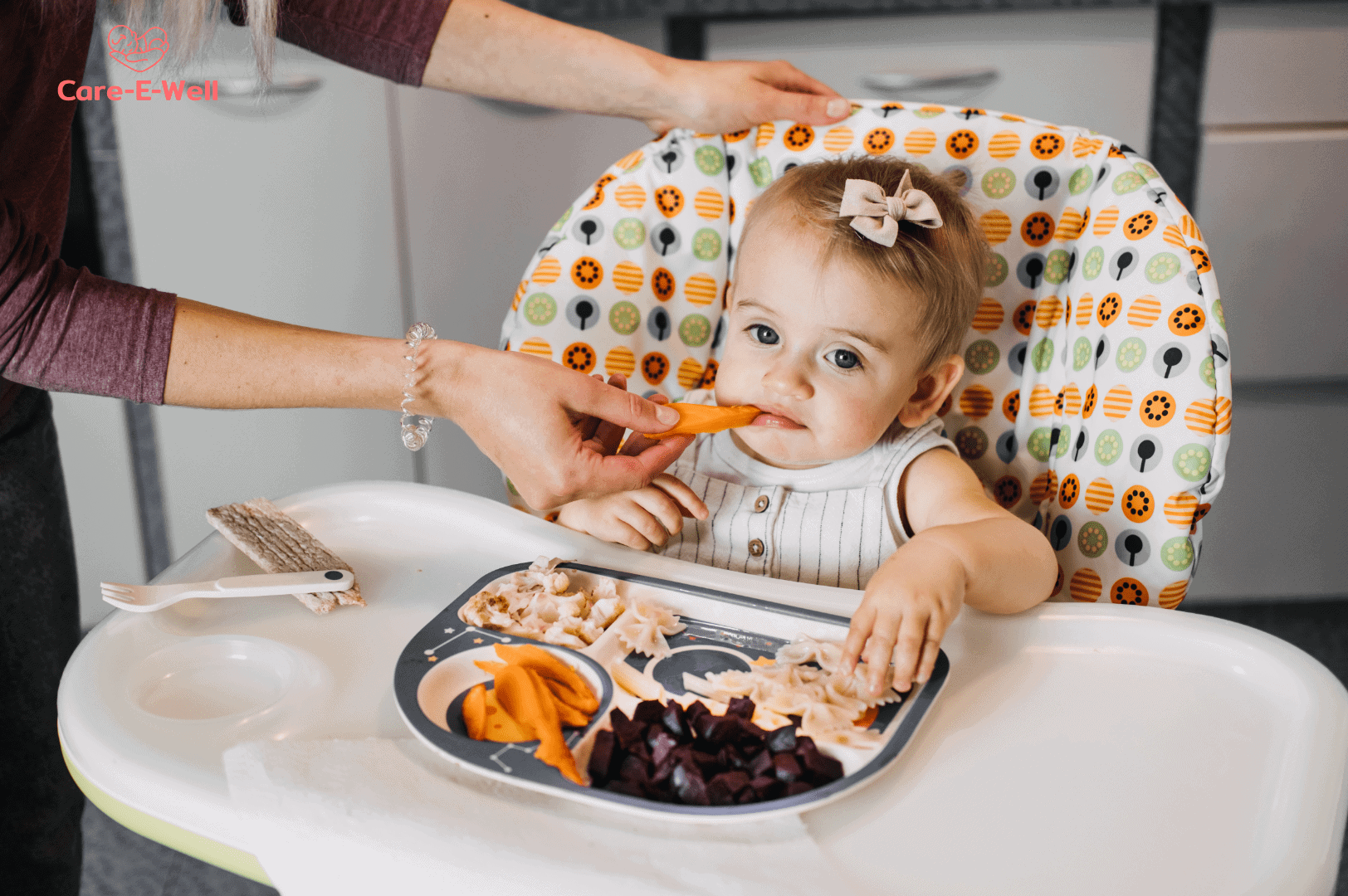
Starting solid foods is a gradual transition, not a switch from milk to meals overnight. For most healthy term babies, complementary feeding begins around 6 months, when nutritional needs are increasing and the baby is developmentally ready to manage food safely. Breast milk or infant formula continues alongside food during this transition.
The first months are mainly about learning: sitting for meals, handling new textures, coordinating chewing and swallowing, exploring flavours and learning hunger and fullness cues. You do not need a perfect menu, a special “first food” or a strict amount your baby must finish.
Think of solids as complementary at first. Food begins to add nutrients, textures and skills while breast milk or infant formula remains an important part of the baby’s diet.
When should you start solid foods?
WHO recommends introducing complementary foods at around 6 months while continuing breastfeeding. EFSA also concludes that there is no single precise age that fits every infant and that developmental readiness varies, but being capable of eating earlier does not necessarily mean a baby needs complementary foods earlier.
For a healthy term baby, “around 6 months plus readiness” is a practical evidence-based starting point. Starting much earlier simply because a baby watches you eat, wakes more at night or is a large baby is not necessary.
Babies born prematurely, babies with poor growth, swallowing concerns, significant developmental differences or medical conditions may need an individual plan based on corrected age, nutritional needs and feeding skills.
What does developmental readiness mean?
Readiness is a cluster of skills rather than one milestone. A baby should have good head control and enough trunk stability to remain safely upright in the feeding position being used. They should be able to coordinate bringing food toward the mouth and begin moving and swallowing food rather than automatically pushing everything out with the tongue.
The exact skill demands depend on the feeding method. Spoon-fed smooth or mashed food requires less self-feeding motor control than picking up and managing finger foods. A baby therefore does not have to perform every advanced feeding skill before any complementary food can begin.
The important point is that age and developmental ability should be considered together rather than treating either one as the only gate.
What should the first foods be?
There is no evidence-based requirement to begin with fruit, rice cereal or vegetables in a particular order. A useful first-food strategy is to offer safe, nutrient-dense foods from different food groups and build variety gradually.
Around 6 months, iron becomes especially important because infant iron stores are being used and complementary foods begin contributing more nutrition. Include iron-rich options regularly rather than letting the first months consist mainly of fruit and low-iron snacks.
- Soft cooked meat, poultry or fish prepared in an age-appropriate texture if your family eats them
- Well-cooked egg in a safe texture
- Beans, lentils and other pulses mashed or prepared soft enough for the baby’s skills
- Iron-fortified infant cereals where used
- Soft vegetables and fruits
- Full-fat plain dairy foods that are suitable as complementary foods, such as unsweetened yoghurt, where culturally and medically appropriate
- Soft grains and other family staples prepared without excess salt or sugar
Variety matters more than chasing a perfect sequence. Repeated exposure to different flavours and textures helps the baby learn how family foods feel and taste.

Purées, mashed food or finger foods: which is best?
More than one approach can work. Some families start with smooth spoon-fed food, some move quickly to mashed textures, and some include soft finger foods from the beginning when the baby has the motor skills to manage them. These approaches can also be combined.
The key is that texture matches the baby’s developmental abilities and progresses over time. Observational research has linked very delayed introduction of lumpier textures with later feeding difficulties, although that evidence does not prove that one specific texture timetable prevents problems in every child.
Avoid getting stuck on perfectly smooth purées for many months simply because they feel easier. As the baby gains skills, offer thicker, mashed, lumpy and soft finger-food textures that require more oral-motor work.
How much food should a baby eat at first?
There is no universal spoon count or gram target for a healthy baby beginning solids. Start with small amounts and allow the baby to decide whether to continue. Early intake can vary dramatically from one meal to the next.
Responsive feeding means the caregiver offers suitable food while watching the baby’s signals. The baby decides whether to eat and how much from what is offered. Turning away, closing the mouth, slowing down, pushing food away or becoming distracted can signal that the meal is finished.
Do not pressure a baby to empty a bowl or finish a portion. Learning to recognise hunger and fullness is part of complementary feeding.
How often should you offer meals?
WHO guidance describes a gradual increase in feeding frequency as complementary feeding develops. In the earliest phase, one relaxed food opportunity each day may be enough for a family to learn the routine, with frequency increasing as the baby becomes more skilled and interested.
By 6–8 months, WHO guidance commonly describes two to three complementary feeding opportunities per day in addition to milk feeds. Individual babies vary, and quantity at each meal can remain small initially.
Choose times when the baby is awake, reasonably calm and not desperately hungry or exhausted. A baby who is frantic for milk is often not in the best state to practise a completely new eating skill.
Does milk still matter after solids start?
Yes. Complementary feeding means food is added to breast milk or infant formula rather than immediately replacing it. Milk remains nutritionally important while the amount and variety of complementary food increase.
There is no need to abruptly drop milk feeds on the day solids begin. Let the transition happen gradually. If a baby’s milk intake falls sharply soon after starting solids, or growth, hydration or feeding behaviour concerns you, discuss the pattern with a healthcare professional.
For formula-fed babies, prepare formula exactly as instructed and do not dilute it to “make room” for solids.
How should you introduce common food allergens?
Current evidence does not support routinely delaying allergenic foods for months solely in the hope of preventing allergy. Once a baby has started complementary feeding and can manage the food’s texture safely, common allergens can be introduced in age-appropriate forms.
Examples include well-cooked egg, smooth peanut preparations diluted or mixed into another suitable food, dairy foods, wheat, fish and other locally relevant allergens. Whole nuts and thick spoonfuls of nut butter are choking hazards for babies and should not be offered in those forms.
Introduce an allergen when you can observe the baby rather than just before sleep or a rushed journey. For babies with severe eczema, an existing food allergy or a history that places them at higher allergy risk, discuss introduction with an appropriate healthcare professional because individual guidance may be useful.
Seek urgent medical help for signs of a severe allergic reaction such as breathing difficulty, swelling affecting breathing, collapse, marked lethargy or rapidly worsening multi-system symptoms.
What is the difference between gagging and choking?
Gagging is a protective response that can occur while babies learn to manage food. It may involve coughing, noise, tongue movement, watering eyes or bringing food forward in the mouth. Choking is an airway obstruction and may be quiet if the baby cannot move air effectively.
Safe complementary feeding reduces risk by keeping the baby upright, directly supervising meals and matching food size and texture to the baby’s skills. Hard round foods, whole nuts, chunks of raw hard vegetables and other foods that can block the airway need modification or avoidance.
Every caregiver who feeds a baby should know age-appropriate first aid for choking. If a baby cannot breathe, cough effectively or make sound because the airway is blocked, act immediately according to infant choking first-aid guidance and call emergency services as required.
How should you prepare food safely?
Babies are vulnerable to foodborne illness, so hygiene matters. Wash hands, use clean utensils and preparation surfaces, cook foods thoroughly when required, and store leftovers safely. Discard food that has been contaminated by saliva rather than repeatedly returning a used spoon to a storage container.
WHO recommends gradually increasing food consistency and variety while maintaining good hygiene. Family foods can often be adapted by setting aside the baby’s portion before adding extra salt, sugar or strong salty sauces.
Avoid adding salt or sugar to make food more appealing. Babies can learn the natural flavours of foods without adult-level seasoning.
Do you need special baby food?
No. Commercial baby food can be convenient, but it is not required. Many ordinary family foods can be adapted into safe textures and nutritionally useful meals.
The advantage of adapted family food is that the baby can gradually join the family’s normal eating pattern. The important questions are whether the food is safe in texture, nutritionally appropriate, hygienically prepared and not overloaded with salt or added sugar.
Packaged foods marketed for babies should not automatically be assumed to be nutritionally superior to simple family foods. Read labels and use them as one option rather than the foundation of the entire diet.

What should a simple first-week routine look like?
Keep the first days uncomplicated. You might offer one small food opportunity once a day when the baby is alert, then add variety and frequency as the baby becomes comfortable.
- Seat the baby upright and make sure the head and trunk are stable.
- Offer a small amount of one or two suitable foods.
- Let the baby touch, smell and explore rather than rushing each mouthful.
- Follow hunger and fullness cues instead of aiming for a fixed portion.
- Continue usual breast milk or formula feeds.
- Over the following days, add different foods, including iron-rich choices.
- Progress texture as skills develop rather than staying indefinitely with smooth food.
There is no prize for introducing many foods quickly. A steady expansion of variety is easier to observe and often easier for the family to sustain.
Common mistakes when starting solids
- Starting because of night waking alone rather than age, nutrition and readiness
- Expecting solids to replace milk immediately
- Offering mostly fruit or low-iron foods and forgetting nutrient density
- Keeping textures very smooth for too long without progression
- Pressuring the baby to finish portions
- Feeding while the baby is reclined or inadequately supported
- Using hard, round or otherwise high-risk choking foods without modification
- Delaying common allergens for long periods without a medical reason
- Adding unnecessary salt or sugar
None of these mistakes means feeding has been “ruined.” Complementary feeding develops over months, and routines can be adjusted as parents learn what works for their baby.
When should you ask for professional feeding advice?
Seek advice if the baby persistently coughs, chokes or changes colour during feeds; has difficulty swallowing; repeatedly vomits large amounts; shows poor growth; refuses almost all textures over time; seems unusually weak or fatigued during meals; or has a known condition affecting feeding or nutrition.
Premature babies and babies with neurological, cardiac, respiratory, gastrointestinal or oral-motor conditions may need individual guidance. Corrected age, posture, energy needs and swallowing safety can all influence the plan.
If a baby approaches or passes 6 months and does not appear able to begin complementary feeding safely, discuss readiness rather than simply waiting indefinitely or forcing food.
The key takeaway
Starting solid foods works best as a gradual learning process around 6 months, guided by developmental readiness and nutritional need. Keep milk feeds, prioritise nutrient-dense variety, progress textures with skills, introduce allergens in safe forms without unnecessary delay, and let the baby’s hunger and fullness signals shape the pace.
Frequently asked questions
Do babies need teeth before starting solid foods?
No. Babies can manage many soft mashed and finger foods with their gums when they have the appropriate oral-motor and postural skills.
Should vegetables always come before fruit?
There is no required sequence. Offer a variety of vegetables, fruits and nutrient-dense foods rather than relying on one category.
Can I combine spoon feeding and finger foods?
Yes. A mixed approach can work well when every texture and piece of food matches the baby’s skills and is offered with direct supervision.
Should solids make my baby sleep longer?
Do not use sleep as the main reason to start complementary foods. Night waking has many causes, and readiness for food should be judged separately.
What if my baby was premature?
Premature babies may need an individual plan using corrected age, developmental skills and medical or nutritional needs rather than a simple calendar-age rule.
Sources/References
- World Health Organization — WHO Guideline for complementary feeding of infants and young children 6–23 months of age
- World Health Organization — Infant and young child feeding
- European Food Safety Authority — Age to start complementary feeding of infants
- Barnes C, de Klerk E — Complementary Feeding: Pitfalls for Health Outcomes
- Northstone K et al. — The effect of age of introduction to lumpy solids on foods eaten and reported feeding difficulties
- McWilliam V et al. — A pragmatic approach to infant feeding for food allergy prevention
- Ferraro V et al. — Timing of Food Introduction and the Risk of Food Allergy
- Verduci E et al. — Feeding Practices in the Introduction of Complementary Feeding and Implications for Future Healthy Eating
- Waidyatillake N et al. — Association between the age of solid food introduction and eczema: A systematic review and meta-analysis
- Johnson SS et al. — The First Foods Qualitative Study: Caregiver and Infant Feeding Interactions During the Complementary Feeding Period
Did this Insight help?
A little love for something worth reading.


