
Care-E-Well Insights
Swallowed Magnet: When to Seek Emergency Care
Swallowed magnet? Multiple magnets can injure bowel before symptoms appear. Learn why urgent assessment matters and what not to do.
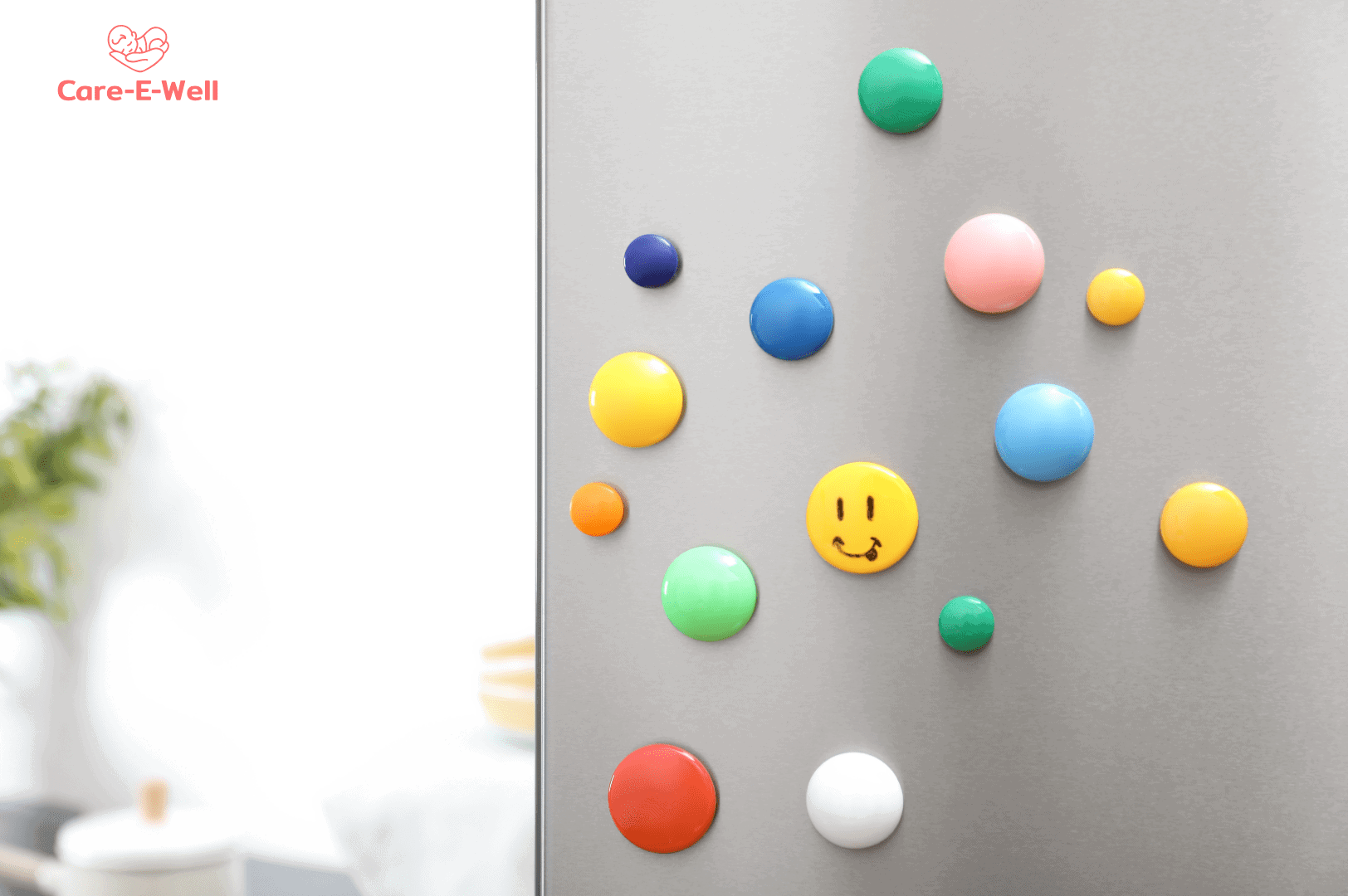
If a child may have swallowed a high-powered magnet, seek urgent medical assessment even if they have no pain, vomiting or other symptoms. The greatest danger is swallowing more than one magnet, or swallowing a magnet together with another metallic object. They can attract each other through separate loops of bowel and trap tissue between them.
That trapped tissue can lose its blood supply and develop pressure necrosis, fistulas, obstruction or perforation. These injuries can begin while a child still looks well, so waiting for symptoms is not a safe way to decide whether the ingestion matters.
Suspected ingestion of multiple magnets, an unknown number of magnets, or a magnet with a metal object needs urgent emergency assessment.
What should you do first if a child swallowed a magnet?
- Check that the child is breathing and responding normally.
- Remove any remaining magnets from reach so no additional magnets can be swallowed.
- Note the approximate time of ingestion and how many magnets may be missing.
- Bring the product, packaging or an identical magnet if it is immediately available.
- Arrange urgent medical assessment.
- Do not induce vomiting.
- Do not give laxatives, food or other remedies to try to move the magnet through unless a clinician specifically advises it.
If the child is choking, has severe breathing difficulty, collapses or becomes unresponsive, emergency airway and resuscitation priorities come first.
With magnet ingestion, the number matters—but an apparently single magnet on an X-ray can sometimes be several magnets stuck tightly together. Let clinicians confirm the count and location.
Why are high-powered magnets different from ordinary swallowed objects?
Many small, smooth foreign bodies can pass through the gastrointestinal tract without causing harm. High-powered neodymium magnets behave differently because two magnets can attract each other across bowel walls.
When bowel tissue is trapped between them, continuous pressure can impair blood flow. Published paediatric series describe pressure necrosis, perforation, entero-enteric fistulas, obstruction, volvulus and peritonitis after multiple-magnet ingestion.
A magnet can also attract a separate metallic object, creating the same trapping mechanism. This is why the history must include not only the number of magnets but whether a metal object might also have been swallowed.
Can a child be injured without symptoms?
Yes. Multiple reports describe children who were initially asymptomatic despite magnets already being positioned in ways that could injure the bowel. Symptoms may appear only after tissue damage has progressed.
This makes home observation based solely on how the child feels unsafe when multiple magnets or an uncertain number may have been swallowed.
What symptoms can develop?
- abdominal pain or tenderness
- repeated vomiting
- abdominal swelling or distension
- fever
- refusal to eat
- lethargy or unusual weakness
- blood in vomit or stool
- inability to pass stool or gas
- severe or worsening pain
- collapse or signs of serious illness
Severe abdominal pain, repeated vomiting, a swollen abdomen, blood in vomit or stool, fever with worsening illness, collapse or marked lethargy after magnet ingestion needs immediate emergency care.
Do not wait for these symptoms before seeking assessment when a high-powered magnet ingestion is suspected.

What if only one magnet was swallowed?
A truly single magnet generally carries less risk than multiple magnets because there is no second magnetic object to trap bowel tissue. However, management still depends on the magnet’s size, location, timing, the child’s symptoms and how certain the number is.
Magnets can adhere tightly to one another and appear as one object on a single radiographic view. Clinicians may use more than one view to work out whether there is truly one magnet.
Parents should therefore avoid deciding at home that a missing group of magnets is “probably just one.”
How will doctors locate swallowed magnets?
Radiographs are commonly used because high-powered magnets are radiopaque. Imaging helps determine how many objects are present, where they are and whether they appear to be moving together.
Multiple views may be useful when magnets overlap. Serial imaging may also be used in selected cases to assess progression, but the timing and need for repeat imaging are clinical decisions.
When do swallowed magnets need removal?
Management depends on number, location, symptoms and timing. When multiple magnets are still reachable in the stomach or upper gastrointestinal tract, urgent endoscopic removal may be recommended before they pass farther into the bowel.
Magnets beyond endoscopic reach may require close specialist management, serial imaging or surgery depending on whether they progress and whether complications are suspected.
A child with signs of obstruction, perforation, peritonitis or other significant complication needs urgent surgical assessment.
Do not try to manage multiple magnets at home by waiting for them to appear in stool unless a specialist has explicitly given that plan.
Should you make the child vomit?
No. Inducing vomiting is not a safe or reliable way to retrieve a magnet. It can create aspiration risk and does not address magnets that have already passed into the oesophagus or stomach.
Should you give food, fibre or laxatives?
Not unless the treating team recommends it. Food can interfere with sedation or endoscopy if urgent retrieval is needed, and laxative strategies are not appropriate generic first aid.
Keep the child fasting if emergency clinicians instruct you to do so.
Is honey useful for swallowed magnets?
No. Honey guidance is specific to suspected button-battery ingestion under narrow conditions. Honey does not neutralise the mechanical attraction between magnets and should not be used as a magnet-ingestion treatment.
What if the swallowed object might be a magnetic toy piece?
Treat small magnetic beads, building-set magnets, jewellery magnets and other high-powered neodymium products seriously. Their small size can make them easy for children to swallow several at once.
If pieces are missing from a set, tell the medical team how many could be unaccounted for. A photograph of the intact product or packaging can help establish the expected size and shape.
What if you did not see the child swallow the magnets?
Unwitnessed ingestion is common in young children. A missing magnet set plus unexplained abdominal symptoms should raise concern, but absence of symptoms does not exclude ingestion.
If you find a damaged magnetic toy or notice pieces are missing and a child had access, seek professional advice promptly rather than waiting for certainty.
Can magnets cause problems days later?
Yes. If ingestion goes unnoticed, pressure injury can evolve over time and a child may present later with abdominal pain, vomiting, fever or complications such as fistula or perforation.
Tell clinicians about any possible earlier magnet exposure if a child develops unexplained gastrointestinal symptoms, even if several days have passed.
How are magnets different from coins?
A coin is not magnetic and cannot attract another object through bowel walls. Multiple high-powered magnets therefore create a unique risk that ordinary coins do not.
This difference is why management algorithms for magnets are more aggressive than for many other blunt foreign bodies.

What should you do after a clinician says a single magnet can be observed?
Follow the exact imaging and symptom-monitoring plan you are given. Do not substitute a generic internet timetable for specialist instructions because management depends on the child and the magnet’s location.
Return immediately if the child develops worsening abdominal pain, repeated vomiting, abdominal distension, fever, blood in stool or vomit, or becomes generally unwell.
How can magnet ingestions be prevented?
- keep high-powered magnetic beads and loose magnets away from young children
- follow age restrictions on magnetic products
- discard broken toys or sets with missing magnetic pieces
- store spare magnets securely
- count pieces after older children use magnetic sets around younger siblings
- keep desk toys and adult magnetic accessories out of reach
- teach older children never to put magnets in the mouth, nose or ears
Prevention also matters for teenagers. Some magnet ingestions happen when older children imitate tongue or lip piercings with magnetic jewellery.
Frequently asked questions
My child swallowed one magnet and feels fine. Is it still urgent?
Yes, it needs medical assessment to confirm the number and location. A true single magnet is lower risk than multiple magnets, but the count should not be assumed.
Can two swallowed magnets stick together safely?
They may stick together, but they can also attract across different bowel loops. That second situation can trap and damage tissue.
Should I search the stool for the magnet?
Only if a clinician has given a specific observation plan. Multiple magnets or an uncertain number should not be managed with unsupervised stool watching.
Can a metal object cause the same problem?
A magnet swallowed with a metallic object can create attraction across bowel walls, so tell clinicians if a screw, ball bearing or another metal item may also be missing.
Is an ordinary refrigerator magnet dangerous?
Magnet strength varies greatly. High-powered neodymium magnets are the major concern, but parents should not attempt to classify a swallowed magnet at home. Seek medical advice with the product information.
The key takeaway
A swallowed magnet deserves urgent medical assessment, especially when more than one magnet, an unknown number or a magnet plus metal may have been swallowed. Multiple magnets can attract through bowel walls and cause pressure necrosis, fistulas, obstruction or perforation before symptoms appear. Do not induce vomiting or try food or laxatives to force passage. Let clinicians confirm the number and location and decide whether endoscopic removal, imaging follow-up or surgery is needed.
Sources and References
- Nguyen TA, McCallum R, O’Loughlin EV, et al. — Management patterns of multiple magnet ingestion in children
- Lorenze A, Scheller RL, Reichert N — Gastric Mucosa Fistula Secondary to Magnet Ingestion
- Mathew RP, Liang TI, Kabeer A, et al. — Clinical presentation, diagnosis and management of aerodigestive tract foreign bodies in the paediatric population: Part 2
- Lai HH, Lin HY, Chang CH, et al. — Magnet ingestion by children: a retrospective study in Taiwan
- Flaherty MR, Buchmiller T, Vangel M, et al. — Pediatric Magnet Ingestions After Federal Rule Changes, 2009-2019
- Rashed YK, Khalfan K — Button Batteries and High-Powered Neodymium Magnet Ingestion in Children
- Kwon HJ, Park J — Surgical removal of ingested magnets in children: a single-center experience
- Kelaidi N, Bountis V, Kalyvas D, et al. — Entero-Enteric Fistula Following Multiple Magnet Ingestion in Children: A Systematic Review
- Nezhentsev A, et al. — Diagnosis and management of paediatric magnet ingestion: a systematic review of clinical practice guidelines
- Kennedy JM, et al. — Pediatric magnet ingestion and gastrointestinal injury
Did this Insight help?
A little love for something worth reading.


