
Care-E-Well Insights
How to Turn and Reposition a Baby During Diaper Changes
Learn gentle ways to lift, roll and reposition a baby during diaper changes while supporting natural hip movement and caregiver comfort.
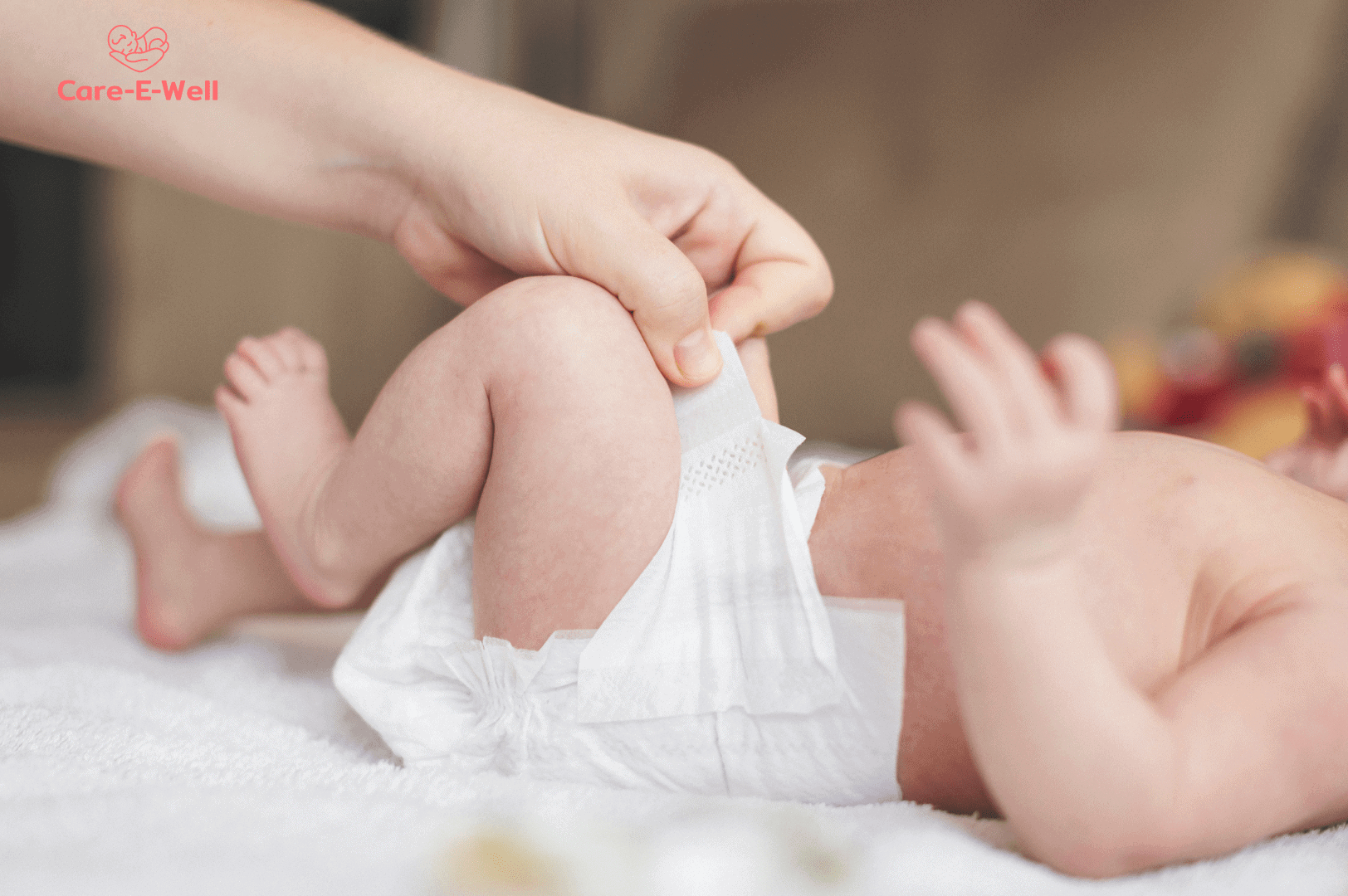
The easiest way to turn and reposition a baby during diaper changes is to use slow, supported movements rather than pulling on the legs or twisting the trunk. For everyday cleaning, you can lift the pelvis gently with your hands or roll the baby slightly from side to side while keeping the head and trunk supported.
There is no evidence that parents need a complex therapeutic handling sequence for every diaper. The goal is simpler: keep your baby secure on the changing surface, move the hips and legs within a comfortable range, avoid forceful end-range positions, and use the change as another opportunity for calm, symmetrical handling.
Diaper changes do not need to be rigid or perfectly symmetrical. Gentle variation from side to side is more useful than repeatedly forcing the same position.
What is a safe starting position for a diaper change?
Place your baby on their back on a stable changing surface. Keep everything you need within reach before you begin so you do not have to turn away or leave the baby unattended.
A newborn can move suddenly even before rolling becomes an intentional milestone. Keep at least one hand close to the baby whenever the changing surface is elevated.
If possible, stand close to the changing surface rather than reaching forward from a distance. Repetitive infant-care tasks can load the caregiver's back, hips and knees, especially when the adult bends and twists while holding the baby's weight away from the body.
Is it okay to lift a baby's legs by the ankles?
Parents often lift both legs briefly during diaper changes, and a gentle small lift is not automatically harmful in a healthy infant. The problem is using the ankles as handles to pull the pelvis high into the air or forcing the knees toward the face.
Instead, use one hand to gather the lower legs gently while the other hand can support the pelvis, or slide a hand under the bottom and lift only as much as needed to place or remove the diaper.
Keep the hips and knees comfortable rather than pushing them into extreme flexion or holding the knees straight while the hips are deeply flexed.

How can you roll a baby during a diaper change?
Side-to-side rolling can be useful for cleaning the back of the thighs, buttocks and lower back. Place one hand across the baby's pelvis or upper thigh and guide the body into a small side turn while supporting the trunk as needed.
Let the shoulders and pelvis move together rather than twisting the lower body sharply while the chest stays flat. For a newborn with limited head control, make sure the head does not roll abruptly or become trapped against the surface.
Then return to the middle and repeat toward the other side if needed. The movement can be small; you are creating access, not practising a large developmental roll.
Why does gentle hip positioning matter?
A normal newborn usually rests with the hips and knees flexed. Research on developmental dysplasia of the hip shows why prolonged forceful positioning with the hips constrained in adverse positions can matter for hip development.
This does not mean ordinary diaper changes cause hip dysplasia. The evidence relates more strongly to sustained positioning practices and to babies who already have risk factors or abnormal hip development.
During a diaper change, simply allow the legs to bend and open naturally. Avoid repeatedly forcing the knees together, straightening the legs against resistance or pushing the hips to an extreme range.
Should you use double diapers to keep the hips apart?
Not routinely. Although studies have investigated double diapering and hip maturation, a diaper is not a substitute for proper assessment or prescribed treatment when developmental dysplasia of the hip is suspected or diagnosed.
If your baby's clinician has identified hip instability, an immature hip or dysplasia, follow the exact positioning and orthosis instructions from the treating team. Do not modify a Pavlik harness or other device for diaper access unless you have been shown how.
Routine diaper changing for a healthy infant should prioritize comfortable free movement rather than trying to create a therapeutic hip position.
How can diaper changes support symmetrical movement?
Babies often develop temporary preferences for looking or turning one way. Varying how you approach the changing table can give them chances to look to both sides without forcing the head.
You can place your face, voice or a simple visual target slightly to one side during one change and the other side during another. When rolling for cleaning, alternate the direction you begin with rather than always turning the baby the same way.
This kind of everyday variation is consistent with developmental guidance that encourages symmetrical movement opportunities and early attention to persistent postural preference.
What if your baby hates diaper changes?
Crying during diaper changes does not necessarily mean the movement is painful. Babies may dislike cold air, hunger, being interrupted during sleep or the loss of body contact.
Prepare supplies in advance, keep the room comfortably warm, move predictably and talk to your baby as you work. Briefly placing a hand on the chest or bringing the arms toward the midline can help some newborns reorganize after a startle.
If your baby cries specifically when one hip or leg is moved, seems consistently stiff on one side or has a new change after an injury, that is different from general fussiness and deserves assessment.

How should you change a baby with a Pavlik harness or hip treatment?
Follow the orthopaedic team's instructions. A Pavlik harness is designed to maintain a therapeutic hip position, and the straps should not be casually adjusted or removed unless your baby's treatment plan allows it.
Diaper access is usually managed within the device, but the exact method depends on the harness, fit and clinical protocol. Ask the treating team to demonstrate the change with your own baby before you leave the clinic.
If a baby being treated for hip dysplasia develops swelling, persistent colour change, marked skin injury, unusual leg immobility or you believe the harness fit has changed, contact the treating team promptly rather than tightening or repositioning straps yourself.
What signs of asymmetry should parents mention?
Many harmless preferences come and go, but persistent asymmetry is worth discussing. Examples include consistently looking to only one side, a fixed head tilt, clearly limited movement of one hip, or one leg that seems to move very differently from the other.
Congenital muscular torticollis guidelines emphasize early identification of postural preference and symmetrical movement opportunities because earlier assessment can shorten treatment when a true restriction is present.
Do not try to diagnose hip dysplasia or torticollis from a diaper change alone. These conditions require clinical assessment and, when indicated, imaging or physiotherapy evaluation.
A step-by-step diaper repositioning routine
- Place your baby supine on a stable surface and keep supplies within reach.
- Undo the diaper while keeping one hand close to the baby.
- Gently flex the knees and hips only as far as the baby moves comfortably.
- Lift the pelvis slightly with support under the bottom, or roll the baby a little to one side.
- Clean the exposed area without pulling the legs into an extreme position.
- Return to the middle and roll to the other side if more access is needed.
- Slide the clean diaper into place with minimal lifting.
- Let the legs return to their natural flexed, freely moving position.
Once the sequence feels familiar, diaper changes become a series of small controlled movements rather than one big lift of the legs. That is easier on the baby and often easier on the caregiver too.
Frequently asked questions
Can diaper changing cause hip dysplasia?
Normal gentle diaper changes are not established as a cause of developmental dysplasia of the hip. The greater concern is prolonged or forceful positioning that restricts natural hip movement.
Should I roll my newborn instead of lifting the legs?
You can use either a small supported pelvic lift or gentle side rolling. Alternating methods can make cleaning easier and reduces the need for large leg lifts.
Why does one hip feel tighter during changes?
Temporary resistance can happen, but persistent asymmetry or clearly reduced movement on one side should be mentioned to your baby's healthcare professional.
Is side rolling safe for a newborn?
Yes, when you control the movement and keep the baby secure on the changing surface. It should be a small supervised turn, not leaving the baby unattended on their side.
Sources and references
- Vaquero-Picado A, González-Morán G, Gil Garay E et al. — Developmental dysplasia of the hip: update of management
- Noordin S, Umer M, Hafeez K et al. — Developmental dysplasia of the hip
- Bracken J, Tran T, Ditchfield M — Developmental dysplasia of the hip: Controversies and current concepts
- Gahleitner M, Hochgatterer R, Großbötzl G et al. — Short Term Results of Early Treatment of Developmental Dysplasia of the Hip or Luxation with Pavlik Harness in Human Position
- Chang CH, Lee WC, Kao HK et al. — Double diapering facilitates hip maturation in newborns
- Sargent B, Coulter C, Cannoy J et al. — Physical Therapy Management of Congenital Muscular Torticollis: A 2024 Evidence-Based Clinical Practice Guideline
- Krishnan S, Chokshi TR, Alaparthi GK et al. — Practice patterns of physiotherapists in neonatal intensive care units: A national survey
- Luu TM, Xie LF, Peckre P et al. — Web-Based Intervention to Teach Developmentally Supportive Care to Parents of Preterm Infants: Feasibility and Acceptability Study
- Kim JW, Eom GM, Kwon YR et al. — Analysis of maximum joint moment during infant lifting-up motion
- Todd BK, Banerjee R — Lateralization of infant holding by mothers: A longitudinal evaluation of variations over the first 12 weeks
Did this Insight help?
A little love for something worth reading.


