
Care-E-Well Insights
When Can Babies Use an Open Cup or Straw Cup?
Learn when babies can start open-cup and straw drinking, how to practise safely and which readiness signs matter more than age.
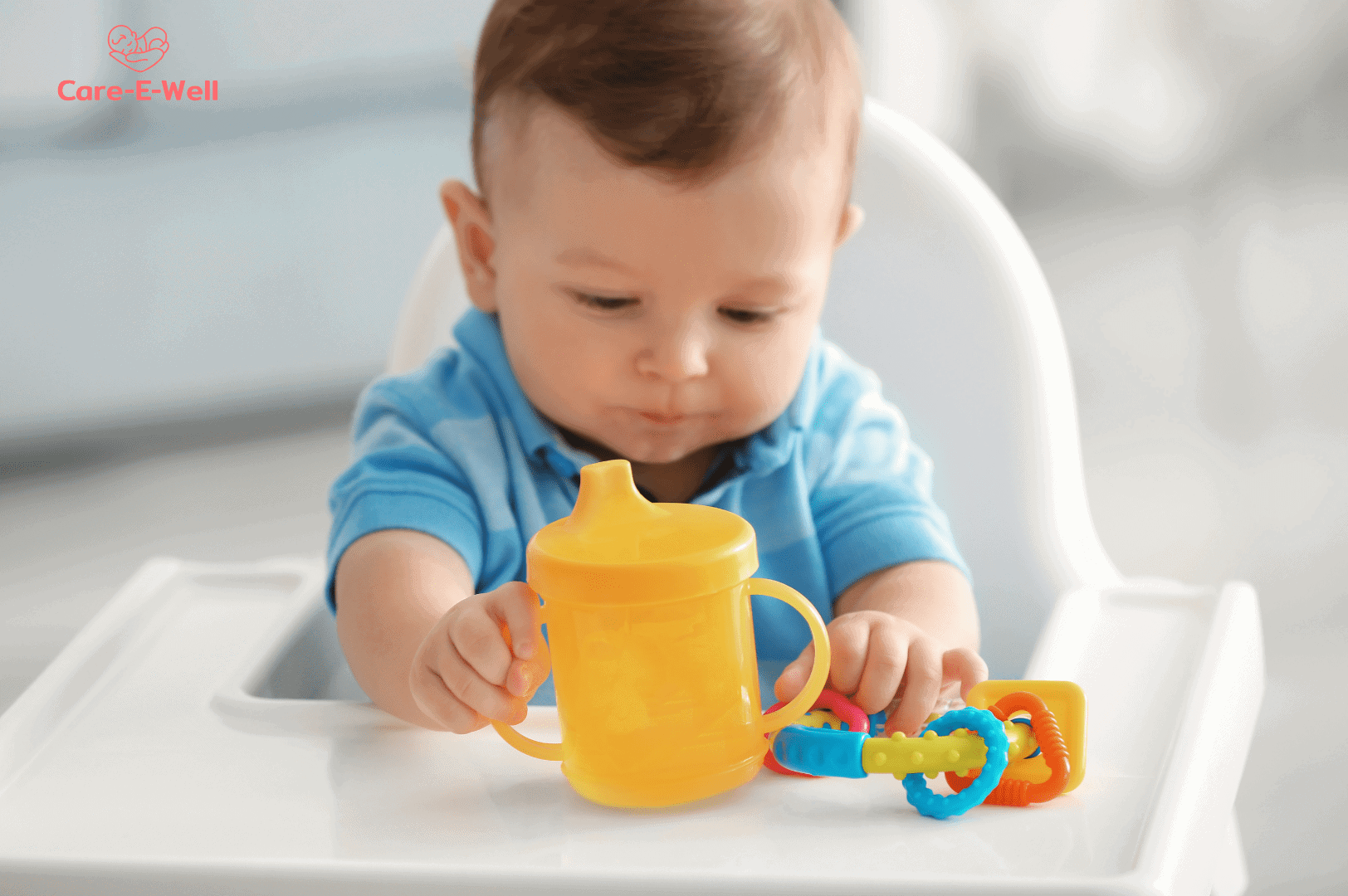
Babies can begin practising cup drinking during the complementary-feeding period, usually from around six months, with hands-on adult help. An open cup and a straw cup are both learnable skills; neither is universally required to come first, and independent drinking usually develops gradually over many months.
The useful question is not simply “What age can a baby use a cup?” but whether the baby can sit upright, coordinate swallowing and manage small amounts of liquid safely. Early practice can be brief and messy. The goal is skill-building, not replacing breast milk or infant formula too quickly.
Cup practice is a developmental exercise. A few supervised sips at meals can be enough at first.
When can babies start using an open cup?
Many babies can start practising with a small open cup at around six months when complementary foods begin. WHO describes the complementary-feeding period as a time for increasing independence and responsive feeding, and later in infancy many children can participate in self-feeding and drinking skills.
Research on feeding development shows wide variation. Some infants can hold a cup with help early in the second half of the first year, while coordinated independent drinking emerges later (Sdravou et al., 2023; Verduci et al., 2025).
When can babies use a straw cup?
A straw can also be introduced during the complementary-feeding period once the baby can maintain a stable upright position and coordinate sucking and swallowing. Straw drinking is a distinct skill; babies do not have to master an open cup first.
Some developmental descriptions place straw use later than initial cup practice, but these are population patterns rather than hard safety thresholds. Ramos et al. described straw self-feeding as a later-emerging skill than initial cup exposure, while other work shows large variation in drinking milestones.
Open cup vs straw cup: is one better?
Neither method is inherently superior for every healthy baby. An open cup encourages lip control and graded sipping, while a straw cup can be practical for travel and may reduce spills. What matters most is that the baby can drink safely, the cup is easy to clean, and parents do not rely on a cup design that encourages constant sipping of sweet drinks.
For most families, using both methods over time is reasonable. Skills develop through repeated, low-pressure practice.

What about sippy cups?
A sippy cup is not essential. Some families find free-flow cups convenient, while others move directly between open cups and straws. There is limited high-quality evidence showing that one specific cup type produces superior oral development in healthy children.
Choose a cup that is easy to clean and that your baby can eventually control. Avoid making cup choice a source of anxiety.
What should babies drink from a cup?
During the first year, breast milk or infant formula remains nutritionally important. Once complementary feeding begins, small amounts of water can be offered with meals. A cup should not become a vehicle for frequent sweet drinks.
WHO’s complementary-feeding guidance emphasises nutrient-dense foods and healthy beverages. Sweet beverages are not needed, and repeated exposure to sugary drinks can displace more nutritious intake and increase free-sugar exposure.
How much water should be offered?
There is no single plain-water volume that is right for every baby. Fluid needs vary with milk intake, food intake, climate, illness and activity. In the early stages, cup practice may involve only small sips while milk feeds continue.
Do not force water simply to achieve a cup target. Watch the baby’s overall feeding pattern and discuss individual fluid needs with a healthcare professional if there are medical concerns.
How to teach open-cup drinking
- Sit the baby upright and well supported.
- Use a small, lightweight cup that is easy for an adult to control.
- Add only a small amount of liquid so the flow is manageable.
- Bring the rim gently to the baby’s lips rather than pouring liquid into the mouth.
- Let the baby close the lips and take a small sip.
- Pause between sips and watch breathing and swallowing.
- As coordination improves, allow the baby to place hands on the cup and gradually take more control.
Early attempts often involve spilling, biting the rim or taking too much at once. That is normal skill development, provided the baby remains comfortable and safe.
How to teach straw drinking
Offer a short, manageable straw and begin with small amounts. Some babies discover straw suction quickly; others need repeated exposure. Do not squeeze large volumes rapidly into the baby’s mouth.
A straw cup should allow parents to clean all valves, tubes and hidden surfaces thoroughly. Complex cups that cannot be fully cleaned can retain food or liquid residues.
What are signs a baby is coping well?
- Stable upright sitting during drinking.
- Comfortable breathing throughout.
- Small, coordinated sips.
- Occasional coughing that resolves quickly rather than repeated distress.
- Increasing ability to control the cup or straw over time.
Mess alone is not a sign that the baby is not ready. Learning to drink involves sensory and motor practice.
When coughing with a cup needs attention
An occasional cough while learning can occur, but repeated coughing, choking, wet or gurgly breathing, colour change, significant breathlessness or frequent chest infections deserve professional assessment.
Stop feeding and seek urgent help if a baby cannot breathe or has a true choking episode. Repeated coughing or choking with liquids should be discussed promptly with a healthcare professional because swallowing difficulty needs individual assessment.
Do babies need to stop bottles as soon as they use a cup?
No. Introducing a cup does not mean abruptly removing breast or bottle feeds. Cup skills and nutritional transitions are separate processes. In the first year, milk remains central while complementary foods and drinking skills expand.
Observational research shows that prolonged bottle use can persist well beyond the period when many children are capable of cup drinking, but the exact transition should take account of the child’s development and family feeding context (Yeung et al., 2017).
Can a baby drink independently at six months?
Some babies can hold or steady a cup briefly, but full independent drinking is not expected immediately. A 2025 review of complementary-feeding development notes that by around nine months many infants can drink from a cup using both hands, but this is a population description, not a pass-fail milestone (Verduci et al., 2025).
Developmental research consistently shows variation in feeding skills. Support your baby’s attempts without comparing them rigidly with another child.
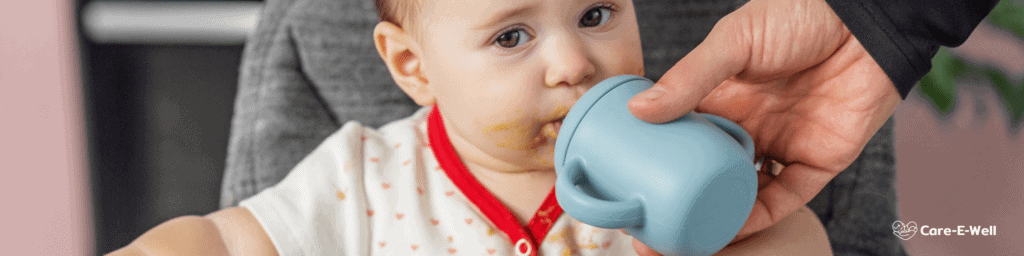
Cups and responsive feeding
Offer drinks without pressure. Let the baby pause, turn away or stop. Responsive feeding means caregivers provide appropriate options and assistance while respecting hunger, thirst and satiety signals.
Cup practice should be part of calm meals, not a performance test. If the baby becomes frustrated, stop and try again another time.
Frequently asked questions
Is an open cup safe for a six-month-old?
It can be when the baby is developmentally ready, seated upright and directly supervised, with an adult controlling small amounts at first.
Does a straw cup delay speech?
There is no good evidence that ordinary straw use in a healthy child causes speech delay. Feeding and speech both involve complex oral-motor systems, but one cup type should not be blamed for speech development without clinical evidence.
Should I teach open cup before straw?
No universal sequence is required. Many babies learn both during the first year. Choose the method the baby manages comfortably and safely.
Can breastfed babies use a cup?
Yes. Cup practice does not require ending breastfeeding. It is simply an additional drinking skill used as complementary foods and other fluids are introduced.
Conclusion
Babies can begin practising an open cup or straw cup during complementary feeding, often around six months, but independence develops gradually. Keep the baby upright, start with small amounts, use direct supervision and let skill rather than a rigid age determine progression.
Sources/References
- World Health Organization. WHO Guideline for complementary feeding of infants and young children 6–23 months of age. https://www.who.int/publications/i/item/9789240081864
- World Health Organization. Complementary feeding. https://www.who.int/health-topics/complementary-feeding
- European Food Safety Authority. Appropriate age range for introduction of complementary feeding into an infant’s diet. DOI: https://doi.org/10.2903/j.efsa.2019.5780
- Sdravou K, Printza A, Emmanouilidou-Fotoulaki E, et al. Developmental Feeding Stages and Their Impact on Child Feeding Behavior. DOI: https://doi.org/10.1097/MPG.0000000000003892
- Verduci E, Fiore G, Agostinelli M, et al. Feeding Practices in the Introduction of Complementary Feeding and Implications for Future Healthy Eating. DOI: https://doi.org/10.1159/000543126
- Ramos CCF, Maximino P, Machado RHV, et al. Delayed Development of Feeding Skills in Children with Feeding Difficulties. DOI: https://doi.org/10.3389/fped.2017.00229
- Yeung SSY, Chan R, Li L, et al. Bottle milk feeding and its association with food group consumption, growth and socio-demographic characteristics. DOI: https://doi.org/10.1111/mcn.12341
- Van der Merwe J, Kluyts M, Bowley NA, et al. Optimizing the introduction of complementary foods in the infant's diet. DOI: https://doi.org/10.1111/j.1740-8709.2007.00111.x
- Toh JY, Yip GCK, Han WM, et al. Infant Feeding Practices in a Multi-Ethnic Asian Cohort: The GUSTO Study. DOI: https://doi.org/10.3390/nu8050293
Did this Insight help?
A little love for something worth reading.


