
Care-E-Well Insights
When Can Babies Use a Spoon by Themselves?
Learn when babies start using a spoon independently, how the skill develops and how to encourage self-feeding without pressure.
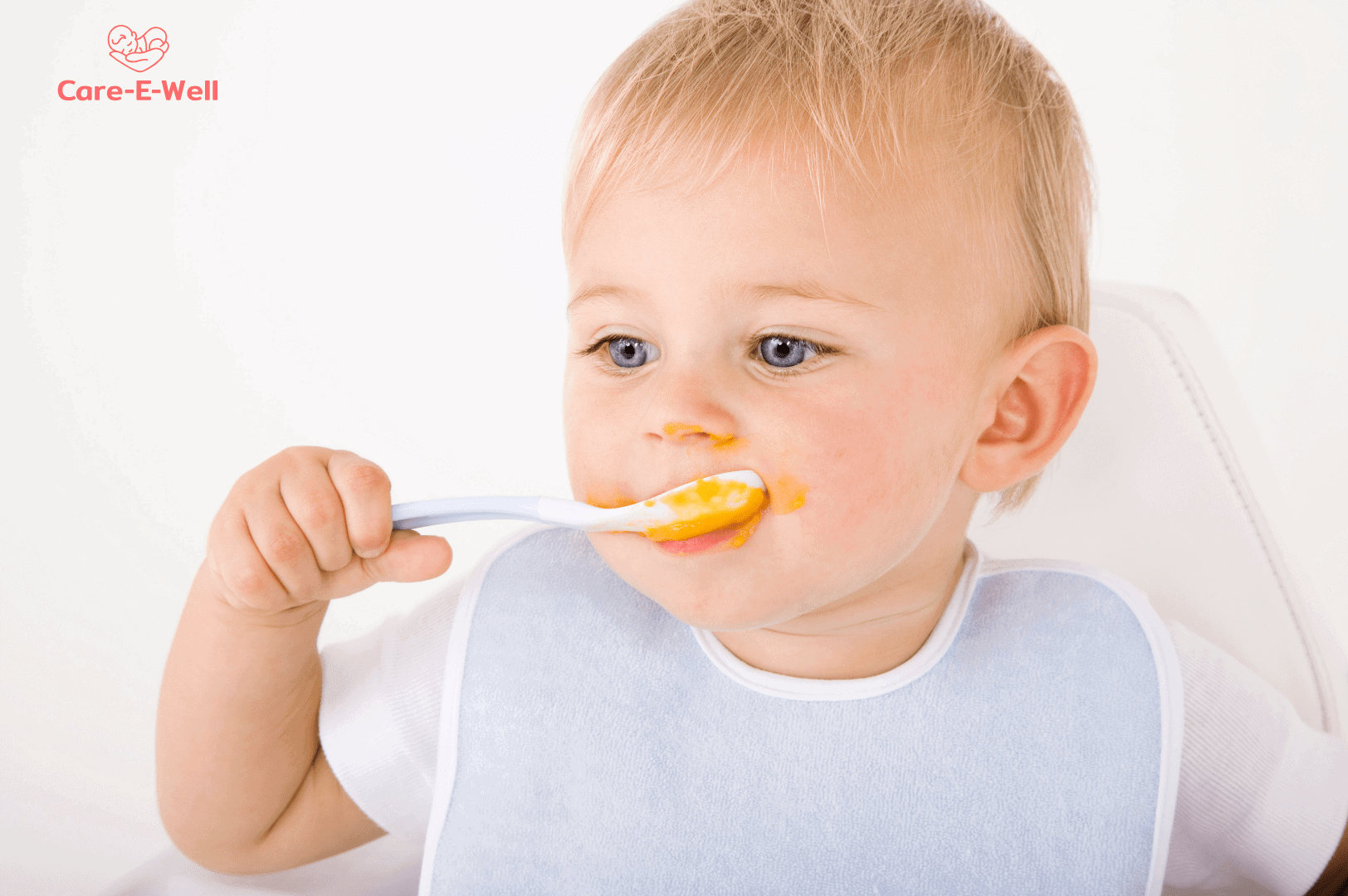
Babies can start exploring a spoon from the beginning of complementary feeding, usually around six months, but actually scooping food and getting it into the mouth independently is a much later skill. At first, self-feeding with a spoon may mean grasping a preloaded spoon, mouthing it, dropping it and making a considerable mess.
There is no single age when a baby “should” use a spoon alone. Feeding skills develop through practice alongside hand control, posture, vision, oral-motor coordination and experience. Many babies become much more effective with utensils during the second year rather than the first.
Independent spoon use is a progression: holding comes before accurate scooping, and accurate scooping comes before tidy eating.
When can babies start holding a spoon?
Once a baby is developmentally ready for complementary foods, parents can offer a safe infant spoon to hold during meals. A baby does not need to understand scooping before they can benefit from exploring the utensil.
Early spoon play supports familiarity and gives the baby an opportunity to practise hand-to-mouth movement. Research on feeding development describes self-feeding as a gradual acquisition rather than a single milestone (Sdravou et al., 2023).
What does spoon self-feeding look like by stage?
Early complementary feeding
A young baby may hold a spoon placed into the hand, bring a preloaded spoon to the mouth or use both hands to explore it. Accuracy is low and food often falls off.
Later in the first year
Hand control, sitting balance and coordination improve. Some babies begin dipping or attempting to scoop, while others still rely mostly on finger feeding and adult help.
During the second year
Many children become increasingly able to load the spoon, orient it toward the mouth and control the amount of food. Even then, spills are normal.
A feeding-skills study by Ramos et al. described independent spoon feeding as a later-emerging skill than finger feeding or initial cup use. The exact age varies and should not be treated as a rigid developmental deadline.

Does a baby need to self-feed with a spoon at six months?
No. Six months is a common time to begin complementary feeding, not a deadline for independent utensil use. At this stage many babies are far better at grabbing food with the whole hand than at manipulating a spoon.
WHO recommends responsive feeding: assist infants and young children while also supporting increasing independence. This means adults can spoon-feed, offer preloaded spoons, allow finger foods and combine methods according to the child’s abilities.
Is finger feeding important before spoon use?
Finger feeding provides a direct way to practise reaching, grasping and hand-to-mouth coordination. It does not have to be “completed” before a spoon is introduced, but it often develops earlier than true spoon independence.
Research on baby-led and conventional feeding shows that self-feeding skills emerge over a broad range. Wright et al. found many infants were reaching for and eating finger foods between four and seven months, while routine self-feeding still varied considerably later.
How to help a baby learn to use a spoon
- Seat the baby upright and well supported.
- Choose a short, light spoon that fits comfortably in the baby’s hand and mouth.
- Offer one spoon for the baby while you keep another for assistance if needed.
- Start with thicker foods that stay on the spoon more easily.
- Try a preloaded spoon so the baby practises the hand-to-mouth movement without needing to scoop.
- Let the baby experiment instead of repeatedly correcting the grip.
- Gradually introduce dipping and scooping as control improves.
- Keep meals calm and stop when the baby signals they are finished.
What foods are easiest for spoon practice?
Thick foods generally stay on a spoon more easily than thin liquids. Examples can include thick porridge, mashed vegetables, thick yoghurt where appropriate, mashed beans or lentils, and other soft foods suitable for the baby.
The food should still match the baby’s swallowing and texture skills. Do not make food unusually sticky or dense simply to keep it on a spoon.
What kind of spoon is best?
There is no evidence-based requirement for one specific commercial spoon. A practical first spoon is usually lightweight, easy to grip, smooth, not sharp and appropriately sized for a small mouth.
Avoid broken utensils or spoons with detachable components that could become a hazard. Clean feeding equipment thoroughly between uses.
Should parents use hand-over-hand guidance?
Gentle assistance can help a child understand a movement, but repeatedly controlling the baby’s hand is not necessary for typical development. Let the child initiate as much of the movement as possible.
Responsive feeding is more about creating opportunity than enforcing performance. A baby who is hungry may become frustrated if every mouthful has to be self-fed before the skill is established, so combine independent practice with help.
Why does my baby throw the spoon?
Dropping and throwing objects are common parts of sensorimotor learning. Babies experiment with cause and effect and do not understand table manners in the adult sense.
Keep one or two spoons available, return them calmly when practical and avoid turning the behaviour into a battle. If the meal becomes entirely about throwing, pause spoon practice and continue feeding another way.
Is messy eating useful?
Mess is expected when babies learn to feed themselves. Touching and manipulating food provides sensory information about texture, temperature and consistency.
You do not need to maximise mess deliberately, but allowing some exploration can support comfort with foods and self-feeding. Protect the floor rather than expecting precise utensil control too early.
What if a baby refuses the spoon?
Some babies prefer fingers, while others accept adult spoon-feeding but dislike holding a spoon. This is not automatically a problem. Offer opportunities without pressure and revisit the skill regularly.
Persistent refusal of all utensils together with difficulty managing food textures, significant oral aversion, recurrent coughing or choking, or poor growth deserves professional review.
Can spoon use improve fine-motor skills?
Spoon feeding requires grasp, wrist control, visual guidance and hand-to-mouth coordination, so it is one of many everyday activities that use fine-motor skills. However, it is not necessary to train spoon use intensively to produce normal motor development.
Broader opportunities to reach, grasp, play and self-feed are more important than achieving a particular utensil milestone on schedule.

Spoon feeding and responsive feeding
Adults remain responsible for offering safe, nourishing food and a supportive eating environment. The child should be allowed to respond to hunger and fullness cues.
Spoon self-feeding can fit within this approach, but so can assisted spoon-feeding. The method does not need to be ideologically pure. A mixed approach is often practical and developmentally appropriate.
A baby does not fail at self-feeding because they need help with a spoon. Assistance and independence can coexist at the same meal.
When to ask for professional advice
Seek assessment if a baby persistently cannot bring objects to the mouth, has marked asymmetry, loses previously acquired skills, repeatedly coughs or chokes with food, cannot progress through age-appropriate textures, or shows significant feeding distress.
Prematurity, neurological conditions, oral structural differences and developmental delay can change the expected pathway, so individual guidance may be more useful than generic milestone charts.
Frequently asked questions
Should I give my six-month-old a spoon?
You can offer a safe spoon to explore and use preloaded spoons if the baby is ready for solids. Independent scooping is not expected at this age.
When should a toddler be able to use a spoon?
Efficiency develops gradually through the second year and beyond. Large individual variation is normal, so consider the whole developmental picture rather than one exact age.
Is finger feeding better than spoon feeding?
Neither is universally better. Both provide useful experiences, and many families combine finger foods, adult spoon-feeding and self-feeding with utensils.
Do babies need special training spoons?
No particular product is essential. Choose a safe, easy-to-hold utensil and provide regular low-pressure practice.
Conclusion
Babies can explore a spoon when complementary feeding begins, but using it independently is a later and gradually developing skill. Offer preloaded spoons, allow finger feeding, help when needed and focus on safe, responsive meals rather than a fixed age for tidy spoon use.
Sources/References
- World Health Organization. WHO Guideline for complementary feeding of infants and young children 6–23 months of age. https://www.who.int/publications/i/item/9789240081864
- World Health Organization. Infant and young child feeding. https://www.who.int/news-room/fact-sheets/detail/infant-and-young-child-feeding
- European Food Safety Authority. Appropriate age range for introduction of complementary feeding into an infant’s diet. DOI: https://doi.org/10.2903/j.efsa.2019.5780
- Sdravou K, Printza A, Emmanouilidou-Fotoulaki E, et al. Developmental Feeding Stages and Their Impact on Child Feeding Behavior. DOI: https://doi.org/10.1097/MPG.0000000000003892
- Ramos CCF, Maximino P, Machado RHV, et al. Delayed Development of Feeding Skills in Children with Feeding Difficulties. DOI: https://doi.org/10.3389/fped.2017.00229
- Wright CM, Cameron K, Tsiaka M, Parkinson KN. Is baby-led weaning feasible? DOI: https://doi.org/10.1111/j.1740-8709.2010.00274.x
- Toh JY, Yip GCK, Han WM, et al. Infant Feeding Practices in a Multi-Ethnic Asian Cohort: The GUSTO Study. DOI: https://doi.org/10.3390/nu8050293
- Van der Merwe J, Kluyts M, Bowley NA, et al. Optimizing the introduction of complementary foods in the infant's diet. DOI: https://doi.org/10.1111/j.1740-8709.2007.00111.x
- Boswell N. Complementary Feeding Methods—A Review of the Benefits and Risks. DOI: https://doi.org/10.3390/ijerph18137165
Did this Insight help?
A little love for something worth reading.


