
Care-E-Well Insights
When Is a Child Ready for a Booster Seat?
Learn when a child is ready for a booster seat, including restraint limits, belt fit, posture and European safety considerations.
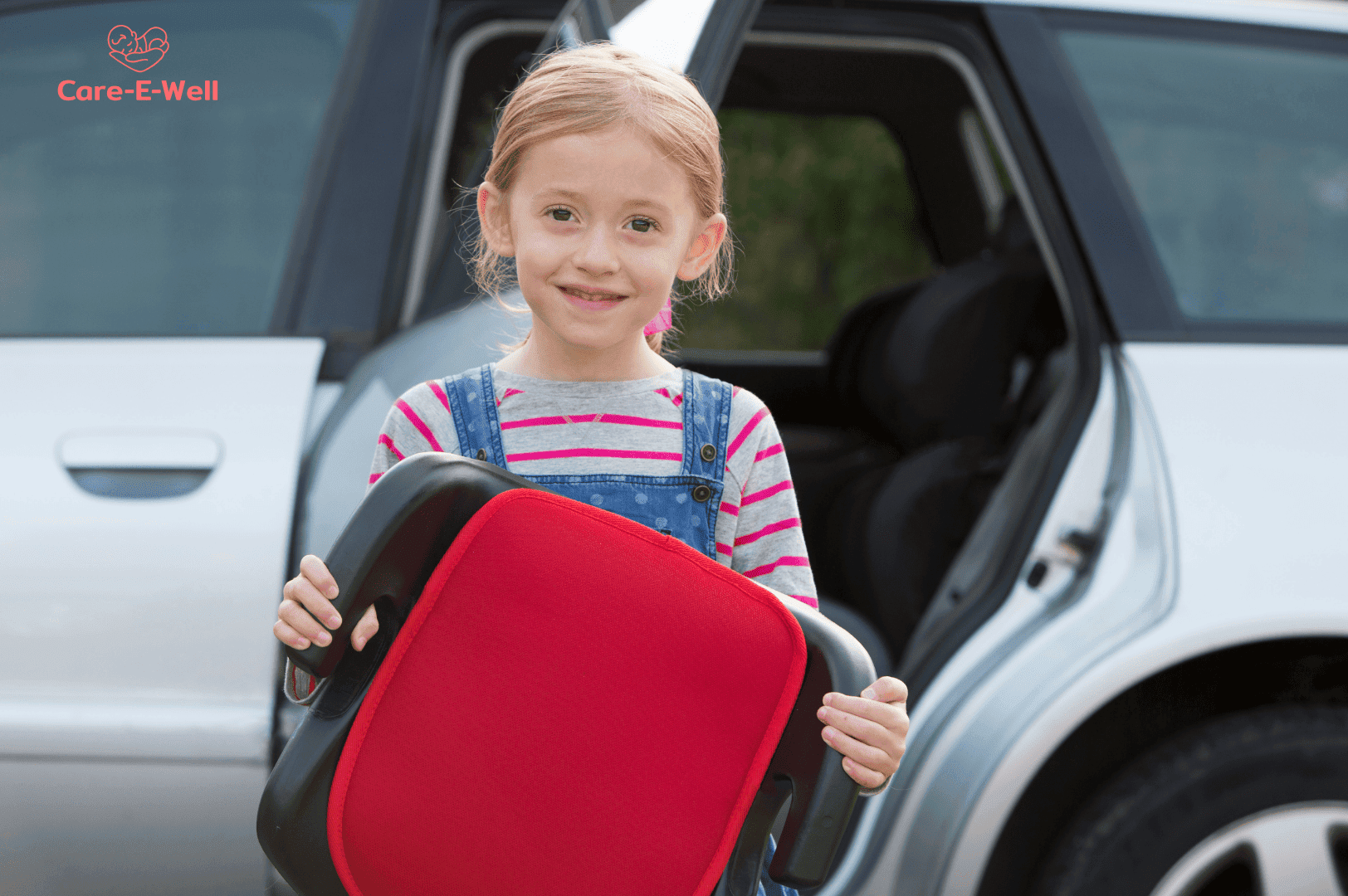
A child is ready for a booster seat when they have outgrown the forward-facing child restraint they are using, meet the booster’s approved size limits, and can sit in the correct position for the whole journey. Age alone is not enough, and moving to a booster early does not make a child safer.
A booster works differently from a harnessed child seat. It does not restrain the child with its own harness. Instead, it positions the child so the vehicle’s three-point seat belt crosses the stronger parts of the pelvis, shoulder and chest. That means both body size and behaviour matter.
Do not move a child to a booster simply because friends of the same age have already switched. Use the limits and fit requirements of the child’s current restraint and the prospective booster.
What does a booster seat actually do?
Vehicle seat belts are designed around adult body proportions. In a smaller child, the lap belt can ride too high across the abdomen and the shoulder belt can sit on the neck, face or outer edge of the shoulder. A belt-positioning booster raises and positions the child so the belt geometry works more as intended.
Research comparing boosters with seat belts alone consistently shows better belt fit and lower injury risk for children who are still too small for an adult belt. Booster use also reduces slouching because the effective seat depth becomes shorter for the child.
The lap belt should sit low over the upper thighs and bony pelvis rather than across the soft abdomen. The shoulder belt should cross the middle of the chest and shoulder without touching the face or falling off the shoulder.
When is a child ready for a booster seat?
The safest transition happens when all three conditions are met: the child has genuinely outgrown the current forward-facing restraint, the child is within the booster’s approved stature and mass limits, and the child can maintain correct belt position throughout the trip.
- The current forward-facing restraint has reached one of its stated limits or no longer fits according to its instructions.
- The child meets the minimum requirements printed on the booster’s approval label and instructions.
- The booster is approved and compatible with the vehicle seating position.
- The vehicle has the belt configuration required by that booster.
- The child can sit upright without leaning, slouching, twisting or repeatedly moving the shoulder belt.
A child who technically meets a booster’s minimum size but cannot yet sit properly may still be better protected in an approved restraint with an integrated harness that accommodates their size. The exact choice depends on the products available and their approved ranges.

Is there one age when every child should switch?
No. Children grow at different rates, and child restraints have different approved ranges. European child-restraint regulation increasingly classifies restraints by the child’s stature, which is more useful than relying on age alone.
UN Regulation No. 129 covers enhanced child restraint systems and includes non-integral restraints such as belt-positioning boosters. Parents should use the exact stature and mass limits on the approval label and instructions rather than applying a generic birthday rule.
National traffic law also matters. A restraint can be technically suitable for a child but still need to be used in a way that complies with the law where the vehicle is travelling.
Why is moving to a booster too early a problem?
In a forward-facing seat with an integrated harness, the restraint controls the child’s torso directly. In a booster, the vehicle belt performs that job. If the child leans forward, puts the shoulder belt behind the back or under the arm, or slumps sideways while asleep, the belt may no longer be positioned where the booster was designed to place it.
Crash research shows that premature graduation from dedicated child restraints can expose children to abdominal, spinal and head injuries associated with poor belt fit. The problem is not that boosters are unsafe; it is that they depend on correct belt positioning and appropriate child behaviour.
High-back booster or backless booster?
Both types can be approved child restraints, but they are not interchangeable in every vehicle or for every child. A high-back booster can provide belt guidance and lateral support that may help a younger child remain well positioned, particularly when resting or sleeping.
A backless booster requires appropriate vehicle head support behind the child and must position the belt correctly. Some vehicles or seating positions do not provide suitable geometry for every booster design.
Follow the booster instructions for head support, belt routing, use of ISOFIX attachments if present, and any vehicle-seat restrictions. ISOFIX on a booster may stabilise the booster when unoccupied, but the vehicle belt is still the restraint that holds the child during travel in a non-integral booster.
Does the child's maturity really matter?
Yes. A booster cannot force a child to stay in the correct position. The child needs to remain seated back, keep the lap belt low, keep the shoulder belt across the chest and shoulder, and avoid leaning far forward or sideways.
Long journeys and sleep can make this harder for younger children. If a child repeatedly slips out of position, returning to an approved harnessed restraint that still fits may be the more appropriate option.
This is a practical fit issue rather than a judgement about behaviour. Some children are physically ready before they are consistently able to maintain booster posture.
What if the child's legs look cramped in the harnessed seat?
Leg position alone does not mean a forward-facing restraint has been outgrown. Use the manufacturer’s stated stature, mass, harness and head-position limits. A child can bend or cross their legs without that automatically creating a reason to move to a booster.
The transition should be driven by the restraint’s limits and the child’s ability to use the next restraint correctly, not by how “grown up” the old seat looks.
What belt fit should you check in a booster?
Once the child is seated, check the belt before every journey. The lap section should remain low and flat over the pelvis. The shoulder section should cross the chest and middle of the shoulder.
The belt should not be routed behind the child, under an arm or across the abdomen. Never add clips, pads or routing devices that are not approved for that booster or vehicle.
Belt fit can vary between vehicle seats. A booster that works well in one car may not give equally good geometry in another, so reassess the fit when moving the booster between vehicles.

What does EU law say?
European Commission road-safety information states that children under 1.35 metres travelling in cars or lorries must use an approved restraint appropriate to their size, while taller children may use an adult seat belt. Individual countries can have additional requirements, so families travelling across borders should check the rules for each country.
Legal permission to use a certain restraint is not the same as optimal fit. The child should still remain in an appropriate booster until the adult belt fits properly without it.
A practical booster-readiness checklist
- Confirm that the current harnessed restraint is genuinely outgrown.
- Read the booster’s approval label and instructions for minimum and maximum size limits.
- Confirm that the booster is permitted in the chosen vehicle seating position.
- Sit the child fully back in the booster.
- Check that the lap belt stays low on the pelvis.
- Check that the shoulder belt crosses the centre of the shoulder and chest.
- Watch whether the child can maintain that posture when awake, tired and asleep.
- Recheck belt fit whenever the booster moves to another vehicle.
When should you get help with the transition?
Seek advice from a trained child-restraint specialist if you are unsure whether the current seat is outgrown, the child falls between product ranges, the belt does not sit correctly, the child has a disability or medical condition affecting posture, or the vehicle has unusual belt geometry.
A specialist can assess the actual combination of child, restraint and vehicle rather than relying on a generic age chart.
The key takeaway
A child is ready for a booster seat when the previous restraint is outgrown, the booster is approved for the child’s size and vehicle, and the child can maintain correct belt position for the entire ride. Do not rush the transition. A booster is a safety step, not a milestone to reach as early as possible.
Frequently asked questions
Is a five-year-old automatically ready for a booster?
No. Age alone does not determine readiness. Check the current restraint’s limits, the booster’s approved range and whether the child can sit correctly for the whole trip.
Can a child move to a booster before outgrowing a harnessed seat?
A booster may be legally and technically permitted for some children, but there is no safety advantage in moving early when a correctly fitted approved harnessed restraint still accommodates the child.
Does a booster need ISOFIX?
Not necessarily. Many boosters use the vehicle belt as the primary restraint for the child. Some also attach to ISOFIX anchorages. Use only the installation method approved for that booster.
What if the shoulder belt touches the child's neck?
Recheck the booster, belt guide and seating position. If correct routing still produces poor belt fit, that booster or seating position may not be suitable for the child.
Sources/References
- UNECE — UN Regulation No. 129 – Rev.4: Enhanced Child Restraint Systems
- European Commission — Children – Seat belts and child restraints
- Durbin DR, Elliott MR, Winston FK — Belt-Positioning Booster Seats and Reduction in Risk of Injury Among Children in Vehicle Crashes
- Arbogast KB, Jermakian JS, Kallan MJ et al. — Effectiveness of Belt Positioning Booster Seats: An Updated Assessment
- Ma X, Griffin R, McGwin G et al. — Effectiveness of Booster Seats Compared With No Restraint or Seat Belt Alone for Crash Injury Prevention
- Jones MLH, Ebert SM, Manary MA et al. — Child Posture and Belt Fit in a Range of Booster Configurations
- Parab A, Whyte T, Albanese B et al. — Can Age or Height Define Appropriate Thresholds for Transition to Adult Seat Belts?
- Morris SD, Arbogast KB, Durbin DR et al. — Misuse of booster seats
- McDonald CC, Kennedy E, Fleisher L et al. — Situational Use of Child Restraint Systems and Carpooling Behaviors in Parents and Caregivers
- Bauer M, Hines L, Pawlowski E et al. — Using CODES to examine injury in front vs. rear-seated infants and children involved in a motor vehicle crash
Did this Insight help?
A little love for something worth reading.


