
Care-E-Well Insights
When Should a Newborn Have the First Bath?
Learn when a newborn should have the first bath, why waiting 24 hours matters, and how to make the first wash safe and gentle.
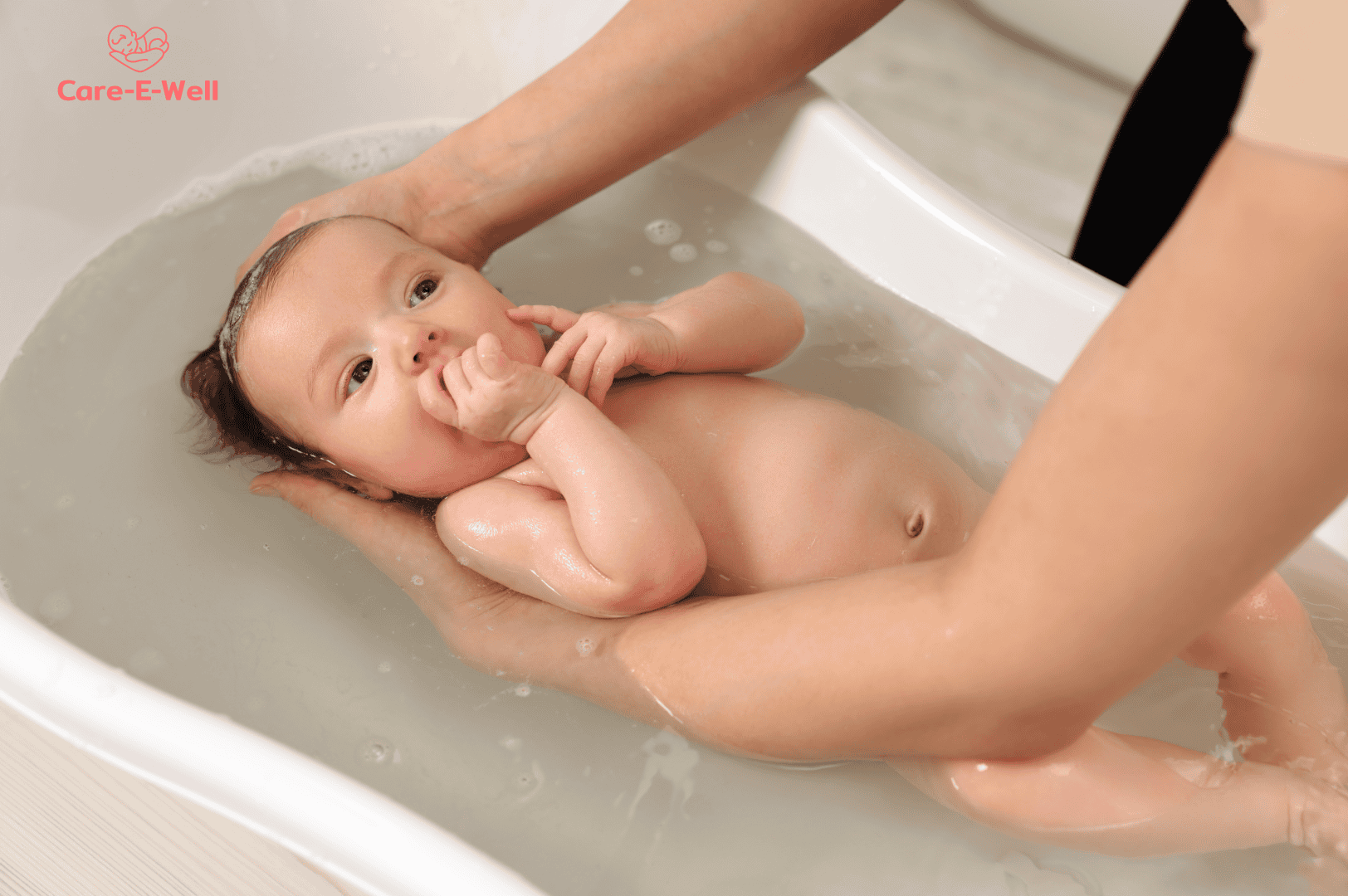
If you are wondering when should a newborn have the first bath, the safest general answer is not immediately after birth. For a healthy, stable newborn, the World Health Organization (WHO) recommends delaying the first bath for at least 24 hours. During those first hours, keeping your baby warm, supporting skin-to-skin contact and feeding are more important than washing away every trace of birth.
That can feel surprising when a newborn still has vernix, small amounts of blood or other birth fluids on the skin. But a baby does not need to look freshly washed to be clean enough and well cared for. The first bath is mainly a hygiene and comfort routine, not an urgent medical task.
For most healthy newborns, wait at least 24 hours before the first bath. If your baby is not medically or thermally stable, bathing may need to wait longer.
Why is newborn first bath timing important?
Newborns lose heat more easily than older babies and adults. Immediately after birth, they are adapting to breathing, maintaining body temperature, feeding and life outside the womb. Bathing exposes wet skin to evaporation, which can increase heat loss. WHO therefore places thermal protection, skin-to-skin contact and early feeding among the priorities of essential newborn care.
Research on newborn first bath timing is not perfectly uniform, and studies have used different bathing times and methods. However, thermoregulation consistently appears as a central concern. A randomized pilot study by Mardini and colleagues compared bathing at 2, 6 and 24 hours after birth and highlighted the importance of temperature stability and uninterrupted early contact. Other experimental studies have also examined changes in body temperature, skin moisture and comfort around bathing.
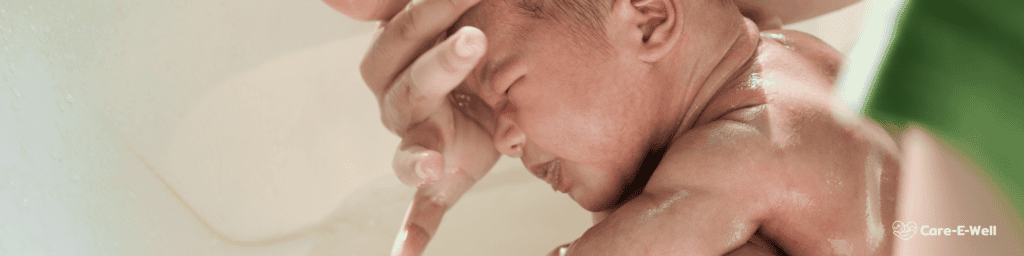
Why does WHO recommend waiting at least 24 hours?
WHO guidance specifically advises delaying the first bath for at least 24 hours. This recommendation sits within a broader package of newborn care that prioritises warmth, skin-to-skin contact, early and responsive feeding, hygienic cord care and observation for danger signs.
Delaying the bath also avoids interrupting the first period of close parent-baby contact simply for cosmetic reasons. A newborn can be gently dried and visibly soiled areas can be wiped without giving a full bath. Vernix caseosa, the white creamy coating that may remain on the skin after birth, does not need to be scrubbed off.
“Clean” does not mean removing every trace of vernix or birth residue in the first hours. Gentle drying and wiping are usually enough until the first bath is appropriate.
What if the hospital offers a bath earlier?
Practices vary between maternity units and countries. If a routine bath is offered before 24 hours, you can ask whether it can be postponed, especially when your baby is healthy and there is no clinical reason to wash sooner. WHO’s recommendation provides a reasonable basis for that request.
There can be individual exceptions. A healthcare team may recommend a different approach because of a specific exposure, infection-control issue or medical circumstance. In that situation, the clinical reason matters more than a general timing rule.
How do you know a newborn is ready for the first bath?
Time since birth is only one part of the decision. A baby should also be warm and physiologically stable. If you are still in hospital, the maternity team can confirm that your baby is ready.
- Your baby is at least 24 hours old in the usual healthy-newborn situation.
- Your baby is warm and maintaining a stable temperature.
- Breathing, colour and general condition are reassuring.
- Feeding and early skin-to-skin contact have not been unnecessarily interrupted for bathing.
- The room is comfortably warm and free from drafts.
- Everything needed for the bath and drying is ready before you begin.
Premature, low-birth-weight, unwell or temperature-unstable newborns may need an individual bathing plan. Follow the neonatal or paediatric team’s advice rather than a standard home routine.
What should you do before the first bath?
Preparation matters because a wet newborn can cool quickly. Set out a towel, clean nappy, clothes, washcloth and any gentle baby cleanser you plan to use before undressing your baby. Keep the bath short and dry your baby promptly, especially around skin folds.
You do not need to use fragranced soap or scrub the skin. Evidence reviews of healthy infant skin care support gentle cleansing and caution against harsh soap because newborn skin is still adapting after birth. Trials comparing appropriately formulated infant cleansers with water alone have generally not shown harm to skin-barrier development in healthy term newborns, although simple routines are perfectly reasonable.
What about the umbilical cord?
WHO recommends keeping the umbilical cord stump clean and dry and not routinely applying ointments or other substances to it. If the stump becomes wet during cleaning, gently pat it dry rather than rubbing it. Your maternity team may give specific instructions based on local cord-care practice.
Should you wash a newborn every day after the first bath?
No. The timing of the first bath and the frequency of later bathing are separate questions. Newborns usually need regular cleaning of the face, neck folds and nappy area, but a full bath does not have to be a daily event. How often you bathe can depend on your baby’s skin, family routine, climate and how messy your baby gets.
More bathing is not automatically better hygiene. Newborn skin benefits from gentle care, and frequent exposure to hot water, long baths or harsh cleansers can contribute to dryness or irritation. Keep baths brief, comfortably warm and calm.
What if your baby still has vernix after 24 hours?
You do not need to remove it aggressively. Vernix usually absorbs or wears away naturally. If some remains in creases, you can leave it alone or clean gently during routine care. Scrubbing offers no hygiene advantage and can irritate delicate skin.
Does the first bath need to happen exactly at 24 hours?
No. “At least 24 hours” is a minimum delay, not an appointment. If your baby is feeding, sleeping or having skin-to-skin contact at the 24-hour mark, there is no need to interrupt a settled moment simply to bathe. Waiting longer is generally reasonable for a healthy baby when hygiene needs can be managed with gentle spot cleaning.
This is also why a practical newborn first bath age guide should not be reduced to a single clock time. The key combination is enough time after birth plus a baby who is warm, stable and ready.
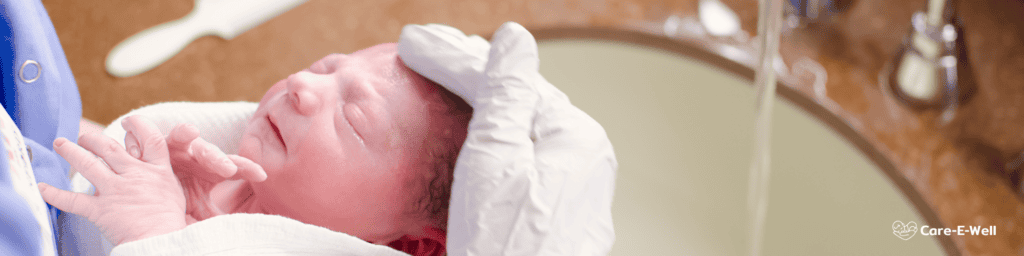
When should you seek professional advice before bathing?
Ask your maternity, neonatal or paediatric team if your baby was born early, has a low birth weight, has trouble maintaining temperature, is unwell, has a skin condition, has a medical device or wound, or has been given special cord-care instructions.
WHO advises families to seek prompt care for newborn danger signs such as feeding difficulties, reduced activity, breathing problems, fever, convulsions or unusually cold skin. A bath should never delay assessment of a baby who seems unwell.
A simple first-bath routine
- Choose a calm time when your baby is awake enough and not urgently hungry.
- Warm the room and gather the towel, clean nappy and clothes first.
- Fill the baby bath with comfortably warm water and check it before putting your baby in.
- Undress your baby only when everything is ready.
- Support the head and neck securely and keep a continuous hand on your baby.
- Wash gently, focusing on skin folds and visibly soiled areas rather than scrubbing.
- Lift your baby out carefully, wrap in a towel immediately and pat dry.
- Dress your baby promptly and offer feeding or skin-to-skin contact if wanted.
FAQ
Can a newborn have a bath on the day of birth?
Routine bathing on the day of birth is not recommended for a healthy newborn when it occurs before 24 hours. WHO advises delaying the first bath for at least 24 hours. A medical team may occasionally recommend an exception for a specific clinical reason.
Is it okay to wait several days for the first bath?
For a healthy baby, there is usually no need to rush the bath once the first 24 hours have passed. Gentle spot cleaning can manage milk, stool or other visible dirt. If there is a medical or skin-care concern, ask your healthcare professional for individual advice.
Should vernix be washed off during the first bath?
It does not need to be scrubbed away. Vernix can remain on the skin and disappear gradually. Gentle cleansing is enough.
Should the first bath happen before or after feeding?
Avoid bathing a baby who is very hungry or immediately after a large feed. A calm period when your baby is comfortable is easier for everyone. Feeding and skin-to-skin contact should take priority over fitting the bath to a rigid schedule.
The key takeaway
The best answer to when should a newborn have the first bath is usually: after at least 24 hours, and only when the baby is warm and stable. There is no benefit in rushing a healthy newborn into a bath simply for appearance. Prioritise warmth, feeding, skin-to-skin contact and gentle care, then make the first bath a short, safe and unhurried experience.
Sources/References
- World Health Organization — Caring for a newborn
- World Health Organization — WHO recommendations on maternal and newborn care for a positive postnatal experience
- World Health Organization — 10 Ways to improve the quality of care in health facilities
- World Health Organization Regional Office for Europe — Newborn health
- Mardini J, Rahme C, Matar O, et al. — Newborn’s first bath: any preferred timing? A pilot study from Lebanon
- Gözen D, Yalnızoğlu Çaka S, Ateş Beşirik S, et al. — First bathing time of newborn infants after birth: A comparative analysis
- Çaka SY, Gözen D — Effects of swaddled and traditional tub bathing methods on crying and physiological responses of newborns
- Lund C, Kuller JM, Durand DJ — Baby's first bath: Changes in skin barrier function after bathing full-term newborns with water vs liquid baby cleanser
- Blume-Peytavi U, Hauser M, Stamatas GN, et al. — Skin Care Practices for Newborns and Infants: Review of the Clinical Evidence for Best Practices
Did this Insight help?
A little love for something worth reading.


