
Care-E-Well Insights
Why Does My Baby Cry in the Carrier?
Learn why babies cry in carriers and how to check fit, hunger, temperature, tiredness and positioning before trying again.
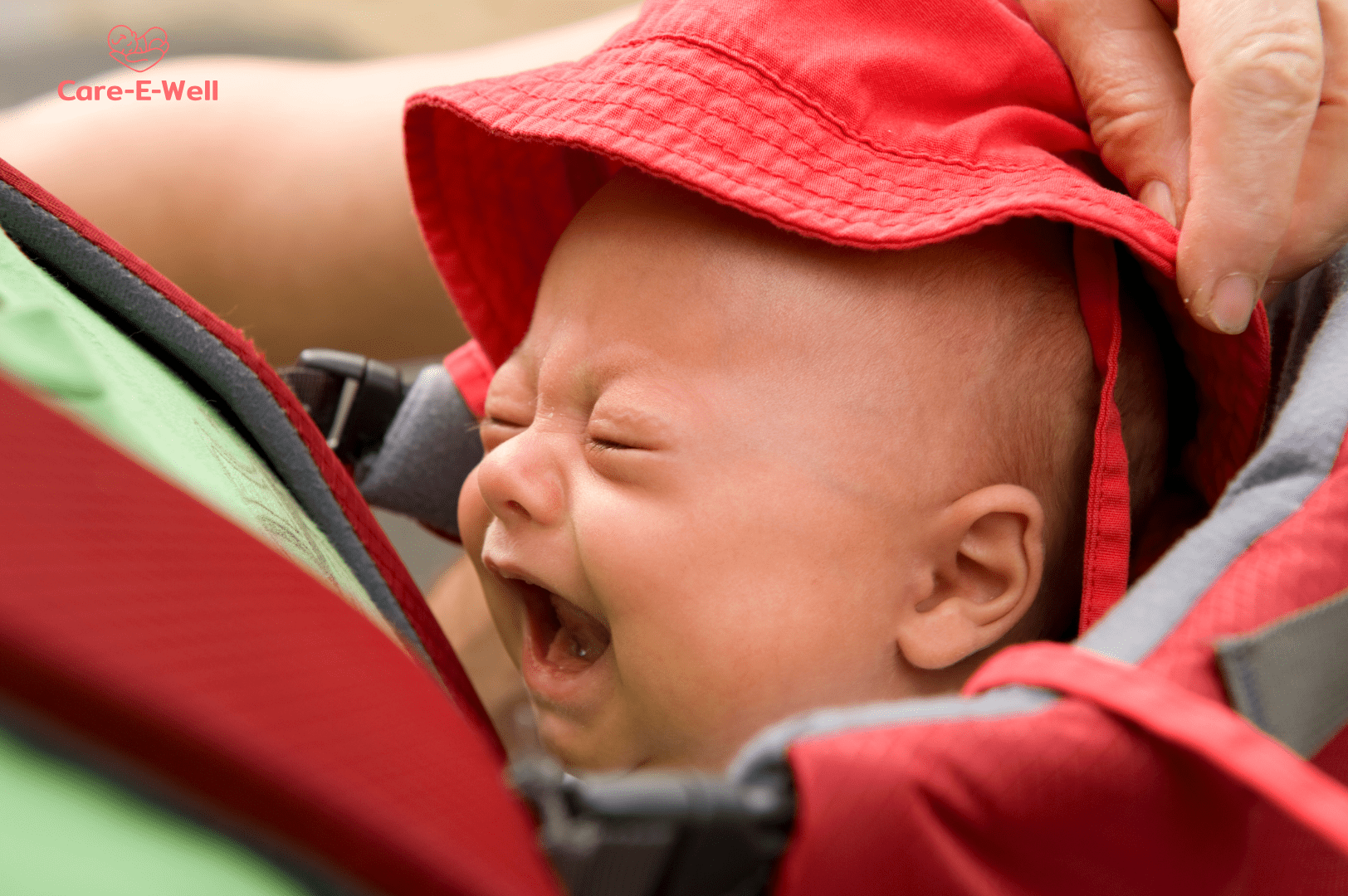
If your baby cries in the carrier, it does not automatically mean the carrier is unsafe or that your baby will never enjoy babywearing. Babies may protest because of hunger, tiredness, temperature, an awkward fit, trapped pressure around the legs, overstimulation, reflux discomfort or simply because being placed in the carrier is a transition they do not like.
Start by treating crying as information. Check the baby before trying to “push through” with walking or bouncing. A short fit check often reveals something simple that can be changed.
The goal is not to make every baby love every carrier. The goal is to understand what the crying may be communicating while keeping airway, position and comfort safe.
Is it normal for a baby to cry when put in a carrier?
It can be. Some babies protest during the process of being wrapped or buckled and settle once the adult begins moving. Others become more upset when tired, hungry or already overstimulated.
Research on increased infant carrying and close physical contact suggests that carrying can reduce crying for some babies, but results are not universal. Trials of behavioural approaches to unsettled crying also show that no single soothing strategy works for every infant.
First check: Is the carrier position safe?
Before interpreting crying as preference, rule out positioning problems. A baby who cannot maintain an open airway, who is compressed by fabric or whose legs are being forced into an uncomfortable position may cry because something genuinely feels wrong.
- Keep the face fully visible.
- Make sure the nose and mouth are free of fabric and clothing.
- Prevent deep chin-to-chest flexion.
- Support a newborn’s torso so the body cannot slump.
- Check that the seat and panel match the baby’s current size.
Remove the baby immediately if breathing looks or sounds abnormal, the face is obscured, the baby becomes unusually limp or difficult to rouse, or there is a colour change. Seek urgent medical help for breathing difficulty, blue or very pale colour, reduced responsiveness or other acute concerns.
Reason 1: Your baby is hungry
Hunger cues often begin before crying. Rooting, hand-to-mouth movements, restlessness and searching against the adult’s chest may appear first. Physical contact may make those cues more obvious.
Observational research has linked high levels of mother-infant physical contact with more responsive feeding patterns, although that does not mean babywearing itself guarantees better feeding.
What may help
Feed the baby before putting them into the carrier if they are already showing clear hunger cues. If breastfeeding, establish a comfortable feed outside the carrier first rather than trying to solve both latch and carrier fit at the same time.

Reason 2: The baby is tired but not yet settled
A tired baby can cry during any transition. The carrier may eventually help through warmth, movement and close contact, but the first few minutes can still be difficult.
Gentle rhythmic walking may help once the fit is correct. Avoid increasingly vigorous bouncing when the baby remains distressed. More stimulation is not always more soothing.
Reason 3: The carrier is too loose
Some babies dislike the sensation of moving away from the adult with every step. A loose carrier can also make a young baby slump, which becomes a safety issue rather than just a comfort issue.
What may help
Support baby with one hand and remove slack gradually from the carrier. The baby should feel securely supported against your torso without being flattened or over-compressed.
Reason 4: The carrier feels too tight
Overtightening can also trigger protest. It may restrict comfortable movement, create pressure behind the knees or pull the baby’s torso into an unnatural position.
The correct fit is secure, not rigid. You should be able to breathe and move normally, and the baby should have room for normal chest expansion.
Reason 5: The seat is the wrong width
A seat that is too narrow may leave the legs hanging with little thigh support. A seat that is too wide may push against the calves or force the hips apart beyond the baby’s comfortable range.
Research on infant hip position supports flexed and abducted positioning in appropriately fitted carriers but does not justify forcing a dramatic M-shape.
Reason 6: Baby is too hot
Babywearing creates a shared thermal environment. The adult’s body, carrier fabric and the baby’s clothes all contribute to insulation.
What may help
- Remove unnecessary layers.
- Check the upper back or chest for excessive warmth.
- Move out of direct sun.
- Use breathable clothing.
- Take the baby out for cooling and feeding breaks when needed.
Hands and feet can feel cooler than the trunk, so they are not the best place to judge overall warmth.
Reason 7: Baby needs to burp or has digestive discomfort
Some babies become uncomfortable when placed into a carrier immediately after a large feed. Others seem calmer upright. Evidence on infant reflux shows that physiological reflux is common, while the benefit of routine positional “reflux precautions” is less certain than many parents are told.
If your baby has frequent vomiting with poor weight gain, blood, feeding refusal, marked pain, breathing symptoms or other concerning signs, discuss this with a healthcare professional instead of relying on the carrier as treatment.
Reason 8: The baby dislikes the direction or level of stimulation
A young baby facing inward can still receive a large amount of sensory input from movement, light, noise and the adult’s body. An older baby may become frustrated if they want to look around but cannot comfortably turn their head.
This does not mean outward-facing is automatically the answer. Developmental readiness, carrier instructions, airway control and the baby’s ability to tolerate the position all matter.
Reason 9: The timing is wrong
Trying a new carrier when a baby is hungry, overtired or already crying hard makes learning more difficult for both of you. Practise during a calm alert period when possible.
Begin with a short session at home. Once baby is positioned correctly, walk around the room for a few minutes before deciding whether the setup works.
Reason 10: Your baby senses your tension
Babies respond to multiple cues during close contact, including movement and handling. That does not mean a parent “causes” crying by being anxious. It simply means learning a new carrying technique is often easier when the adult can move slowly and confidently.
If possible, practise over a bed or sofa with another adult present, or work with a qualified babywearing educator.

How long should I try before taking baby out?
There is no evidence-based number of minutes. A mild protest that settles as soon as you begin walking is different from escalating crying, repeated arching or a baby who appears physically uncomfortable.
If crying increases, stop and check needs and fit. Taking the baby out is not a failure. It gives both of you a chance to reset.
A step-by-step carrier crying check
- Stop walking and look at baby’s face and breathing.
- Check hunger, diaper, temperature and tiredness.
- Inspect chin position, panel height and seat width.
- Support baby with your hands and adjust the carrier.
- Try calm movement for a short period.
- If distress continues, take baby out and soothe in another way.
Persistent crying is a reason to reassess, not a signal to bounce harder or tighten more.
When crying deserves medical assessment
Most carrier crying has an ordinary explanation, but crying can also accompany illness or pain. Seek medical advice for a baby who has a fever, repeated forceful vomiting, poor feeding, reduced wet diapers, unusual sleepiness, breathing difficulty, a new rash, swelling, injury or a cry that is markedly different from normal.
If something about your baby’s behaviour feels acutely wrong, remove the carrier so you can examine and respond to the baby directly.
Frequently asked questions
Does crying mean my baby hates the carrier?
Not necessarily. Many babies object to being put in and then settle with movement. Others genuinely prefer a different carrier, carry position or soothing method.
Should I keep walking if my baby cries?
Only after checking fit, airway and basic needs. Gentle walking can help some babies, but persistent or escalating distress should prompt you to stop.
Can I introduce a carrier gradually?
Yes. Short, calm sessions can help both baby and adult learn the carrier without making every attempt a long outing.
Is arching always reflux?
No. Arching can occur with discomfort, tiredness, frustration, feeding issues or positioning. Recurrent painful arching or other concerning symptoms deserves individual assessment.
Conclusion
When a baby cries in the carrier, start with safety and needs before assuming the baby dislikes babywearing. A different fit, cooler clothing, better timing or a shorter session may be enough. Some babies still prefer other forms of holding, and that is a normal individual difference.
Sources and References
- Lovell-Kennedy SR, Strong RLJ, Grieve LM et al. — Safety and benefits of adult-worn slings and baby carriers: a narrative systematic review to inform guidance for parents
- Sidharthan S, Kehoe C, Dodwell ER — Post-Natal Positioning through Babywearing: What the Orthopaedic Surgeon Needs to Know
- Cooijmans KHM, Beijers R, de Weerth C — Daily skin-to-skin contact and crying and sleeping in healthy full-term infants: A randomized controlled trial
- Stanzel K, Honda T, Tran T et al. — Behavioural Interventions for Problematic Infant Sleeping and Cry/Fuss Behaviour: A Systematic Review and Meta-Analyses
- Cook F, Bayer JK, Le H et al. — Baby Business: a randomised controlled trial of a universal parenting program that aims to prevent early infant sleep and cry problems and associated parental depression
- McRury JM, Zolotor AJ — A Randomized, Controlled Trial of a Behavioral Intervention to Reduce Crying among Infants
- Little E, Legare CH, Carver LJ — Mother–Infant Physical Contact Predicts Responsive Feeding among U.S. Breastfeeding Mothers
- Jenik A, Grad E — Babywearing practice and unnoticed danger
- Strong RLJ, Lovell-Kennedy S, Grieve LM et al. — Adult-worn sling and baby carrier safety: exploring parental practices, knowledge and information needs
Did this Insight help?
A little love for something worth reading.


